Mycenaeans
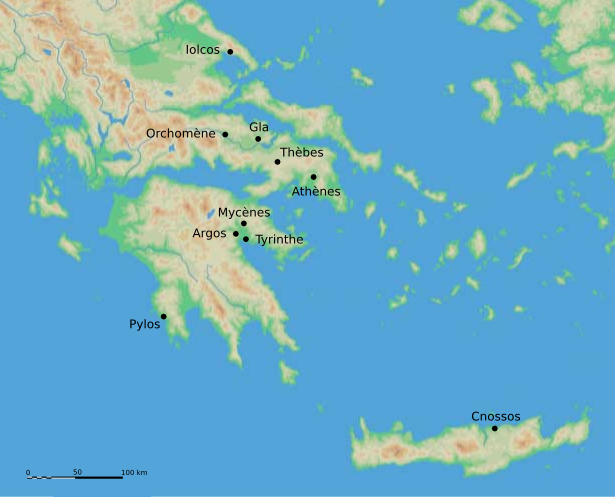

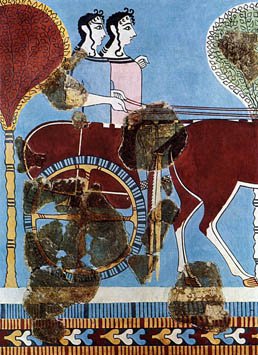
The Mycenaean culture (around 1600–1100 BC ) was an early Greek culture during the Bronze Age on the Greek mainland and on Crete.
The name Achaean was used by Homer to describe them and occurs in the Iliad. The term that is used is derived from Mycenae, which is an important archaeological site about 90 km from Athens. Other important Mycenaean sites are at Athens, Thebes, Tiryns and Pylos. The epic poems of Homer, the Iliad and the Odyssey, are Mycenaean in origin.
The earlier Minoans traded but did not conquer. The Mycenaeans traded and conquered.
Language
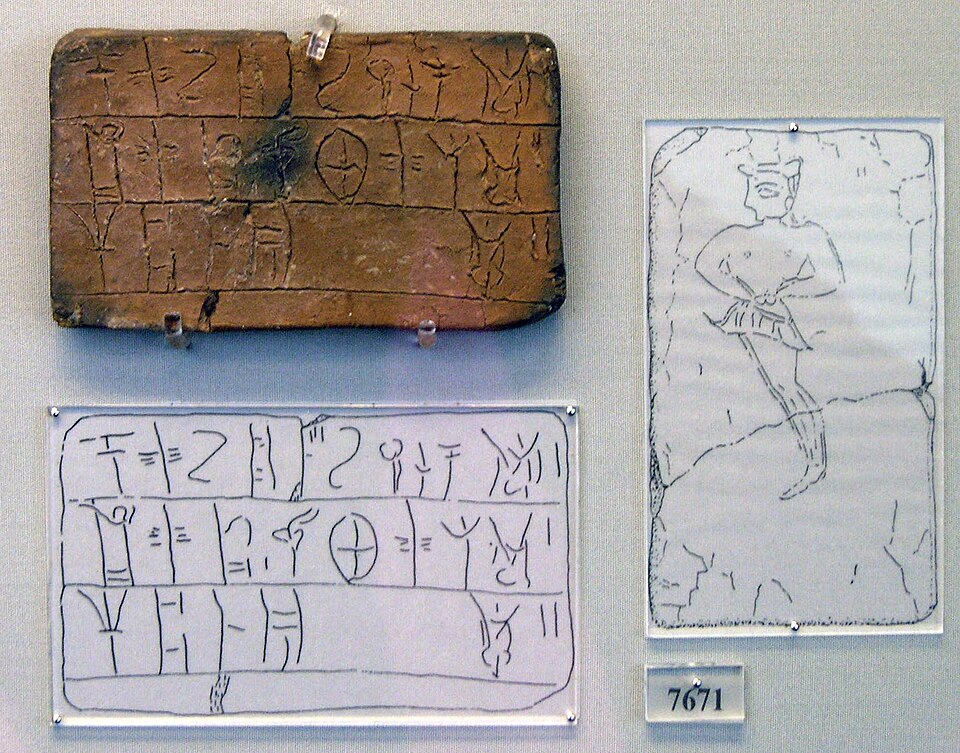
Mycenaean is the oldest-known form of Greek. It was spoken on the Greek mainland and on Crete in the Mycenaean period, from the 16th century to the 12th century BC. The language is written on clay tablets in a script called Linear B. Most of the tablets were found in Knossos, in central Crete, and in Pylos, in the southwest of the Peloponnese. Other tablets have been found at Mycenae itself; Tiryns and Thebes; and at Chania, on western Crete.
For a long time, no one could translate the tablets. At last, Michael Ventris deciphered the script in 1952 and showed that the language was an early form of Greek.
The texts on the tablets are mostly lists and inventories. There are no stories, myths, or poetry, but they give some idea of the people who made them.
By the late 13th century BC, mainland Greece witnessed a wave of destruction. The Mycenaean sites declined, and the people moved to refuge settlements. That is called the Greek Dark Ages since little or no writing is found until the 8th century BC. See Ancient Greece for that and the later periods.
Comparison with Hittite
Both Old Hittite and Mycenaean Greek are Indo-European languages. The oldest Hittite texts are slightly earlier than the earliest Mycenaean texts, but Greek is the oldest Indo-European language that is still spoken.
Identity
The somewhat younger Linear B tablets suggest that the people called Mycenaeans might have been Achaeans. No written source found at a Mycenaean site reveals what they called themselves. In the Iliad, the residents of the Peloponnesus and nearby islands are often called Achaeans. There is mention of the Ahhiyawa in Hittite sources from the Late Bronze Age, which suggests itself that the Mycenaeans could possibly be Achaeans. The Tawagalawa Letter, written by an unnamed Hittite king (14th–13th century BC) to the king of Ahhiyawa, treats him as an equal. The letter suggests that Miletus (Millawanda) was under his control and refers to an earlier ‘Wilusa’ episode" involving hostility by Ahhiyawa.
Ahhiya(wa) has been identified with the Achaeans of the Trojan War and the city of Wilusa with the legendary city of Troy. However the exact relationship of the term Ahhiyawa to the Achaeans had been hotly debated by scholars even after the discovery that Mycenaean Linear B is an early form of Greek. The written forms of the two languages are quite different.
Written for younger readers
Mycenaeans, in simpler words
This version comes from Wikijunior, a set of books written for children aged 8 to 11. It is shorter and uses plainer language than the article above.
From Wikijunior: Ancient Civilizations
The Mycenaeans lived in mainland Greece from approximately 1600–1100 B.C. They were the first advanced civilization in mainland Greece. They are sometimes called the first Greeks because they were the first to speak the Greek language. Their largest city was called Mycenae, which gives the culture its name. Mycenae was a large city that had a population of around 30,000 people at its peak. There were other Mycenaean cities that grew into major city-states during the height of Ancient Greece such as Thebes and Athens.
The Mycenaeans developed trade throughout the Mediterranean. They built large trade ships and traveled to places like Egypt where they traded goods like olive oil and wine for metals and ivory.
They were considered a warrior people. Expansion (growing their country) was very important to them. They were the downfall of other, less powerful cultures, including the Minoans. The famous city of Troy also fell to their army and naval strength.
In the eyes of the later Greeks, the Mycenaeans were larger than life. One reason for this belief comes from the ruins of the Mycenaean city-states. The walls around these palaces are massive, made from blocks of stone weighing several tons and carried to the mountain-top settlements. The later Greeks called these walls cyclopean walls, named after the one-eyed giant race, because the later Greeks felt only giants could move the stones.
A walled mountain or hilltop settlement is called a citadel. Carefully built on fertile plains, at ports or near the coastline, the citadel was the center of power and authority. The palace was placed at the top of the structure. The complex was not just a military one. It had many functions, including worship and storage, with areas for each purpose.
The Mycenaeans inherited some of the clothing styles of the Minoan civilization, a civilization on the island of Crete whom they probably conquered. One of these styles was women’s pairing of long skirts, typically with colorful geometric patterns, gold sequins, and bolero shirts (like a small jacket) with an open front. The Mycenaeans adopted most of this, but often changed the open-fronted shirt and closed it or covered it with another shirt.
Men wore loin cloths which were pieces of cloth tied around the waist to cover the groin area. The most common clothing for men was a tunic. Tunics in the Mycenaean civilization were usually long dress-like shirts with long sleeves and were typically tied around the waist with a belt. Soldiers usually wore an armor of bronze.
Jewellery was a important part of a Mycenaean woman’s daily outfit. Their jewellery varied from necklaces and bracelets to anklets, brooches, and diadems. Based on what has been found in graves, women wore very impressive jewellery that gave a strong insight to her social class. Dark blue was especially desirable, because it was a very rare and expensive stone.
We do not know a lot about food in the Mycenaean civilization, except from trade. From trade records, we know that the Mycenaeans were major producers of olive oil, wine, and grains. We also know that they hunted, based on what we know about their sports. The average Mycenaean diet was probably composed of various grains and some kind of meat - probably deer or boar.
The Mycenean religion was very similar to that of the Minoans’. The Minoan “Earthshaker”, became known as Poseidon. The Goddess became known as Athena, Hera, Rhea, Demeter, and Artemis. Minoan symbols are found throughout Mycenea and include the bulls, pillars, doves, and snakes.
Not much is known about the religious practices of the Mycenaeans. They worshipped many gods, but only a few names of their many gods have appeared in tablets uncovered in archeological digs. Almost no temples or central places of worship have been discovered.
The Myceneans practiced human sacrifice.
Where this page comes from
The article above is adapted from “Mycenaeans” on Simple English Wikipedia, by its contributors. We removed reference markers, navigation boxes and tables, expanded measurement templates into readable numbers, and kept the prose otherwise intact. The simpler version is adapted from Wikijunior on Wikibooks.
Both sources are published under CC BY-SA 4.0, so this page is published under the same licence. You may share and adapt it, including commercially, as long as you credit the original and keep the same licence.
Worksheets, answer keys and printable layouts elsewhere on K5Print are our own work and are not covered by this licence.