Norse
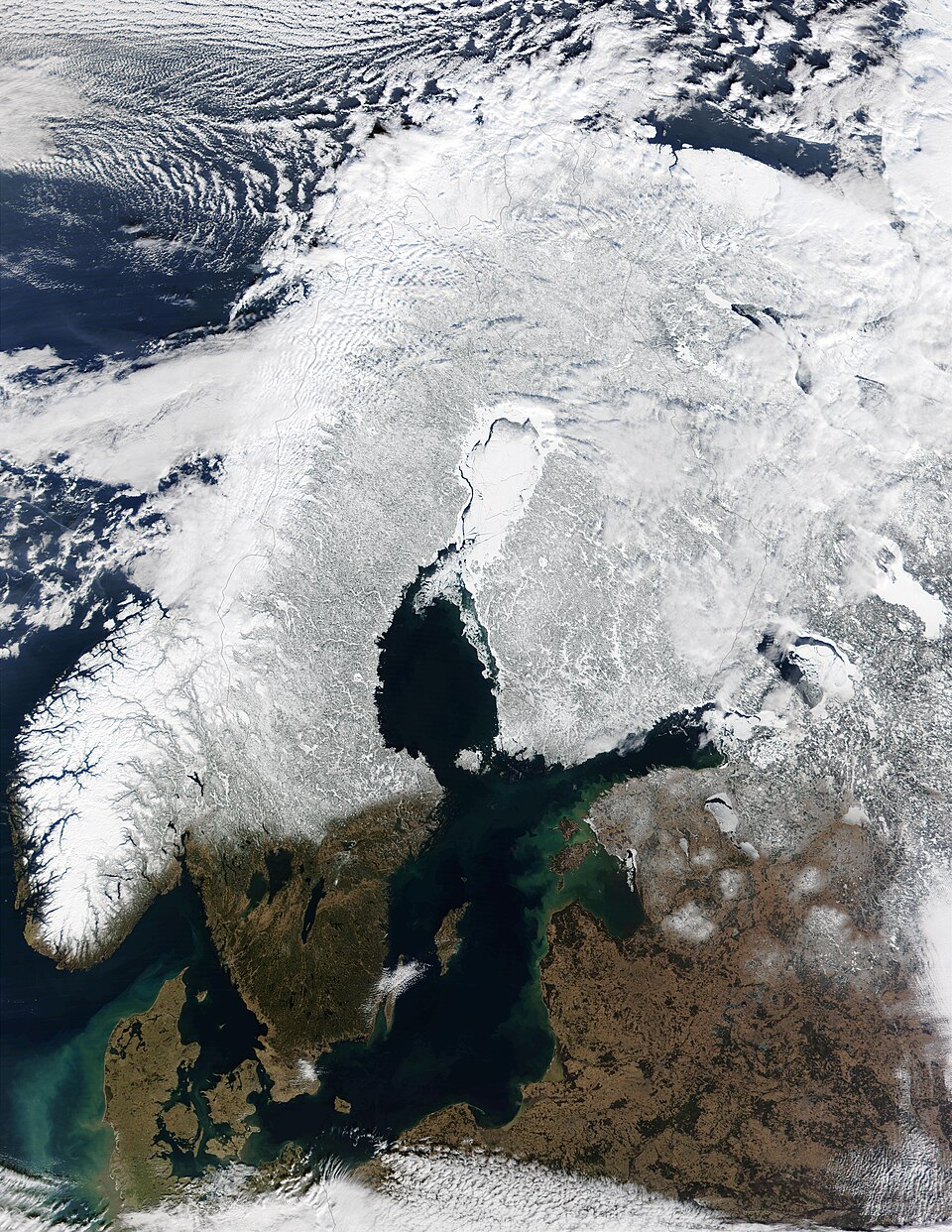

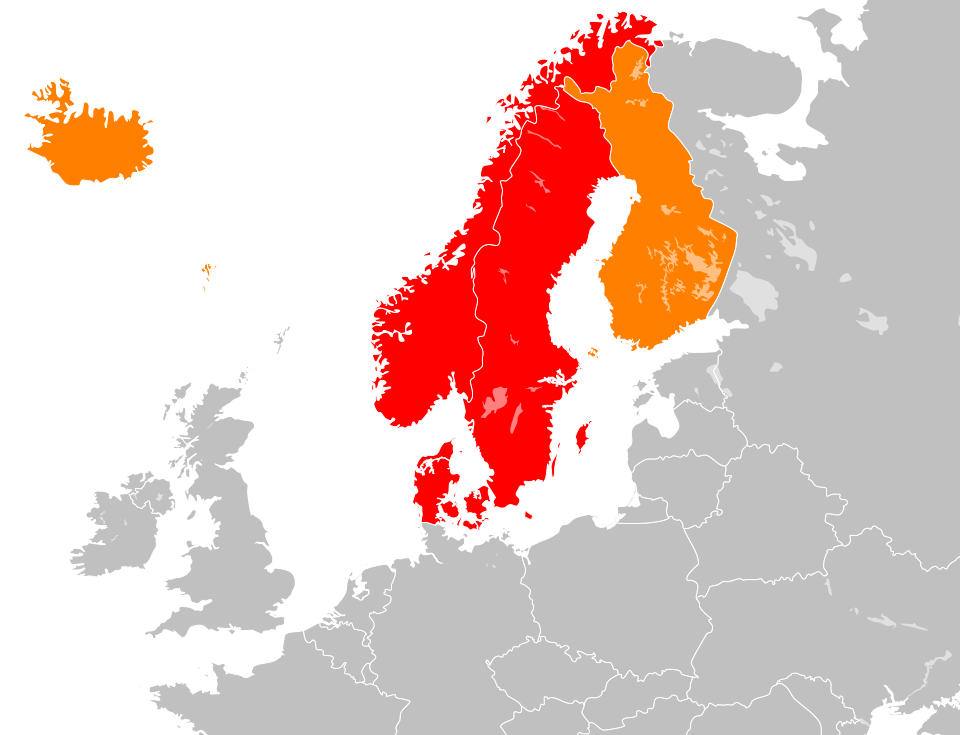
Scandinavia is a group of countries in Northern Europe, including Denmark, Norway, and Sweden. Some people also think Finland is part of Scandinavia and that Iceland and the Faroe Islands should also count.
Most of the time, “Scandinavia” is used to mean places whose people speak Scandinavian languages, also called North Germanic languages or Nordic languages. The Scandinavian languages (Swedish, Norwegian, Danish, Icelandic, and Faroese) are very similar to each other, and many Scandinavians partly understand the other languages because they are similar. Finnish is not a North Germanic language.
What people mean when they say “Scandinavia” depends on what they think is important at the time. When people talk about maps, natural land formations and the economy, they may say that Finland is part of Scandinavia but not Iceland. When people talk about history and languages, they may say that Iceland is part of Scandinavia but not Finland.
The Scandinavian Peninsula is a large peninsula reaching west from Northern Europe over the northern side of the Baltic Sea. Norway, Sweden, and part of Finland are on the peninsula. However, Denmark is considered part of Scandinavia in the ethnic sense more often than is Finland because Danish is a Scandinavian language but not Finnish.
The Nordic countries include Norway, Sweden, Denmark (including the Faroe Islands), Finland, and Iceland. The five countries use the Nordic Council to work together on political and cultural activities. Denmark, Sweden, and Finland are also members of the European Union (EU), but only Finland is part of the eurozone and so uses the euro as its currency. The other Nordic countries still use their own money, called krone or krona (from the word “crowns”). Norway and Iceland, which are not members of the EU, are members of NATO and the European Free Trade Association (EFTA). Only Denmark, Sweden and Finland are members of both the EU and NATO.
Geography
Most of the Scandinavian Peninsula has few people in it. The peninsula has large forests of pine, birch, and spruce trees. Its western and northern parts are mountainous. The Scandinavian Mountains are some of the oldest in the world; the tallest mountain is Galdhøpiggen, in Norway.
Denmark (43,098 km 2 ) is the smallest Scandinavian country. It is more densely populated than the others, and most of the country is farmland. Sweden (449,964 km 2 ) is the largest Scandinavian country. It has the most lakes, and its landscape ranges from plains in the south to mountains in the west, along the border with Norway, to tundra in the north.
The far north of Scandinavia and of Finland is called Lapland, where the Sámi live. Some Sámi still herd reindeer, but most of them live in modern houses and have modern jobs, like other Scandinavians.
Vikings
The most famous group of Scandinavians were the Vikings of the Middle Ages. The Vikings attacked and raided in the Middle Ages, but they also were traders who travelled to what is now Ukraine and started trade routes to the Middle East.
The Vikings from Norway were explorers and crossed the North Atlantic in their longships. They came to Iceland and Greenland and built towns and farms there. The Norwegian explorers also came to the Atalantic coast of Canada. They built at least one town there, but it did not last long.
The Vikings from Denmark came to England, where they affected its history, politics, and language. Danish raiders attacked England many times with great violence. Sometimes, the Danes would ask for the English pay them to go away. The payments were called “Danegeld” (Danish gold). The priests and bishops of churches on the East Coast of England wrote a famous prayer: “deliver us, O Lord, from the wrath of the Norsemen!” “Norsemen” is another way to say “men from the north,” or the Danes.
In fiction and theatre
Much later, in the 19th century, Richard Wagner and other artists in the Romantic period made operas and other artwork about ancient Germanic culture. They liked the Vikings because they were not Greeks or Romans. Those artists were the first to have the idea of Vikings wearing helmets with wings or horns on them and drinking out of hollowed-out animal horns. Some ancient Germanic peoples wore helmets with horns on them, but the real Vikings did not. Wagner and his partners dressed the actors in the opera Ring des Nibelungen to look like ancient Germanic tribes so that the audience would feel like modern Germanics came from the meadieval Vikings.
History
In the 10th to the 13th centuries, Christianity spread in Scandiavia. Modern countries started to form there and came together into three kingdoms:
- Denmark
- Sweden
- Norway These three Scandinavian kingdoms formed the Kalmar Union in 1387 under Queen Margaret I of Denmark. In 1523, Sweden left the union. That made civil war start in Denmark and Norway. The Protestant Reformation then caused Catholics and Protestants to fight each other. After things had settled, the Norwegian Privy Council was abolished: it assembled for the last time in 1537. Denmark and Norway formed another union in 1536, which lasted until 1814. It turned into the modern countries of Denmark, Norway and Iceland.
The borders between Denmark, Sweden and Norway came to the shape that have today in the mid-17th century. In the 1645 Treaty of Brömsebro, Denmark–Norway gave some land to Sweden: the Norwegian provinces of Jämtland, Härjedalen and Idre and Särna and the Baltic Sea islands of Gotland and Ösel (in Estonia). The 1658 Treaty of Roskilde made Denmark–Norway lose the Danish provinces of Scania, Blekinge, Halland, Bornholm, and the Norwegian provinces of Båhuslen and Trøndelag to Sweden. In 1660, the Treaty of Copenhagen returned Bornholm and Trøndelag back to Denmark–Norway from Sweden..
Finland was part of Sweden until the Napoleonic Wars, when it became part of Russia.
Written for younger readers
Norse, in simpler words
This version comes from Wikijunior, a set of books written for children aged 8 to 11. It is shorter and uses plainer language than the article above.
From Wikijunior: Ancient Civilizations
The Norse were a people in northern Europe. They are also often called Vikings. The Vikings were skilled sailors and sailed long distances on their ships. They even visited America hundreds of years before any other European went there.
During the Viking Age, Vikings often raided the British island and other parts of Europe. But they also traded with the rest of Europe.
The Scandinavians were many different kinds of people who had different homes. They lived in the areas that are now Denmark, Sweden, Norway, Iceland, Greenland and many small islands in the Baltic Sea, North Sea and Norwegian Sea. These places were their home countries. When the Viking Age began around the 9th century, they traveled far and wide across all of Europe, the Mediterranean and even down into the Middle East. Some settled in the places they traveled to, but their homes remained in the north. Norway, Sweden and Denmark were the homes to the Scandinavians before Iceland was discovered in the 9th century. Many people sought out Iceland as a place of refuge, and possible fortune (because of the available new lands) during the reign of Harald Fairhair. Many went to Iceland to escape punishment and sometimes they left for Iceland when they had been exiled.
Greenland was settled sparsely. In the Norse sagas they say that Erik the Red was exiled from Iceland for murder, and when travelling further west, found Greenland and named it Greenland. But regardless of his discovery, Eskimo tribes were already living there at the time.
Though each country was ‘Scandinavian’, there were many differences between the people, kings, customs and history of Denmark, Sweden, Norway and Iceland.
The word “Viking” is an Old Norse adjective meaning " to go on an adventure". people who travelled overseas from their native land were called Vikings.
The Norse lived mainly on farms, but some lived in towns and villages. The houses were made of whatever was available. Wood was preferred, but stone or blocks of turf were also used, as was wattle and daub, which was woven sticks with mud caked up to several feet thick on them, placed between posts to hold up the roof. Roofs are believed to have usually been thatched or of sod. Some roofs may have had tiles made of slate, limestone or wood. They usually had only one room, but a wealthy family could have up to four rooms. The farmhouse was usually larger than town houses, and there were other buildings that were part of the farm, for things like storage, livestock and the blacksmith. The houses were called long-houses because they were much longer than they were wide. They had a very steep pitch to their roofs so that most of the snow that fell in winter would slide off, and not cause the roof to collapse under its weight.
The cooking was done on a long open hearth, which usually ran down the centre of the main room. There was no chimney. A hole in the roof let much of the smoke out, but the houses would still be very smoky. Raised platforms along the long sides of the house would be used for seating during the day, and as beds for most of the household at night. Sometimes the head of the household, particularly in wealthier homes, would have a bed in a separate room, or in a small closet in the main hall. The homes of the wealthier Norse also decorated their homes with carving and paint.
In towns, half logs were often laid out between houses as a kind of path or road as the ground could become quite muddy. Some homes also had wattle fences erected around what we would call their front yard so they could keep a few livestock and not have them wander through the town.
Inside the home, there were no cupboards or wardrobes for keeping things in. They had hooks on the wall for hanging up items and chests to store things, which could also be used for seats. The woman in charge of the household would have the keys to these chests hung from her brooches; they were considered a sign of status. In addition, items (especially food) could be hung from the open rafters overhead, out of reach of the dogs, children, and mice.
The loom was used for making cloth for clothing and sails for the ships, and was a common item in most houses.
The food they ate for breakfast was porridge from ground grains mixed with goat’s milk and honey. Many different foods have been found at Viking sites including berries, apples, fish, seal, pig, cow, lamb, grains, flat bread, turnips, herbs and more. Stews were a common food as all the ingredients, meat, herbs and vegetables, could be thrown in a pot hung over the fire. Flat bread was made from ground grain and liquid and eggs were added to the flour until it became dough. This was then rolled out and cooked in a similar way that you would cook pancakes on an open fire. A common drink was mead, which was made from honey.
Their garments were mainly made of wool and linen. Thread was spun using a spindle whorl and then woven into cloth using a drop weight loom. Tablet weaving and even embroidery was used to decorate garments. Women usually wore an under-dress, a dress and an apron. Men wore a shirt that reached to mid thigh and trousers. Both men and women used cloaks. Boots were made of leather. Since Vikings did not have pockets, the men had leather pouches on their belts and the women hung items from utility chains that were attached to brooches they wore at the top of their aprons. Children were dressed similarly to adults. Vikings also loved bright colours used natural things like bark and vegetation to dye their clothes. They had colours like orange, yellow, brown, green and blue as well as many others.
The Vikings believed that their world was divided up into nine worlds, on three levels, all held together by the great tree, ‘Yggsdrasil’. Perched upon the tree was the eagle ‘Vidofnir’.
The top level consisted of:
- Asgard, home of the Aesir or Warrior Gods.
- Vanahiem, the home of the Vanir or Fertility Gods
- Alfeim, the home of the Light Elves.
The middle level or “Middle Earth” was connected to the Higher worlds by the great rainbow bridge ‘Bifrost’. Inside this level, were the homes of:
- Midgard, home of the Humans.
- Nidavellir, home of the Dwarves.
- Jotunhiem, home of the Giants.
- Svartalfhiem, home of the Dark Elves.
Encircling this level, was the great serpent ‘Jormungand’, one of god Loki’s misshapen offspring.
The bottom level included:
- Muspell, Realm of Fire.
- Niflhiem, Land of the Dead.
- In this land is the ‘Niddhog’
In pre-Christian times; the Vikings used an alphabet which was comprised of Runes. Their alphabet was called the Futhark, from the first five letters of their alphabet.
In later times, after most had converted to Christianity (from their earlier Pagan religion), they adopted most of the Latin Alphabet (one of the reasons they adopted it was due to the fact that most Christian writings were written in Latin). However, they kept two runes and adopted them to their Latin alphabet. They were Thorn (Þ) and Eth (Ð).
Yes. One of the most famous Vikings was Leif Eriksson. He took fleet of ships and around the year 1000 sailed to Canada. He is known as one of the first Europeans to set foot in North America. Leif Eriksson was the second son of Erik Thorvalsson, or Eric the Red as we more commonly know him. Erik the Red discovered Greenland after being banished from both Iceland and Norway.
Another famous Viking King is Harald Hardraada, who attacked the North of England in 1066. Harold I of England defeated him in battle and repelled the invaders. Later on, when William the Conqueror of Normandy invaded, Harold lost the battle of Hastings and was shot in the eye with an arrow. This was the beginning of the line of French kings to rule England.
Descendants of the Vikings inhabit most of northern Europe even today. The Scandinavian countries of Sweden, Norway, Iceland, and Denmark openly claim Viking heritage and the royalty from those countries descend from the ancient Viking kings. The Vikings also were absorbed into the cultures of many other Northern European countries, especially those countries surrounding the Baltic Sea and the North Sea.
Many Germanic languages like English also have words that come from Norse traditions. For example, the days of the week were named after Norse gods. Tuesday was named after Tyr; Wednesday was named after Wodin, another name for Odin; Thursday was named after Thor; and Friday was named after Frige.
We know this from carefully studying what they have left behind, in their garbage heaps (called middens), their graves, and in areas where their houses had been built. We also can read about their lives in the sagas, stories that they told about themselves. Several of them were written down by early Christian monks. We also have carvings they left behind on large rocks, called rune-stones, that were often raised in memory of a person or event. These rune-stones allow us to have an idea of what they looked like, and what they considered important enough to go to the expense and effort of raising a stone to remember.
Today, new technology, such as computer imaging and DNA sequencing, is allowing us to learn even more, even from very old finds, such as the Oseberg ship burial, which was found over a hundred years ago.
There are many great websites that have information about the Norsemen. Here are a few:
The Viking Wikipedia Article
Where this page comes from
The article above is adapted from “Norse” on Simple English Wikipedia, by its contributors. We removed reference markers, navigation boxes and tables, expanded measurement templates into readable numbers, and kept the prose otherwise intact. The simpler version is adapted from Wikijunior on Wikibooks.
Both sources are published under CC BY-SA 4.0, so this page is published under the same licence. You may share and adapt it, including commercially, as long as you credit the original and keep the same licence.
Worksheets, answer keys and printable layouts elsewhere on K5Print are our own work and are not covered by this licence.