Olmec
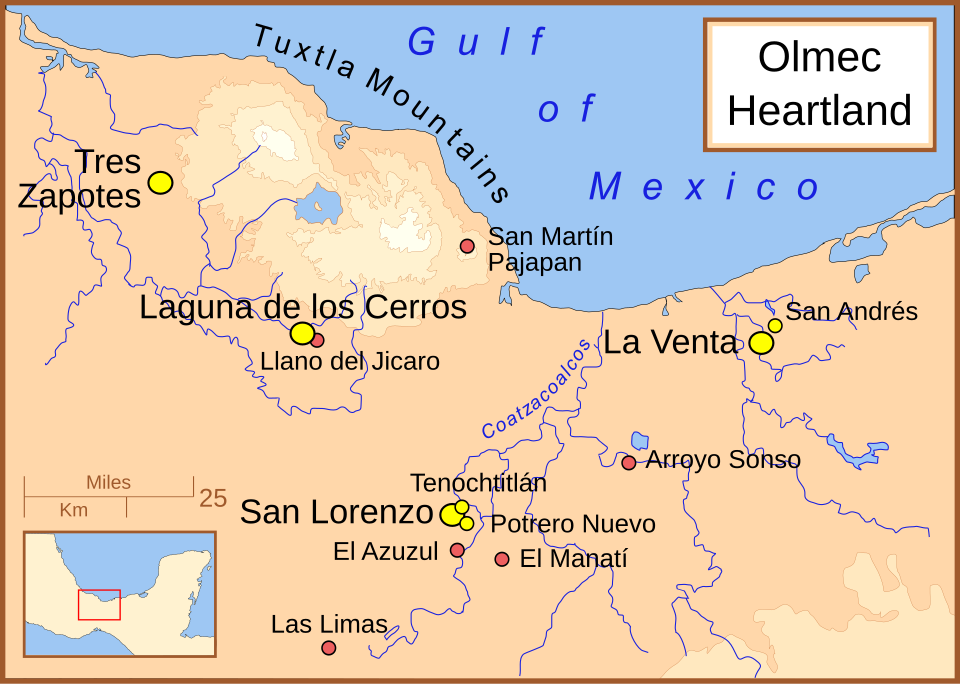

The Olmecs were a group of people who lived about 3000 years ago in what is today south-central Mexico. The Olmec were the first civilization in the ancient area known as Mesoamerica. Because they were the first civilization, many later Mesoamerican civilizations used and repeated Olmec features and characteristics.
The Olmec people discovered and made use of many natural resources in the area, including rubber and corn. Dozens of mysterious stone heads were discovered in the Olmec territory as well; archaeologists are still not sure what their purposes were.
Overview
The Olmecs lived from 1200 BC to about 400 BC. They had two important cities, first San Lorenzo Tenochtitlan and then La Venta. The Olmecs were able to thrive due to the fertile land around the Coatzacoalcos river basin. The reason for the fall of the Olmec empire is unknown. They developed many different cultures.
Art
The Olmecs created a range of artwork such as altars, jade masks and stone carvings.
Colossal heads
The Olmec colossal heads are the most recognized symbol of the Olmec civilization. The height and weights of the heads vary, but the largest head is about twice the height of an average human male. They include seventeen heads found in the southern Mexican cities of La Venta, San Lorenzo Tenochtitlan, Tres Zapotes, and Rancho la Cobata. Each head shows a unique facial expression and wears a helmet bearing distinctive decorations. No two are alike. The origins and meaning of the heads are mysterious, and they are the subject of much speculation among scholars and archaeologists.
Scholars have tried to explain how the Olmecs might have made and moved such big objects. The heads were sculpted out of a hard, dense rock called basalt. Archaeologists think the Olmecs found most of the basalt in the Tuxtlas Mountain range. According to this theory, the basalt heads were sculpted roughly in the mountains and then either floated or dragged by thousands of people from the construction site to the Olmec cities.
Perhaps the most notable features of the sculptures – and a clue as to their meaning – are the helmets worn by all the Olmec heads. These helmets, and the rubber balls found near the sculptures, may be evidence that the Mesoamerican ball game originated with the Olmec civilization. The Mesoamerican ball game was a team sport with profound religious and cultural significance for the indigenous people of Mexico and Central America. The Olmec heads were once thought to have represented Mesoamerican ball players who were sacrificed after losing a match. The current theory, however, is that the heads honor Olmec rulers.
Written for younger readers
Olmec, in simpler words
This version comes from Wikijunior, a set of books written for children aged 8 to 11. It is shorter and uses plainer language than the article above.
From Wikijunior: Ancient Civilizations
The Olmecs lived in Mexico and Central America from c. 1,600 BC-400 BC.
The Olmecs ate maize, beans, squash, cassava, sweet potato, fish, turtle, snake, mollusks, crabs, shellfish, birds, peccary, opossum, raccoon, rabbit, deer, dogs.
Some archeologists believe the Cascajal Block to contain writing of the Olmecs, while others are skeptical due to its singularity and lack of resemblance to other Mesoamerican writing systems of its date. The hieroglyphic Isthmian script is believed by some archeologists to contain later Olmec writing, which is debated as well.
Interpretation of Olmec artifacts lead archeologists to believe that the Olmecs practiced anthropomorphic polytheism, with activities being led by rulers, priests, and shamans. Olmec rulers used their supposed links with the Olmec gods to legitimize their ruling. No religious Olmec texts have been found to date, and thus the precise details of the Olmec religion are uncertain.
Aside from archeological sites themselves, Olmec artifacts that have been found include colossal heads, rectangular altars or thrones, standing sculptures, stelas, jade face masks, and Kunz axes.
Where this page comes from
The article above is adapted from “Olmec” on Simple English Wikipedia, by its contributors. We removed reference markers, navigation boxes and tables, expanded measurement templates into readable numbers, and kept the prose otherwise intact. The simpler version is adapted from Wikijunior on Wikibooks.
Both sources are published under CC BY-SA 4.0, so this page is published under the same licence. You may share and adapt it, including commercially, as long as you credit the original and keep the same licence.
Worksheets, answer keys and printable layouts elsewhere on K5Print are our own work and are not covered by this licence.