Sinhala
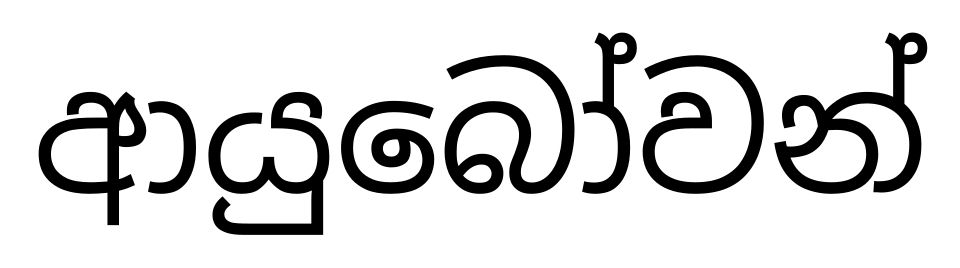

Fast facts
- Speakers
- million
- Region
- Sri Lankan islands
Sinhala or Sinhalese, earlier referred to as Singhalese, is the language of the Sinhalese. They are largest ethnic group of Sri Lanka. It belongs to the Indo-Aryan language family.
Sinhala has two varieties/forms - Spoken and Written, the former being the most popular form. Spoken Sinhala is easier to learn and use because it is so much relaxed in grammatical formality and rigidity.
Sinhala is spoken by about 19 million people in Sri Lanka, about 16 million of them are native speakers. It is one of the constitutionally-recognised official languages of Sri Lanka, with Tamil. Sinhala has its own writing system (see Sinhala script) which is an offspring of the Indian Brahmi script.
The oldest Sinhala inscriptions were written in the 3rd and 2nd centuries BC; the oldest existing literary works date from the 9th century AD.
The closest relative of Sinhala is Dhivehi, the language of the Maldives, .
The word order of Sinhala language is SOV (subject-object-verb) just like Japanese, Korean and many other languages in Asia. It would be easy for people from that particular language style to learn Sinhala with a little time and practice.
Ex 1 : I home go Mama gedara yanawa. Ex 2 : beautiful dress Lassana anduma
Morphologically, the words are built with the stem followed by a particle. The particle can vary so that it adds more grammatical change into the word connecting it to the whole sentence.
pusa yanawa - kitten is going. pusath yanawa - kitten is also going.
ballata denawa - giving (it) to the dog ballatath denawa giving it to the dog as well ballatama denawa giving it to the dog itself.
If you really take a good look at these sentences, you may easily find the stem of the words: pusa, pusath; ballata, ballathath, ballatama.
pusa- is the stem of the subjectival phrase. (kitten)
Pusa + th - as well
pusa + ta - to kitty
pusa + ta + th - to kitty as well
pusa + ta + ma - to kitty itself ^^
Written for younger readers
Sinhala, in simpler words
This version comes from Wikijunior, a set of books written for children aged 8 to 11. It is shorter and uses plainer language than the article above.
From Wikijunior: Ancient Civilizations
The Sinhala lived in Sri Lanka, an island in the Indian ocean just south of the Indian peninsula. The people are descendents of both the indigenous people who migrated from India and other migrants who have come from all over the world.
3rd century BC - World’s largest brick structures at the time close to 400 feet in height. World’s 2nd largest overall structures at the time second only to pyramids.
Axially planned, brick court yard buildings with wooden and stone columns and clay tile roofs.
Those big builidings were in respect of Gautama Buddha who is the founder of Buddhism cause Sri Lanka is the only country practising Heenayana buddhism mainly differ in practising methods as well as some other rituals. During the kingdom of Anuradhapura time, those big mounaments were erected. A king named Dutugemunu was in back of building the great structure, called “stupa” in the name of Gautama Buddha.
Mainly they ate rice and curry.
Sinhala women wore a sort of blouse. They wore dhotis which were long cloths worn from their waist down. The men wore a sarong which was on the lower part of their body. The upper-class women covered everything. All the women were heavily bejewelled. Lower-class women wore a breast-band and the cloth cannot go below their knees. It was fashion for all women to wear a row of pearls on their breast. They wore bracelets and rings around their fingers and toes. They could have been made of glass. They wore earrings also.
They are mainly Buddhists.
Most of the Sinhalese follow the Theravada school of Buddhism. In 1988 almost 93% of the Sinhalese speaking population in Sri Lanka were Buddhist. Buddhists include various religious elements from Hinduism in their religious practices and ancient traditions of godlings and demons, which are native to the island. Sinhalese Buddhists worship Hindu gods such as Vishnu, who has a special place in their religious practices, since he is entrusted with both protecting Buddhism in the island and the island itself. He is also recognised as bodhisattva, or “awakening being” to Sinhalese Buddhists.
There is also a significant Sinhalese Christian community, in the seafaring provinces of Sri Lanka. Christianity was brought to the Sinhalese by Portuguese, Dutch, and British missionary groups during their periods of rule. Sinhalese Christians mainly follow Roman Catholicism, followed by Protestantism. Their cultural centre is Negombo.
The writing differed from time to time as any of the other scripts in Asia. The Sinhala script began as an offshoot from Brahmi and is found in the southern branch of this family, sharing a common root with scripts such as Malayalam, and Tamil. The writing system was originally used in inscriptions, the oldest ones dating from the 6th century BCE on pottery[, with lithic inscriptions dating from the second century B.C. By the ninth century C.E., literature written in Sinhala script had emerged and the script began to be used in other contexts. For instance, the Buddhist literature of the Theravada-Buddhists of Sri Lanka, written in Pali, used the Sinhala alphabet.
Today, the alphabet is used by about 16,000,000 people to write the Sinhalese language in very diverse contexts, such as newspapers, TV commercials, government announcements, graffiti, and schoolbooks.
Where this page comes from
The article above is adapted from “Sinhala” on Simple English Wikipedia, by its contributors. We removed reference markers, navigation boxes and tables, expanded measurement templates into readable numbers, and kept the prose otherwise intact. The simpler version is adapted from Wikijunior on Wikibooks.
Both sources are published under CC BY-SA 4.0, so this page is published under the same licence. You may share and adapt it, including commercially, as long as you credit the original and keep the same licence.
Worksheets, answer keys and printable layouts elsewhere on K5Print are our own work and are not covered by this licence.