Slavs
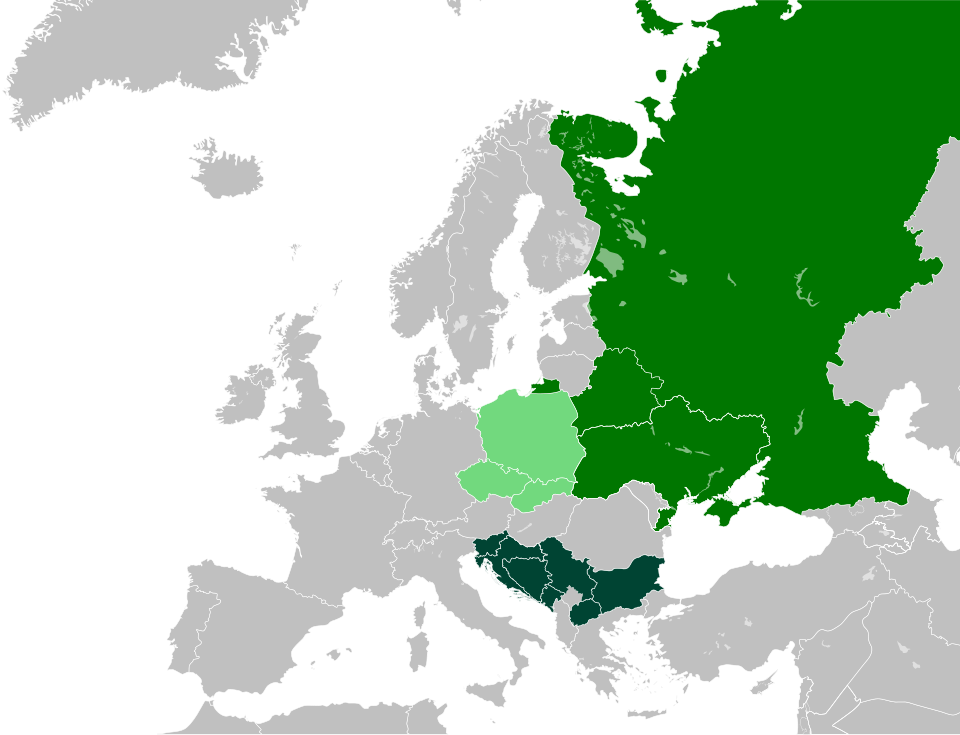

Slavs live in Central Europe, Eastern Europe, Southeast Europe, Central Asia and North Asia. Present-day Slavic peoples are classified into West Slavs (mainly Poles, Silesians, Czechs, Moravians and Slovaks), East Slavs (mainly Ukrainians, Belarusians, and Russians), and South Slavs (mainly Serbs, Bulgarians, Croats, Bosniaks, Pomak, Torbesh, Gorani, Macedonians, Slovenes, and Montenegrins).
Austrians, Hungarians, Romanians (although 1/3 of Romanian population is made of Slavic population, mainly Serbians and Bulgarians), Estonians, Lithuanians and Latvians (and these 3 countries have sizable Russian and Poles population, so much so that they make a majority ethnic groups in those countries) live near the Slavic nations but are not Slavs themselves. There are more Slavs than any other ethnic group in Europe. Russians make up the most Slavs, followed by Poles and Ukrainians.
There are many small historic Slavic nations like Lusatia (and Lusatian Serbs, typically referred to as Sorbs, who still live in eastern Germany), Rusyn, Kashubia and others. Russia is now the most powerful and populated Slavic country, but in the 10th century Bulgarians and Czechs were powerful, and in the 16th century Poland was the strongest nation in the area.
The Slavic languages are closely related. The largest similarities can be found within the same group (for example, Polish and Slovak, both West Slavic languages), but similarities exist even between Slavic languages from other different subgroups (such as Bulgarian and Russian).
However, the greatest similarities are between Serbian, Bosnian and Croatian, which are South Slavic languages. They are considered separate by the Bosnian and Croatian governments (the separation is of political nature), but linguistically they are one language- Serbo-Croatian (since Serbian, Croatian, Bosnian and Montenegrin are more similar than those variants of English, German, Dutch, or Hindi–Urdu, and mutual intelligibility between their speakers “exceeds that between the standard variants of English, French, German or Spanish).
Slavic languages are spoken natively by 300 million people and as second or third languages by many more people in countries as far away as Germany and China.
Written for younger readers
Slavs, in simpler words
This version comes from Wikijunior, a set of books written for children aged 8 to 11. It is shorter and uses plainer language than the article above.
From Wikijunior: Ancient Civilizations
(West) Slavs lives in Poland, Czechia, Slovakia, (South) Slavs lives in Slovenia, Croatia, Serbia, Bulgaria, Macedonia and (East) Slavs lives in Latvia, Lithuania, Belarus, Ukraine and Russia.
The early Slavs were a non-writing culture. After they converted to Christianity, they adopted different writing systems based on which church they converted into. The Catholic Slavs (Poles, Czechs, Slovaks, Slovenes, Croats) adopted the Latin alphabet, while the Eastern Orthodox Slavs (Russians, Belarusians, Ukrainians, Bulgarians, North Macedonians, Serbs) adopted the Cyrillic alphabet.
Early Slavic people believed in many gods. For example, Perun, the god of thunder and lightning, Svarogc father of the chief deities, Dazhbog the god of sun and Svarazic the god of fire are some of their gods. The two most important gods were Byelobog (or Byelun) the White God and Chernobog the Black God. Most of the Slavic people converted to Christianity, that was practiced in the Byzantine Empire in eastern Europe. By the 1000s, all Slavic lands had been converted to Christianity.
Where this page comes from
The article above is adapted from “Slavs” on Simple English Wikipedia, by its contributors. We removed reference markers, navigation boxes and tables, expanded measurement templates into readable numbers, and kept the prose otherwise intact. The simpler version is adapted from Wikijunior on Wikibooks.
Both sources are published under CC BY-SA 4.0, so this page is published under the same licence. You may share and adapt it, including commercially, as long as you credit the original and keep the same licence.
Worksheets, answer keys and printable layouts elsewhere on K5Print are our own work and are not covered by this licence.