Stone age
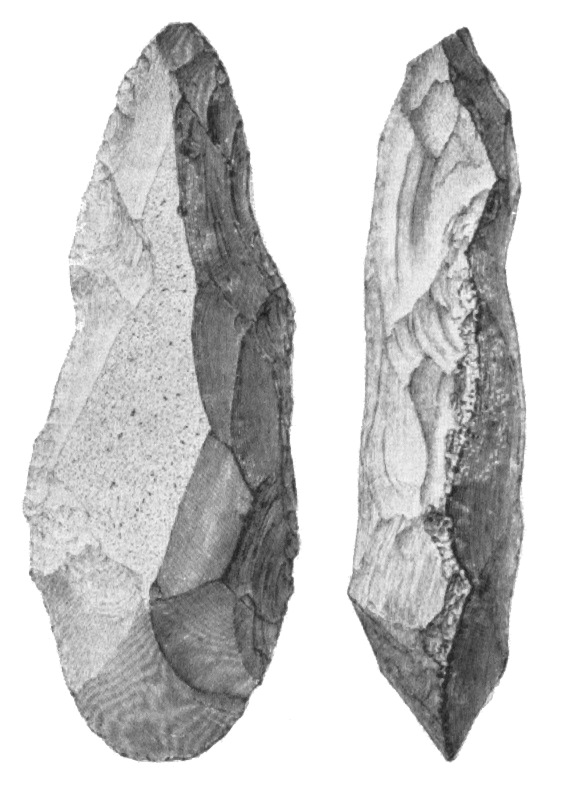

The Stone Age was a prehistoric time when people made tools from stone such as flint. It began when people created the first stone tools about 3.3 million years ago. It lasted for about 3.4 million years, and ended between 4,000 BC and 2,000 BC. About 99% of human history happened during the Stone Age.
Life
Stone Age people also made tools out of wood, antler, and bone. However, these materials do not last as long as stone. For this reason, most of the Stone Age tools archaeologists have found are made of stone.
Food eaten in the Stone Age included berries (e.g. blackberries), fish, animals (e.g. mammoth), and animal organs.
Timeline
Archaeologists divide the Stone Age into three sections: Paleolithic (“old stone”), Mesolithic (“middle stone”), and Neolithic (“new stone”). During the Neolithic period, people invented farming and pottery, and started to care for animals like cows and pigs.
Sometime between 3000 BC and 2000 BC, people discovered the art of making metals. This probably happened in the Middle East. People used copper first, then learned how to make bronze. When people started using these metals instead of stone, the Stone Age ended and the Bronze Age began.
Some groups of people in Papua New Guinea continued to use Stone Age technology into the 20th century. They used stone-tipped weapons to kill animals for food and clothing. They made shelters using animal skin.
Written for younger readers
Stone age, in simpler words
This version comes from Wikijunior, a set of books written for children aged 8 to 11. It is shorter and uses plainer language than the article above.
From Wikijunior: Introduction to History
The first million years of human existence is called the stone age. People spread out over the earth, from the hot jungles to the freezing north. A few tens of thousands of years ago, something wonderful happened. People began to develop new tools, new forms of art, musical instruments, and began to bury their dead. Before that time, primitive tools from widely separated places look very much alike. After that time, human artefacts take on an almost infinite variety of distinctive forms. This is the age of the cave paintings, of the European drawings of buffalo and the African drawings of antelope. These works of art differ not only in subject but in style. This age is called the Neolithic age (or new stone age). In 2005, scientists isolated two genes that they think may be the cause of this wonderful change, but the discovery is too new for anybody to say for sure.
Stone age peoples were hunter-gatherers. They ate animals and what roots and berries they could find growing wild. There was never enough food, and so people organized into tribes and constantly fought with other tribes. Many of the bones dug up from this period show signs of wounds from spears or clubs. Life was, as a writer named Hobbes put it, “nasty, brutish, and short.”
Where this page comes from
The article above is adapted from “Stone age” on Simple English Wikipedia, by its contributors. We removed reference markers, navigation boxes and tables, expanded measurement templates into readable numbers, and kept the prose otherwise intact. The simpler version is adapted from Wikijunior on Wikibooks.
Both sources are published under CC BY-SA 4.0, so this page is published under the same licence. You may share and adapt it, including commercially, as long as you credit the original and keep the same licence.
Worksheets, answer keys and printable layouts elsewhere on K5Print are our own work and are not covered by this licence.