The House of Saxe-Coburg-Gotha
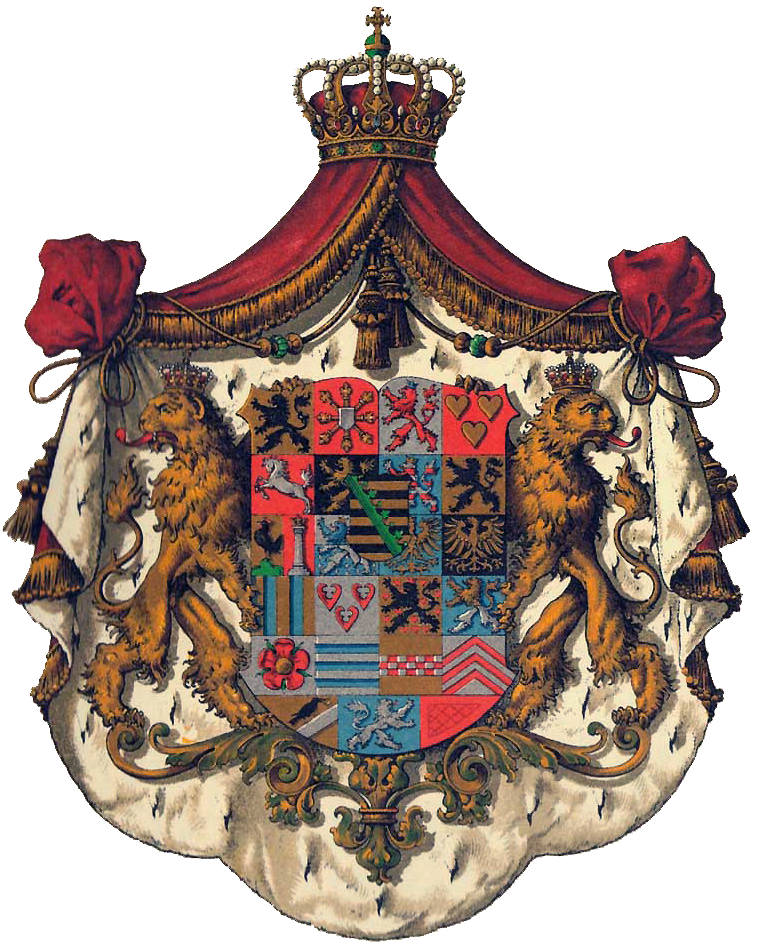

Fast facts
- Capital
- Coburg and Gotha
The Duchy of Saxe-Coburg and Gotha (German Sachsen-Coburg und Gotha) was a dual monarchy in Germany. This means that one ruler ruled over two countries, in this case the duchies of Coburg and Gotha. “Saxe” means of Saxony, because there were many small countries but all were ruled by members of the royal house of Saxony. Usually the royal house of Saxony means the rulers of the Kingdom of Saxony. The house of Wettin ruled the other states (Wettin is the family’s surname).
The royal house of Saxe-Coburg and Gotha was created in 1826. One dynasty of the House of Wettin (the Dukes of Saxe-Gotha-Altenburg) became extinct because there were no more male children to inherit.
The remaining members of the family divided their various lands between them. The duke of Saxe-Coburg-Saalfeld gave up Saalfeld and instead got the duchy of Gotha. Saalfeld became part of Saxe-Meiningen, which also took Hildburghausen when the Dule of Saxe-Hildburghausen became Duke of Saxe-Altenburg.
On 12 November 1826, Ernst III of Saxe-Coburg-Saalfeld became Ernst I Duke of Saxe-Coburg and Gotha, Duke of Jülich (Juelich), Cleves and Berg, also Engern and Westphalia, Prince of Lichtenberg, Landgrave in Thuringia, Markgrave of Meißen (Meissen), Count of Hennerberg, Count of the Mark and Ravensburg, Lord of Ravenstein and Tonna.
Ernst had two sons. His younger son, Albert, married his cousin Queen Victoria of the United Kingdom. Saxe-Coburg and Gotha became the name of the royal house of the United Kingdom from 1901 until 1917 (the reign of Edward VII), when the name was changed the Windsor because of hatred of anything German in World War I.
The Duchy in Germany
Ernst I died in 1844 and his elder son and successor, Ernst II, ruled until he died in 1893. As he had no children childless, the throne of the Duchy passed to the male descendant’s of Ernst’s late brother Albert the Prince Consort, husband of Queen Victoria. But, the Duchies did not want to be joined to Great Britain, so their constitutions stopped the King and heir apparent of Great Britain from becoming Duke if other eligible male heirs exist. Therefore after Edward, Prince of Wales, came his next brother, Alfred, Duke of Edinburgh. Alfred’s only son, also named Alfred, committed suicide in 1899, so when Duke Alfred died in 1900, he was succeeded by his nephew, Charles Edward the Duke of Albany, the sixteen-year-old son of Queen Victoria’s youngest son, Leopold. (Duke Arthur of Connaught and his son did not want to become Duke, so renounced (gave up) their right to succession.) The new Duke started using the German version of his name, and ruled as Duke Carl Eduard. Until he came of age in 1905, the Hereditary Prince of Hohenlohe-Langenburg acted as Regent, Carl Eduard retained his British title Duke of Albany, but because he fought for Germany in the First World War, he was stripped of his British titles in 1919.
Carl Eduard reigned until 18 November 1918, when the Workers’ and Soldiers’ Council of Gotha deposed him during the German Revolution. The two Duchies became separate states, but soon joined with bigger states. Saxe-Coburg became a part of Bavaria, and Saxe-Gotha merged with other small states to form the new state of Thuringia in 1920 in the Weimar Republic.
The capitals of Saxe-Coburg and Gotha were Coburg and Gotha. By 1914 the area and populations of the two duchies were:
Saxe-Coburg and Gotha was the only European country to appoint a diplomatic consul to the Confederate States of America. The consul was named Ernst Raven, consul in the State of Texas. When Raven asked the Confederate Government for a diplomatic exequatur (permission to be act as consul) on 20 July 1861 he was accepted.
House
Other members of the family became kings of Belgium and Bulgaria, and married into nearly all of the other royal families of Europe. More than 50 years after Bulgaria became a republic, King Simeon returned to Bulgaria and was elected Prime Minister. After the First World War the Kings of Belgium stopped using the name Saxe-Coburg and Gotha, but never officially changed their name. Simeon of Bulgaria’s legal name is Simeon Borisov Sakskoburggotski
The Duchy of Saxe-Coburg and Gotha stopped being independent in 1918, when Germany became a republic. Carl Eduard, the last reigning duke had his British titles taken away for supporting Germany in World War I. He died in 1954.
Gotha became part of the new state of Thuringia, and Coburg joined Bavaria.
Written for younger readers
The House of Saxe-Coburg-Gotha, in simpler words
This version comes from Wikijunior, a set of books written for children aged 8 to 11. It is shorter and uses plainer language than the article above.
From Wikijunior: Kings and Queens of England
Edward VII was born at Buckingham Palace on 9 November 1841. His parents were Queen Victoria and Prince Albert. Edward VII was King of the United Kingdom of Great Britain and Ireland, King of the Dominions of the British Empire and the Emperor of India from 22 January 1901 to his death on 6 May 1910. He was the first British monarch of the House of Saxe-Coburg-Gotha. Despite taking the name “King Edward”, he was known to his family as “Bertie” as his first name was Albert.
Queen Victoria and Prince Albert wanted their eldest son to have an education that would prepare him to be a model constitutional monarch. Aged seven, Bertie started a rigorous educational programme devised by the Prince Consort. However, he was not a good student, with his main talents being his tact and charm. Edward hoped to have a career in the British Army, but this was denied him because he was heir to the throne, although he did serve briefly in the Grenadier Guards in 1861. As a young man, he gained a reputation as a playboy.
Once widowed, Queen Victoria withdrew from public life, but she did arrange for her son to marry Princess Alexandra of Denmark, the beautiful elder daughter of King Christian IX of Denmark. The couple married on 10 March 1863. However, Edward kept mistresses throughout his married life.
During Victoria’s widowhood, Edward represented her at public gatherings, but Victoria did not allow him to have an active role in the running of the country. Several incidents, including a court appearance in a notorious divorce case, brought him bad press and caused him to be regarded as unsuitable material for a future monarch. He was known for his love of gambling and country sports. But Edward was also a patron of the arts and sciences and helped found the Royal College of Music.
When Queen Victoria died on 22 January 1901, Bertie, then aged 59, became king. Edward VII and Queen Alexandra were crowned at Westminster Abbey on 9 August 1902. His coronation was going to be on 26 June, but two days before on 24 June, Edward developed appendicitis. He needed what may have been a life-saving operation. Two weeks later it was announced that the King was out of danger.
As king, Edward’s main interests lay in the fields of foreign affairs and naval and military matters. Fluent in French and German, he made a number of visits abroad. One of his most important foreign trips was an official visit to France in spring 1903 as the guest of President Émile Loubet. This visit helped build the Anglo-French Entente Cordiale, which was an informal agreement setting out what territories were British and French colonies in North Africa, with the aim of preventing future wars between the two countries.
Edward VII, mainly through his mother and his father-in-law, was related to nearly every other European monarch and came to be known as the Uncle of Europe. The German Emperor Wilhelm II, Tsar Nicholas II of Russia, King Alphonso XIII of Spain and Carl Eduard, Duke of Saxe-Coburg-Gotha were Edward’s nephews. King Haakon VII of Norway was his son-in-law and nephew by marriage. King George I of the Hellenes and King Frederick VIII of Denmark were his brothers-in-law. King Albert I of the Belgians, King Manuel II of Portugal, King Ferdinand of Bulgaria, Queen Wilhelmina of the Netherlands and Prince Ernst August, Duke of Brunswick-Lüneburg, were his cousins.
In the last year of his life, Edward was involved in a constitutional crisis when the Conservative majority in the House of Lords refused to pass the “People’s Budget” proposed by the Liberal government of Prime Minister Herbert Henry Asquith. The King died before the Liberal victory in the 1910 general election resolved the situation, but he told Asquith that he would, if necessary, appoint new peers to allow the Budget to pass through the House of Lords.
Edward died from a heart attack brought on by bronchitis on 6 May 1910. He was succeeded by his eldest surviving son, who became George V.
George V was born at Marlborough House on 3 June 1865. His parents were Edward VII and Queen Alexandra. He was King of the United Kingdom of Great Britain and Ireland, King of the Dominions of the British Empire and Emperor of India from 6 May 1910 until his death on 20 January 1936.
As a younger son of the Prince of Wales (as Edward VII then was), he was not expected to become king. However, as George was born only fifteen months after his brother Prince Albert Victor, it was decided to educate both royal princes together. Given the importance of Prince Albert Victor’s expected future role as king, both brothers were given a strict programme of study, although neither did well at their studies.
Later the royal brothers served as Naval cadets on HMS Bacchante. They toured the British Empire, visiting the colonies in Australia and the Far East, and also getting tattooed in Japan. When they returned to the UK, the brothers were parted with George joining the Royal Navy and Albert Victor attending Trinity College, Cambridge. George served in the navy until 1891. He travelled the world and visited many areas of the British Empire. He also got many more tattoos, and a parrot that he took home to England with him.
In 1891, Prince Albert Victor became engaged to his second cousin once removed, Princess Victoria Mary of Teck (always called “May”), the only daughter of Prince Francis, Duke of Teck and Princess Mary Adelaide of Cambridge. However, Albert Victor died of pneumonia six weeks later, leaving George second in line to the throne and likely to succeed after his father. Queen Victoria still favoured Princess May as a suitable bride for a future King, so she persuaded George to propose to May and May accepted. Despite its being an arranged marriage, George and May’s marriage was largely successful, and unlike his father, George is not believed to have had a mistress. They married on 6 July 1893, and they had six children in total. David and Bertie were the first two. Then came Mary, Henry, George and John. The first two were later to become King Edward VIII and King George VI respectively.
In 1892 Queen Victoria made George the Duke of York. As Duke and Duchess of York, George and May carried out a wide variety of public duties. In 1900, they toured the British Empire, visiting Australia, where the Duke opened the first session of the Australian Parliament on the creation of the Commonwealth of Australia.
In 1901, Queen Victoria died and George became next in line to the throne. His father, Edward VII, made him Prince of Wales later that year. In contrast with Queen Victoria, who excluded Edward from state affairs, George was given wide access to state documents and papers. He often read over the papers with his wife, Princess May, who was cleverer than him. May also helped write speeches for her husband.
On 6 May 1910, King Edward VII died and George became George V. Princess May became Queen Mary. On 11 December 1911, the King and Queen travelled to India for the Delhi Durbar, where they were presented to Indian dignitaries and princes as the Emperor and Empress of India. George wore the newly-created Imperial Crown of India at the ceremony. Later, the Emperor and Empress travelled throughout India visiting their new subjects.
As King and Queen, George and Mary saw Britain through World War I. This war was fought against Germany, amongst others, which made it a difficult time for the Royal Family, as they had many German relatives. On 17 July 1917 he changed the name of the British Royal House from the German-sounding House of Saxe-Coburg-Gotha to the House of Windsor. He also renounced all use of German titles and styles for his British relatives.
World War I took its toll on George’s health, which rapidly worsened. He had always had a weak chest, which was not helped by his smoking. An illness saw him go to the seaside, by Bognor Regis in Sussex, where Queen Mary helped nurse him back to health (however, reputedly the King’s last words, upon being told that he would soon be well enough to revisit Bognor Regis were “… bugger Bognor!”) He did live to see the Silver Jubilee of his reign, in 1935, by which time he had become a well-loved king.
George died on 20 January 1936 at Sandringham House in Norfolk. He was buried at St George’s Chapel, Windsor Castle. It is said his death was hastened by his doctor giving him a lethal injection of cocaine and morphine, both to end the King’s suffering and to make sure he died by midnight so that his death could be announced in the morning newspapers.
Where this page comes from
The article above is adapted from “The House of Saxe-Coburg-Gotha” on Simple English Wikipedia, by its contributors. We removed reference markers, navigation boxes and tables, expanded measurement templates into readable numbers, and kept the prose otherwise intact. The simpler version is adapted from Wikijunior on Wikibooks.
Both sources are published under CC BY-SA 4.0, so this page is published under the same licence. You may share and adapt it, including commercially, as long as you credit the original and keep the same licence.
Worksheets, answer keys and printable layouts elsewhere on K5Print are our own work and are not covered by this licence.