Area
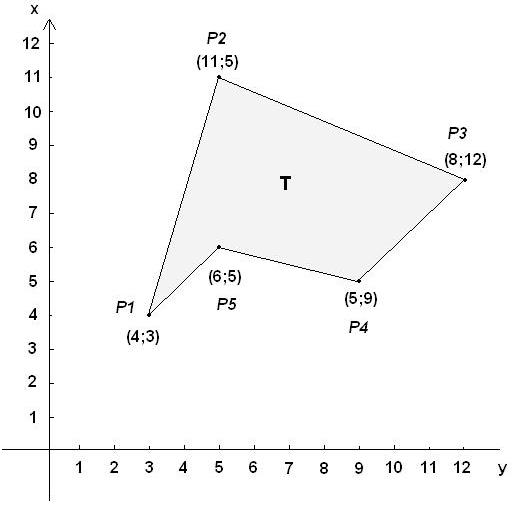

Area is the amount of space a two dimensional (flat) surface takes up. It is useful because it is how much of a material is needed to make a hollow container. Area is the amount of surface covered by a close object or shape.
Some units used to measure area are square foot, square mile, square metre and square kilometre. The area of a planar figure is often written as A. Areas of regular shapes such as square, rectangle, triangle and circle can be calculated through formulas. The area of an irregular shape can be approximated through grid or graph paper.
One can use different formulas to find the area of different shapes. For example:
- The area of a rectangle is the length of any two touching sides multiplied together. In other words, length times width.
- The area of a triangle is half of the product of the base and the perpendicular height. In other words, A = \tfrac{1}{2} bh.
- The area of a circle: A = \pi r^2
The area of a flat object is related to the surface area and volume of a three-dimensional object.
The area under a curve can be found using integration, a concept from calculus.
Perimeter and Area
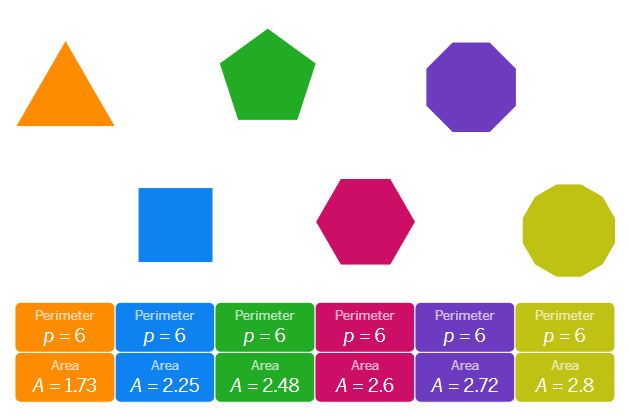
As demonstrated with honeycombs, the best shape to have when you want plenty of area with little perimeter is the circle, with the hexagon being a good alternative.
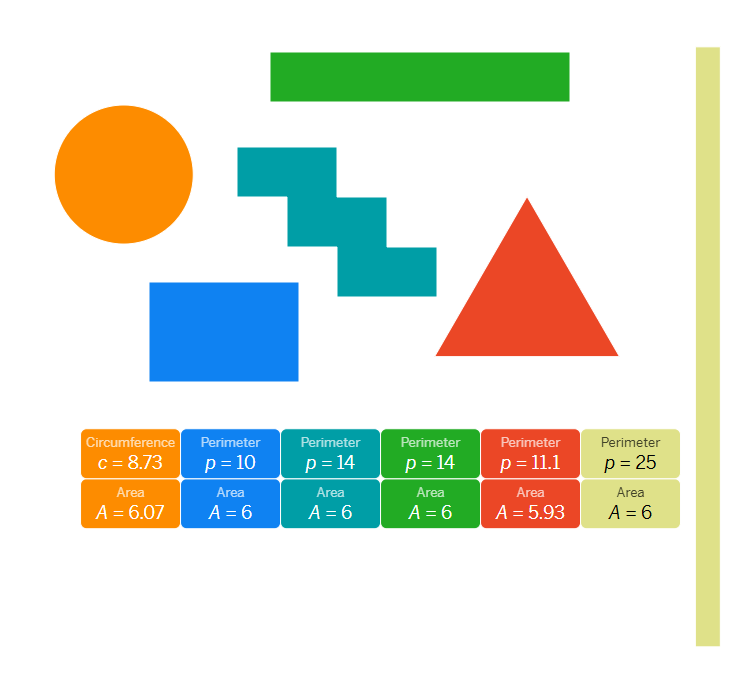
If you want a lot of perimeter and just a little area, simply make the shape into a square, then make it twice as long and half as wide.
Written for younger readers
Area, in simpler words
This version comes from Wikijunior, a set of books written for children aged 8 to 11. It is shorter and uses plainer language than the article above.
From Wikijunior: What can you use math for?
Let’s say that you, for some reason, wanted to know exactly how many squares there are on a chess board. How would you figure it out? The first thing you think of would probably be to count them out: 1, 2, 3, 4, 5, and so on. You’re a busy person though and don’t have that kind of time, you need to know quickly. How do you do it? You could use a very simple geometric property: area.
Area is how much space there is inside a 2d object (a 2d [2 dimensional] object is something like a circle or a square but not a ball or box). Area is measured in square units. The units are whatever I am using to measure the object, they can be feet, inches, or miles in the US or meters, centimeters, or kilometers in the rest of the world. In the case of our chess board, the units we will use will be squares.
How do we find the area? For a square (like our chess board) that is simple; all we need to do is multiply the length of the bottom times the length of a side. So here is the process we will follow to find the area of our chess board. First, count the number of squares along the bottom of the board, then count the number of squares along a side. Both numbers should be 8. Next multiply the two numbers. 8 x 8 = 64. So the area of the chess board is 64 square squares, thus we have 64 squares on one chessboard, and we found that out without wasting time counting all of the spaces.
This idea can be applied to any flat, rectangular surface- even if it doesn’t have squares marked off. Simply measure a surface’s length and width and multiply them. They do not need to even be whole numbers (they can have decimals or fractions). For example, if a table surface measures 150 cm by 250 cm, then its area is 150 x 250 = 37,500. That’s a big number! But if you drew 1 cm by 1cm squares on the table, that’s how many there would be.
It’s hard to think about area with decimals, but it is very useful because not all tables are going to have a whole number of squares. For example, if our table earlier was actually a little bit off- say, 150.2 by 249.6, we can still multiply these numbers, but you might need a calculator. 150.2 x 249.6 = 37,489.92, which is slightly less than before. Notice that even though one side was slightly bigger, the other side was smaller by more, so there is less area. If you drew squares on this table, you would not even get 37,489 full squares, because all squares on the edge would get cut off. But if you added up all of those pieces of squares, 37,4892 is how many full squares could be made (with .92 left over).
Area with decimals has some results that you might not expect. If a square is 1/2 meters by 1/2 meters (.5 m by .5 m), its area is .5 x .5 = .25 or 1/4. That seems strange because it is less than either the length or the width. But if you divide a square by drawing one line vertically through the center and another horizontally through the center, you will have four equal sections. That is, each square is 1/4 of the total area even though it is only 1/2 by 1/2 of the total length and width.
Area can be applied to more than just square surfaces. You can find the area on a circular or triangular table too. In fact, the area of any surface, no matter the shape, can be measured. It gets a lot more difficult for some shapes, however, so we won’t teach just how, but be aware it can be done. By using area, you can compare objects that aren’t of the same shape. For example, you could determine whether a circular table had more or less space than a square table.
Where this page comes from
The article above is adapted from “Area” on Simple English Wikipedia, by its contributors. We removed reference markers, navigation boxes and tables, expanded measurement templates into readable numbers, and kept the prose otherwise intact. The simpler version is adapted from Wikijunior on Wikibooks.
Both sources are published under CC BY-SA 4.0, so this page is published under the same licence. You may share and adapt it, including commercially, as long as you credit the original and keep the same licence.
Worksheets, answer keys and printable layouts elsewhere on K5Print are our own work and are not covered by this licence.