Buying Something

NOTOC
Buying something
When you buy something you pay money and receive change. It is important to know that you have received the correct change. Otherwise, you might pay more than you have to for the item. It can also be useful to understand fractions so you can attribute the right value to parts of a unit (like a slice of cake or pizza) or enable you to deal with lengths, weights and capacities, and conversions. It is even necessary for you to be able to transmit areas or volumes, in case you buy terrain or need a new fish-tank.
Jobs involving buying something
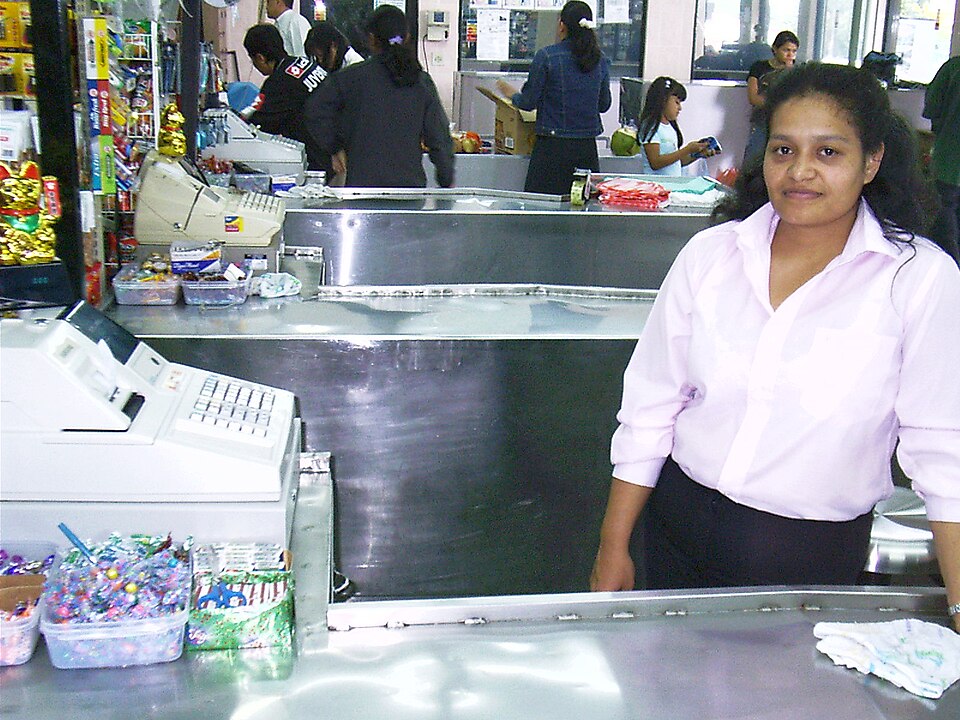
Many jobs are involved with buying things. In fact, there is a type of job called a “purchaser”. This person is paid to buy things for a company. They try to find the best prices on the things the company needs. There is also a type of job called a “cashier.” This person runs a cash register and sells things to customers. In fact, there are many different jobs that involve buying and selling things.
Math used when buying something
There are several types of math used when you buy something. First, you use counting and addition used in order to tell how much money you have. Percentages and addition are used to calculate the purchase price. Then subtraction is used in order to figure out how much change is due.
Examples
You go to a shop to buy a doll. The doll costs $10.00. You take the doll to the cashier. The cashier figures out the selling price by adding the cost, plus the tax. If the tax rate is 7%, the tax would be 70 cents on $10.00. So the cashier adds 70 cents to the 10.00 for a total sales price of $10.70. You take your money out of you pocket and count one ten-dollar bill and one one-dollar bill. Adding these two bills together gives you $11.00. You give this money to the cashier. She subtracts the selling price ($10.70) from the amount tendered ($11.00) and you receive 30 cents in change. The cashier gives you 30 cents and puts the doll in a bag and hands it to you.
Written for younger readers
Buying Something, in simpler words
This version comes from Wikijunior, a set of books written for children aged 8 to 11. It is shorter and uses plainer language than the article above.
From Wikijunior: What can you use math for?
NOTOC
When you buy something you pay money and receive change. It is important to know that you have received the correct change. Otherwise, you might pay more than you have to for the item. It can also be useful to understand fractions so you can attribute the right value to parts of a unit (like a slice of cake or pizza) or enable you to deal with lengths, weights and capacities, and conversions. It is even necessary for you to be able to transmit areas or volumes, in case you buy terrain or need a new fish-tank.
Many jobs are involved with buying things. In fact, there is a type of job called a “purchaser”. This person is paid to buy things for a company. They try to find the best prices on the things the company needs. There is also a type of job called a “cashier.” This person runs a cash register and sells things to customers. In fact, there are many different jobs that involve buying and selling things.
There are several types of math used when you buy something. First, you use counting and addition used in order to tell how much money you have. Percentages and addition are used to calculate the purchase price. Then subtraction is used in order to figure out how much change is due.
You go to a shop to buy a doll. The doll costs $10.00. You take the doll to the cashier. The cashier figures out the selling price by adding the cost, plus the tax. If the tax rate is 7%, the tax would be 70 cents on $10.00. So the cashier adds 70 cents to the 10.00 for a total sales price of $10.70. You take your money out of you pocket and count one ten-dollar bill and one one-dollar bill. Adding these two bills together gives you $11.00. You give this money to the cashier. She subtracts the selling price ($10.70) from the amount tendered ($11.00) and you receive 30 cents in change. The cashier gives you 30 cents and puts the doll in a bag and hands it to you.
Where this page comes from
The article above is adapted from “Buying Something” on Simple English Wikipedia, by its contributors. We removed reference markers, navigation boxes and tables, expanded measurement templates into readable numbers, and kept the prose otherwise intact. The simpler version is adapted from Wikijunior on Wikibooks.
Both sources are published under CC BY-SA 4.0, so this page is published under the same licence. You may share and adapt it, including commercially, as long as you credit the original and keep the same licence.
Worksheets, answer keys and printable layouts elsewhere on K5Print are our own work and are not covered by this licence.