Fractions
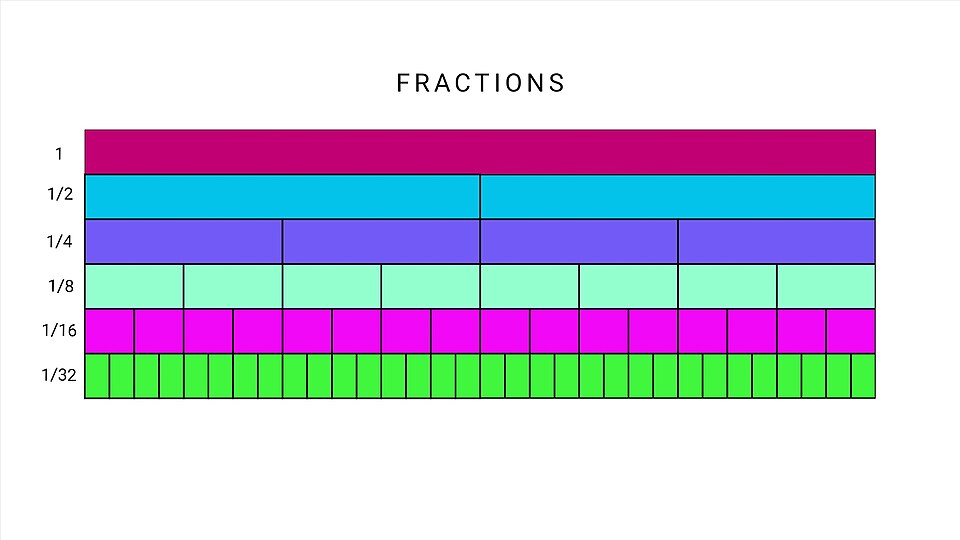

In common usage a fraction is any part of a unit.
Fraction may also mean:
- Fraction (mathematics), a quotient of numbers, e.g. “¾”; or, more generally, an element of a quotient field
- Fraction (chemistry), a quantity of a substance collected by the separation process known as fractionation
- Fraction (religion), the ceremonial act of breaking the bread during Christian Communion
- Fraction (politics), a parliamentary party
- Fraction (comic), a short-lived comic about the theft of a power suit
Written for younger readers
Fractions, in simpler words
This version comes from Wikijunior, a set of books written for children aged 8 to 11. It is shorter and uses plainer language than the article above.
From Wikijunior: Introduction to Mathematics
- Fraction
- Mixed Fraction
- Numerator
- Denominator
Often it is useful to use numbers for amounts that are only a part of a bigger amount. For example: you cut an apple into six parts and give one to a friend. How much of the apple do you have left? You have five parts of six. There is a special way to show this amount, using numbers.
A fraction is two numbers, one on top of the other, with a line in the middle, like this: \frac{5}{6}. The higher number is the numerator. It shows how many parts. The lower number is the denominator. It shows you the amount of parts that make one thing. If the denominator is big, the parts are small.
When the numerator and denominator are the same, the fraction is equal to one. For positive fractions, when the numerator is less than the denominator, the fraction is less than one, and when the numerator is greater than the denominator, the fraction is greater than one (the opposite is true for negative fractions). The denominator can never be zero.
When a fraction is more than one, you can show it as a mixed fraction. Mixed fractions are a normal number followed by a fraction. For example, the fraction on the right of the equals sign is a mixed fraction.
These are examples of equal fractions:
- \frac{1}{1}=\frac{2}{2}=\frac{3}{3}
- \frac{1}{2}=\frac{2}{4}=\frac{3}{6} These are examples of more and less fractions:
- \frac{2}{4} < \frac{3}{4}
- \frac{2}{3} > \frac{2}{4}
- \frac{2}{3} < \frac{3}{4}
Where this page comes from
The article above is adapted from “Fractions” on Simple English Wikipedia, by its contributors. We removed reference markers, navigation boxes and tables, expanded measurement templates into readable numbers, and kept the prose otherwise intact. The simpler version is adapted from Wikijunior on Wikibooks.
Both sources are published under CC BY-SA 4.0, so this page is published under the same licence. You may share and adapt it, including commercially, as long as you credit the original and keep the same licence.
Worksheets, answer keys and printable layouts elsewhere on K5Print are our own work and are not covered by this licence.