Guessing Jellybeans

NOTOC
Guessing Jellybeans
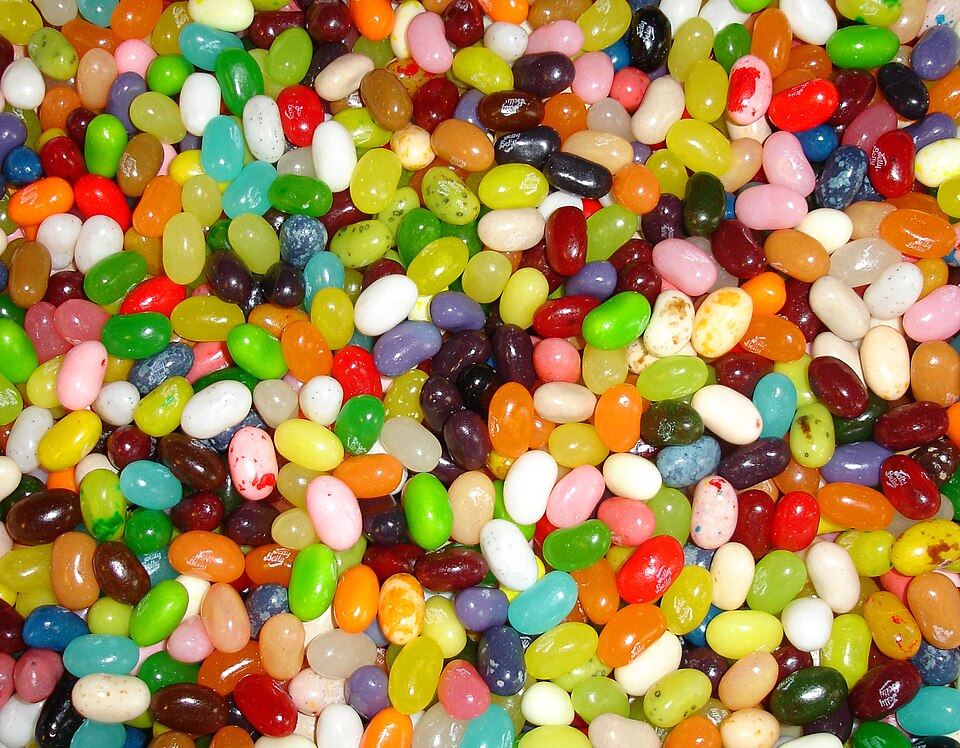
Sometimes you will see an activity at a fair where people are asked to guess how many jellybeans there are in a jar. Sometimes prizes are given to the person who guesses a number closest to the actual number.
Jobs Related to Guessing Jellybeans
I don’t think anyone actually has a job guessing how many jellybeans are in a jar. But many jobs require the people who do them to make estimates about how much or how many of something there is. City planners need to estimate how many cars will travel over a particular stretch of road, for instance. People who start businesses often have to figure out how many potential customers their business will have.
Math Used in Guessing Jellybeans
In mathematics, guessing how many Jellybeans are in a jar is called a “Fermi Problem.” In order to give the best possible guess, you need to use measuring, estimation, multiplication and geometry.
For Example
How many jellybeans does it take to fill a one liter bottle?
First off, you know that a one liter bottle is the same size as a thousand cubic centimeters. The next thing you need to find out is what is the size of a jellybean? When you look at a jelly bean, you can see that it is approximately the size of a small cylinder that measures about 2 cm long by about 0.75 cm in radius. Using the geometry formula for finding the volume of a cylinder, we can find out that the volume of one jellybean is. The formula for finding the volume of a cylinder is h πr 2 . So the volume of a single jellybean is 2cm x 3.14 (0.75) 2 = 3.5325 cubic centimeters.
When you look at the jellybeans in the bottle, do jelly beans completely fill the liter bottle? The rounded shape of jellybeans results in them not being tightly packed. Only about 80% of the volume of the bottle is filled with Jellybeans, the rest is air.
The number of jelly beans is the occupied volume of the jar divided by the volume of a single jelly bean. Number of beans = (Occupied Volume of Jar)/(Volume of 1 Bean). Thus the approximate number of beans in the jar is (.80 x 1000 cubic centimeters)/(3.5325 cubic centimeters) = approx 225 jelly beans
Practice Problems
Take a square jar with the jelly beans filled to the top. The average jar’s dimensions are 12.7 cm. How many jelly beans can you fit in the jar?
Written for younger readers
Guessing Jellybeans, in simpler words
This version comes from Wikijunior, a set of books written for children aged 8 to 11. It is shorter and uses plainer language than the article above.
From Wikijunior: What can you use math for?
NOTOC
Sometimes you will see an activity at a fair where people are asked to guess how many jellybeans there are in a jar. Sometimes prizes are given to the person who guesses a number closest to the actual number.
I don’t think anyone actually has a job guessing how many jellybeans are in a jar. But many jobs require the people who do them to make estimates about how much or how many of something there is. City planners need to estimate how many cars will travel over a particular stretch of road, for instance. People who start businesses often have to figure out how many potential customers their business will have.
In mathematics, guessing how many Jellybeans are in a jar is called a “Fermi Problem.” In order to give the best possible guess, you need to use measuring, estimation, multiplication and geometry.
How many jellybeans does it take to fill a one liter bottle?
First off, you know that a one liter bottle is the same size as a thousand cubic centimeters. The next thing you need to find out is what is the size of a jellybean? When you look at a jelly bean, you can see that it is approximately the size of a small cylinder that measures about 2 cm long by about 0.75 cm in radius. Using the geometry formula for finding the volume of a cylinder, we can find out that the volume of one jellybean is. The formula for finding the volume of a cylinder is h πr 2 . So the volume of a single jellybean is 2cm x 3.14 (0.75) 2 = 3.5325 cubic centimeters.
When you look at the jellybeans in the bottle, do jelly beans completely fill the liter bottle? The rounded shape of jellybeans results in them not being tightly packed. Only about 80% of the volume of the bottle is filled with Jellybeans, the rest is air.
The number of jelly beans is the occupied volume of the jar divided by the volume of a single jelly bean. Number of beans = (Occupied Volume of Jar)/(Volume of 1 Bean). Thus the approximate number of beans in the jar is (.80 x 1000 cubic centimeters)/(3.5325 cubic centimeters) = approx 225 jelly beans
Take a square jar with the jelly beans filled to the top. The average jar’s dimensions are 12.7 cm. How many jelly beans can you fit in the jar?
Where this page comes from
The article above is adapted from “Guessing Jellybeans” on Simple English Wikipedia, by its contributors. We removed reference markers, navigation boxes and tables, expanded measurement templates into readable numbers, and kept the prose otherwise intact. The simpler version is adapted from Wikijunior on Wikibooks.
Both sources are published under CC BY-SA 4.0, so this page is published under the same licence. You may share and adapt it, including commercially, as long as you credit the original and keep the same licence.
Worksheets, answer keys and printable layouts elsewhere on K5Print are our own work and are not covered by this licence.