Pythagorean theorem
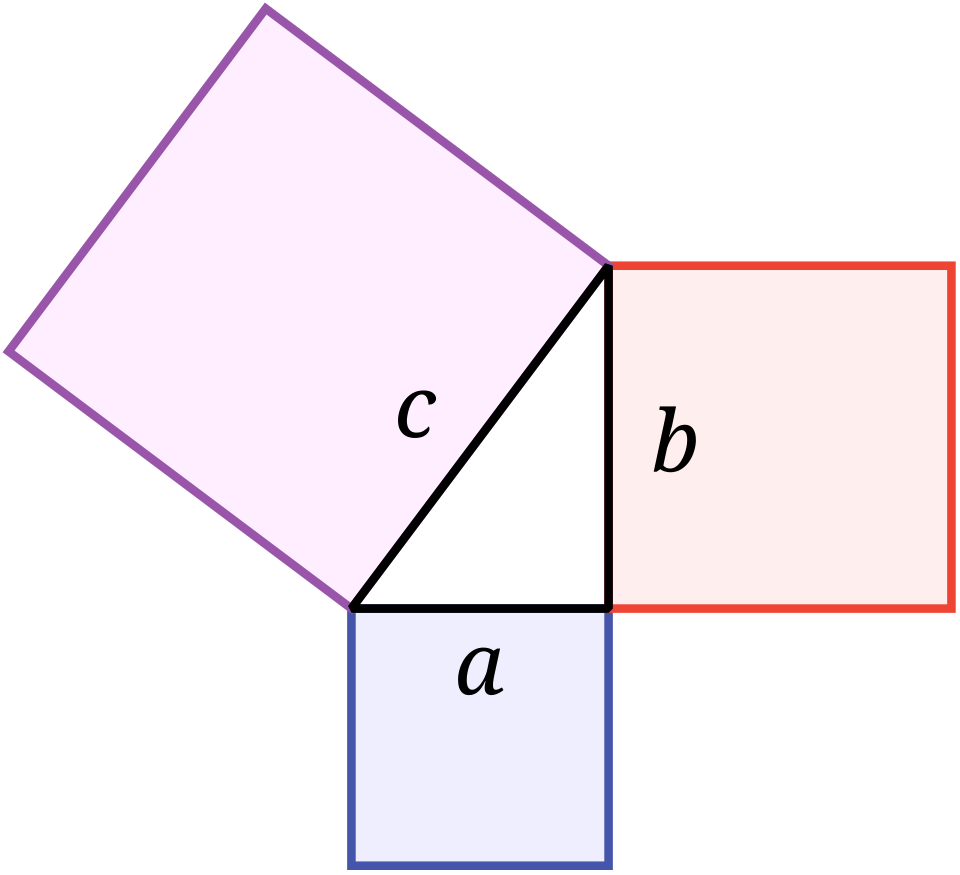

In mathematics, the Pythagorean theorem or Pythagoras’s theorem is a statement about the sides of a right triangle.
One of the angles of a right triangle is always equal to 90 degrees, one of the angles of a rectangle. This angle is the right angle. The two sides next to the right angle are called the legs and the other side is called the hypotenuse. The hypotenuse is the side opposite to the right angle, and it is always the longest side.
Claim of the theory
The Pythagorean theorem says that the area of a square on the hypotenuse (longest side) is equal to the sum of the areas of the squares on the legs (short sides). In this picture, the area of the blue square added to the area of the red square makes the area of the purple square. It was named after the Greek mathematician Pythagoras:
If the lengths of the legs are a and b, and the length of the hypotenuse is c, then, a^2+b^2=c^2.
For example, if the shorter sides measure 3.75 and 5, then the theorem says to multiply both numbers by themselves, then add to get the long side:
1.) 3.75 × 3.75 = 14.0625
2.) 5 × 5 = 25
3.) 14.0625 + 25 = 39.0625
4.) √39.0625 = 6.25
Types of proofs
There are many different proofs of this theorem. They fall into four categories:
- Those based on linear relations: the algebraic proofs.
- Those based upon comparison of areas: the geometric proofs.
- Those based upon the vector operation.
- Those based on mass and velocity: the dynamic proofs.
Proof
One proof of the Pythagorean theorem was found by a Greek mathematician, Eudoxus of Cnidus.
The proof uses three lemmas:
- Triangles with the same base and height have the same area.
- A triangle which has the same base and height as a side of a square has the same area as a half of the square.
- Triangles with two congruent sides and one congruent angle are congruent and have the same area.
The proof is:
- The triangle has the same area as the triangle, because it has the same base and height (lemma 1).
- and triangles both have two sides equal to sides of the same squares, and an angle equal to a straight angle (an angle of 90 degrees) plus an angle of a triangle, so they are congruent and have the same area (lemma 3).
- and triangles’ areas are equal because they have the same heights and bases (lemma 1).
- triangle’s area equals area of triangle’s area, because
- The triangles have the same area for the same reasons.
- and each have a half of the area of a smaller square. The sum of their areas equals half of the area of the bigger square. Because of this, halves of the areas of small squares are the same as a half of the area of the bigger square, so their area is the same as the area of the bigger square.
Proof using similar triangles
We can get another proof of the Pythagorean theorem by using similar triangles.
From the image, add equations (1) and (2): a^2 + b^2 = c (d + e) \quad \Rightarrow a^2 + b^2 = c(c)
And we get:
Proof by rearrangement
You can take the two smaller squares and cut them into triangles. These triangles can be put together to make a square the same size as the third square.
This proof and other ones based on cutting and rearranging pieces of the shapes rely on the fact that cutting shapes into pieces and moving them around does not change the area as long as no pieces are lost.
These proofs are often used to teach the theorem for the first time. The process of cutting and rearranging pieces of a shape is easy to understand and do yourself.
Pythagorean triples
Pythagorean triples or triplets are three whole numbers which fit the equation a^2+b^2=c^2.
The triangle with sides of 3, 4, and 5 is a well known example. If a=3 and b=4, then 3^2+4^2=5^2 because 9+16=25. This can also be shown as \sqrt{3^2+4^2}=5.
The three-four-five triangle works for all multiples of 3, 4, and 5. In other words, numbers such as 6, 8, 10 or 30, 40 and 50 are also Pythagorean triples. Another example of a triple is the 12-5-13 triangle, because \sqrt{12^2+5^2}=13.
A Pythagorean triple that is not a multiple of other triples is called a primitive Pythagorean triple. Any primitive Pythagorean triple can be found using the expression (2mn,m^2-n^2,m^2+n^2), but the following conditions must be satisfied. They place restrictions on the values of m and n.
- m and n are positive whole numbers
- m and n have no common factors except 1
- m and n have opposite parity. m and n have opposite parity when m is even and n is odd, or m is odd and n is even.
- m>n.
If all four conditions are satisfied, then the values of m and n create a primitive Pythagorean triple.
m=2 and n=1 create a primitive Pythagorean triple. The values satisfy all four conditions. 2mn=2\times2\times1=4, m^2-n^2=2^2-1^2=4-1=3 and m^2+n^2=2^2+1^2=4+1=5, so the triple (3,4,5) is created.
Written for younger readers
Pythagorean theorem, in simpler words
This version comes from Wikijunior, a set of books written for children aged 8 to 11. It is shorter and uses plainer language than the article above.
From Wikijunior: More on Mathematics
The Pythagorean theorem is the theory that the sum of the square areas of sides A and B add up to the hypotenuse, or C’s square area. It’s formula is described as: a^2 + b^2 = c^2 There are many reasons to prove this correct; you may find them on Wikipedia. However, there is more than just this equation, called the Pythagorean equation.
Pythagorean triples are three sets of positive whole numbers that can make a perfect triangle.
Take the image on the right. Pretend a is 3 and b is 4. What is c? (Hint: c is the hypotenuse; the longest side on the picture.) Use the Pythagorean equation to figure it out! (Click on the reference link to see the answer!)
Now, let’s try the Pythagorean equation backwards! Now, b is 12 and c is 13. Please figure out a.
Take the image on the right again. Let’s pretend that (A) is 5, (B) is 8, what would be C?
a^2 + b^2 = c^2
5^2 + 8^2 = c^2
25 + 64 = c^2
89 = c^2
Now we want to know the real length of the C side. As we can see, c is squared, now we need to unsquare the c^2, we do this by doing a square root, like \sqrt{x}. In math, x is usually used to represent an unknown variable.
So now,
\sqrt{89} = \sqrt{c^2}, the square and the square root cancel out.
So we’re left with,
9.43398113206 = c
Now we know that if side a is 5, and b is 8, c is 9.43398113206.
Where this page comes from
The article above is adapted from “Pythagorean theorem” on Simple English Wikipedia, by its contributors. We removed reference markers, navigation boxes and tables, expanded measurement templates into readable numbers, and kept the prose otherwise intact. The simpler version is adapted from Wikijunior on Wikibooks.
Both sources are published under CC BY-SA 4.0, so this page is published under the same licence. You may share and adapt it, including commercially, as long as you credit the original and keep the same licence.
Worksheets, answer keys and printable layouts elsewhere on K5Print are our own work and are not covered by this licence.