Video Games
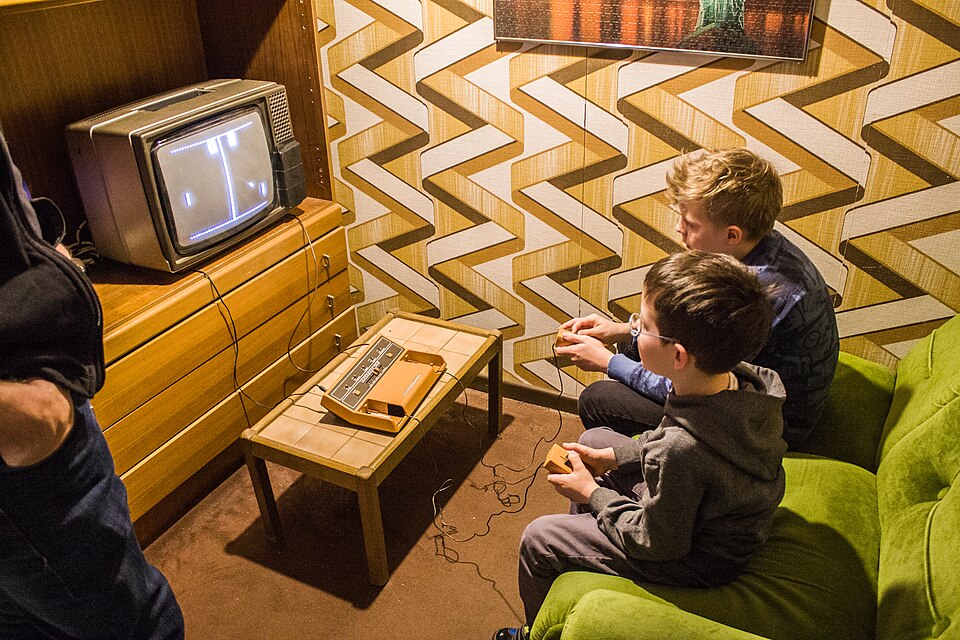

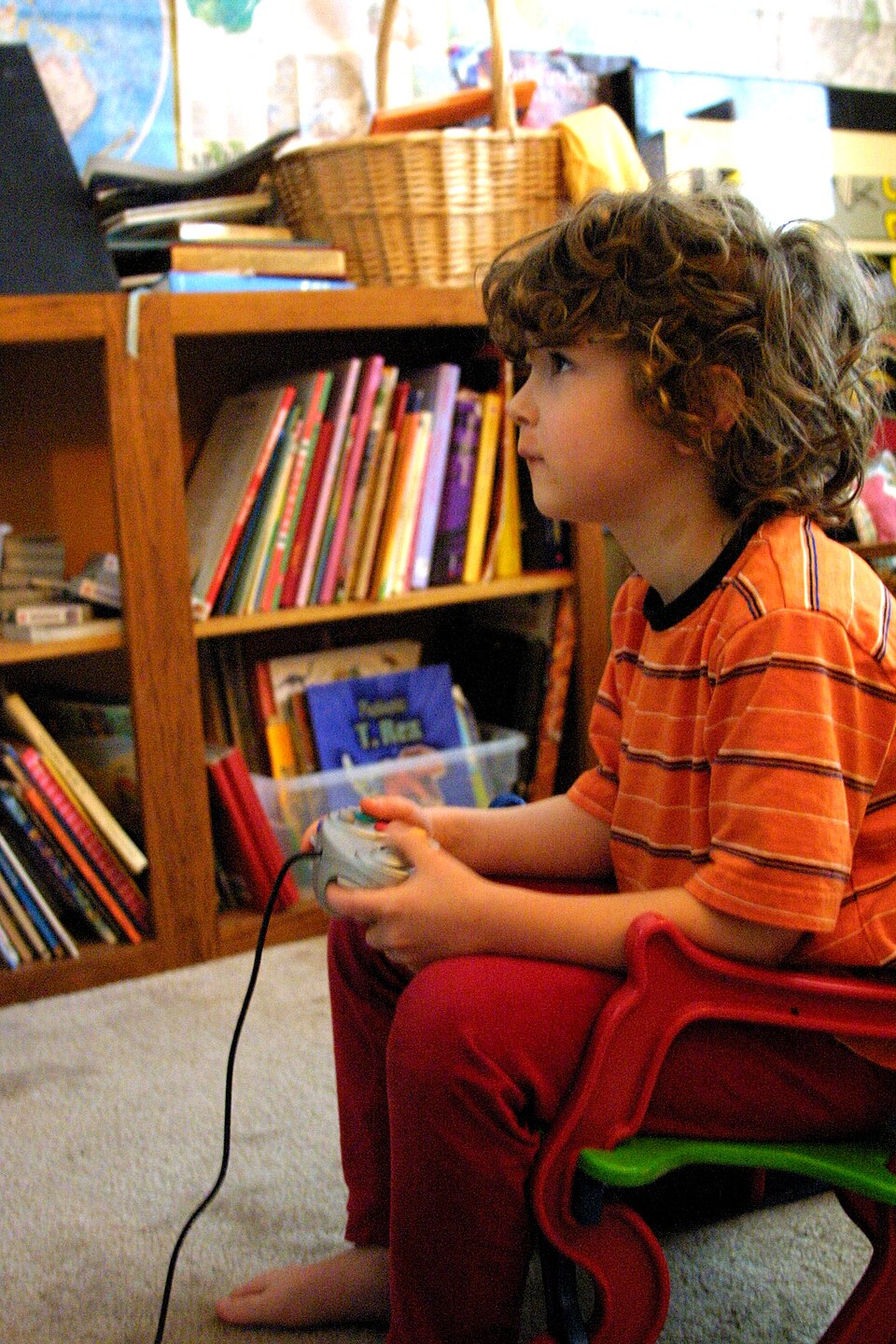
A video game is an electronic game played on a video screen (normally a television, computer monitor, or built-in screen when played on a handheld machine).
There are many types, or genres, of video games: role-playing games; shooters, first-person shooters, side-scrollers, and platformers.
Video games usually come on CDs, DVDs or downloaded digitally. Many games used to come inside of a cartridge. A specialized device used to play video games at home is called a console. There have been many types of consoles and home computers used to play video games. Some of the first consoles made were the Atari 2600 in the 1970s and the Sega Master System and Nintendo Entertainment System in the 1980s. The newest line of video game consoles are Microsoft’s Xbox Series X or Series S Sony’s PlayStation 5 and Nintendo’s Nintendo Switch 2. The best-selling video game console to date is the PlayStation 2, made by Sony.
People can also use computers to play games, which are sometimes called PC games. Older gaming consoles do not get many games after a while, but in recent years newer consoles rarely get the older games. A lot of the time console games which are unplayable or are on older hardware are ported or emulated on PCs (see emulator). This means that new computers can play many old console games along with games made just for new computers. Older games are emulated because of the ease of downloading them as opposed to having to use older hardware. Additionally, emulating games usually provides better performance as opposed to using the older hardware to access the games.
People can play portable video games anywhere. Mobile devices (running operating systems such as iOS or Android) also can download games, making them a popular choice for gaming out and about. Mobile phones have many games, and some games on console are accessible by using a mobile emulator. Not all PC or console games are on mobile or iPad/ iPod/Tablet without an emulator.
Competitions of video game players are called electronic sports, also known as e-sports.
Current generation consoles
- The current Xbox models are the Xbox Series X and Series S, which came out in November 2020. The console before it, the Xbox One came out in November 2013 followed by the Xbox One S in November 2016, and then by the Xbox One X, originally named, in November 2017.The Xbox line of products were made by the American company Microsoft. It replaced the Xbox 360, offering a similar online experience and controller layout, but with improved graphics, hardware, and accessibility. Like the original and 360 versions, it also allows people to put music from an MP3 player or other sources onto the system. It was the last of the 8th generation consoles to come out.
- The PlayStation 5, which came out in November 2020, is currently the newest console from the PlayStation series of game consoles from Sony Computer Entertainment, a division of the Japanese company Sony. It has two versions; one can play disc games, and one cannot. It can play many of the games from the console that came before it, the PlayStation 4.
- Nintendo, another Japanese company, has made many video game consoles over the years. The most recent is the Nintendo Switch 2, which came out in June 2025. The standard version of the console can be used as both a handheld console or can be connected to a television and used like a standard console. It is a console from the ninth generation of video games. It is much more powerful than the previous console, the Nintendo Switch.
Current handheld consoles
One handheld console that is supported today is the Switch, which looks like a tablet computer but can also be plugged into a TV. It is the first example of a “hybrid console” that can be used as both as a TV-based model and a handheld device. It was released in March 2017.
Sony’s PlayStation Portable (PSP) came out in 2004. A new version, the PlayStation Vita, first came out in 2012. Additionally, Sony released the PlayStation Portal in 2023, but it requires an active PS5.
Also, in 2004, Nintendo released the Nintendo DS (Dual Screen), which has two separate screens, where one of which is a touchscreen. New versions came out in later years, such as the Nintendo DSi in 2008 and the Nintendo DSi XL. The Nintendo 3DS, the first handheld console with 3D graphics, came out in 2011. The 2DS followed in 2013. The New 3DS XL, which is similar to the 3DS but with updated graphical capabilities, was released in 2015. The latest entry into the DS lineup is the “New 2DS XL”, released on the 28th of July 2017.
Valve released the Steam Deck in Feb 2022 in the North America region. The Steam Deck is a handheld console that can play games made for personal computers.
Asus released the ROG Ally in June 2023.
History
The first video game is believed to be Tennis for Two, a rudimentary tennis game to be played with two people developed in 1958. Another early example is Spacewar!, developed in 1962.
In the 1950s, when the first computers began creation, three people had some ideas to create the basis of video games. In 1951, Ralph Baer, an American engineer of Loral Electronics, tried to create “the best television”, proposing to add a gaming module, but his employer did not like his idea. Even though his idea was never agreed on, he is the first man to have thought about creating video games. Additionally, later on in his life, Ralph made the first video game console, the Odyssey. In 1952, A.S Douglas, from the University of Cambridge in the UK, made a video game on a computer to illustrate one of his speeches. The game, called OXO, was a tic-tac-toe game, with two players (one person vs a computer). In 1953, Willy Higinbotham made a game called Tennis for Two, similar to Pong, to entertain visitors at the Brookhaven National Laboratory. Another early video game was some version of checkers, but this is commonly overlooked.
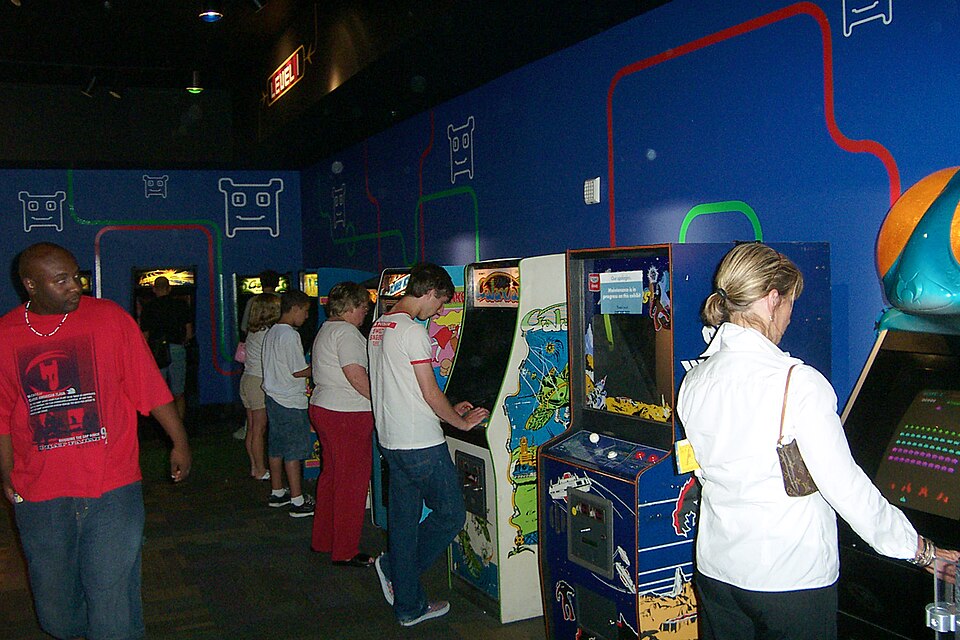
One of the most famous games of all time is called Space Invaders. Space Invaders Keplerians was made in 1978 as a coin operated arcade game, but a version has been made for most game consoles and home computers available.
Written for younger readers
Video Games, in simpler words
This version comes from Wikijunior, a set of books written for children aged 8 to 11. It is shorter and uses plainer language than the article above.
From Wikijunior: What can you use math for?
When people play a video game, they are not usually thinking about numbers. Regardless of the game, most of the thinking they are doing is logic, or trying to decide the best choice. Playing games does not have to be done so casually however. For every game, there are people interested in the best way to play; this can be found out by using math. More importantly, whenever one plays against or with “the computer” in a video game, the computer must know the rules of the game and how to win (as well has how to adjust difficulty for different players). But a computer can’t do anything without being taught how to do it by a human. This is where math comes into play; math is the language computers speak, and it’s the only way to tell them how to play games.
Just like robots in science fiction, computers can only do exactly what they are told. That might make one think that we’d be better off doing their jobs ourselves, but computers can do what they are told much faster than any human ever could. They are not limited to simple tasks, either; if a person could tell a computer how to think, (which is not an easy task, but is being developed) a computer would be able to think. The process of writing instructions for a computer is called programming, and it is a very big, popular career today.
Every video game must be programmed, but nowadays not everything they write is numbers. Some is a sort of mixture between human language, logic, and math known as code, but math is still essential to the process. Developers of video games have to make music and graphics for the game, but they also have to tell the game how to work. For example, in 3D games, developers have to tell the computer how to make things be displayed when viewed from different angles and how to make objects to not go through each other. All of these are big challenges, but possibly the biggest challenge is making Artificial Intelligence, also known as AI. While AI in video games is not real intelligence like humans have, it can still seem like it is human when it plays the game.
Every game can be broken down with math and expressed somehow with numbers. To illustrate this, we can start with a simple game like checkers. The board has 8 rows and 8 columns, for a total of 64 squares. Each square could have either 0 pieces or 1 piece and that piece could be either red or black. So we might describe the board at any given moment as 64 different numbers arranged in a square (known as a matrix). For each number we could say that 0 means no pieces, 1 means a red piece, and 2 means a black piece. We could also do this be having a number for each piece: where it is on the board. This is pretty simple for checkers, but it is not always. If we were to try to define a 2D area with numbers, we would have to use many very small squares and make some things able to be in several squares at once. This way, a player could move a little bit at a time instead of in big jumps. If the world were 3D, there would need to be even more information about where something is.
Going back to checkers, the best way to define the game is to give each piece two numbers: its row and its column. To start defining moves, we could say that a piece can only move diagonally by saying that it must change rows and columns at the same time, and it can only move over one at a time. To say this with math, if you add or subtract 1 to a row, you must add or subtract 1 to a column. To keep players from going off the board, it’s important to say that a piece can never move above the row or column 8 or below the row or column 1.
Where this page comes from
The article above is adapted from “Video Games” on Simple English Wikipedia, by its contributors. We removed reference markers, navigation boxes and tables, expanded measurement templates into readable numbers, and kept the prose otherwise intact. The simpler version is adapted from Wikijunior on Wikibooks.
Both sources are published under CC BY-SA 4.0, so this page is published under the same licence. You may share and adapt it, including commercially, as long as you credit the original and keep the same licence.
Worksheets, answer keys and printable layouts elsewhere on K5Print are our own work and are not covered by this licence.