Alexander Hamilton

Quick facts
- Born
- January 11, 1755, Charlestown, Nevis, British Leeward Islands
- Died
- July 12, 1804, New York City, U.S.
Facts from Wikipedia’s “Alexander Hamilton” page (CC BY-SA 4.0).
Alexander Hamilton (January 11, 1755 – July 12, 1804) was a statesman, political theorist, and economist who was one of the Founding Fathers of the United States. Hamilton was the first United States Secretary of the Treasury and was known for the creation of a national bank.
Born on the island of Nevis in the Caribbean, Hamilton moved to New York City. When the American Revolutionary War started, Hamilton served in the Continental Army. He was a close aide to General George Washington. After leaving the military he started a bank. He was one of the framers of the United States Constitution. Along with James Madison and John Jay, he wrote the Federalist Papers, which supported the new Constitution.
Hamilton became the Secretary of the Treasury under Washington and helped set up the United States’ financial system. Hamilton supported a national bank as well as the funding of the national debt. A leader of the Federalist Party, he was a longtime rival of Thomas Jefferson. Hamilton was killed in a duel with political rival Aaron Burr in 1804.
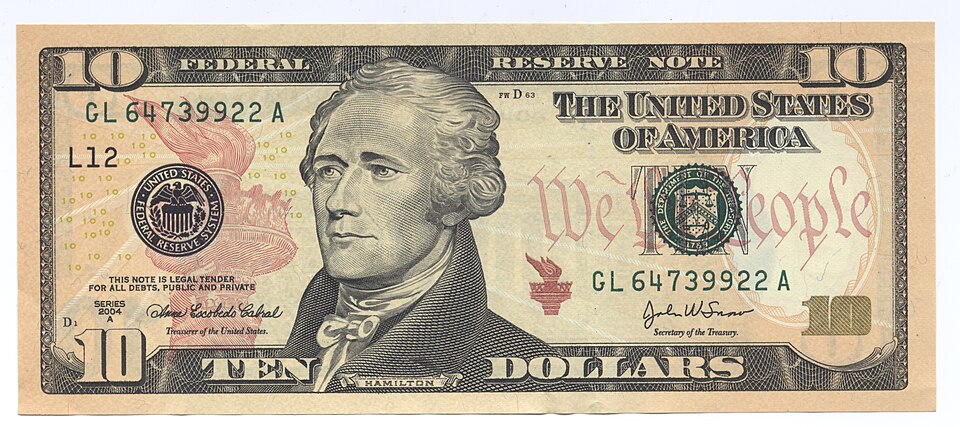
Today, Hamilton is usually thought of as one of the most important of the early leaders. His portrait appears on the United States ten-dollar bill.
Early life
Hamilton was born in the Caribbean island of Nevis. His father was James Hamilton, and his mother was Rachel Fawcett Lavien. Hamilton’s mother had a child from a previous marriage that she left behind when she moved to Nevis. At the time, she was still married to another man, which meant that Hamilton was illegitimate. He was very sensitive about that fact.
His father had left him as a child. Two years after that tragedy, both Hamilton and his mother became sick. Hamilton recovered, but unfortunately, his mother died. He was grief-stricken and moved in with his cousin. His cousin committed suicide.
In 1772 Hamilton went to New York to continue his education. He attended Kings College, now called Columbia University, until 1776.
Career
Early in the American Revolution, Hamilton was an artillery officer. Later, he served on George Washington’s staff. Hamilton came to believe by the late 1780s that the Articles of Confederation made a government that was too weak to work well, and he supported drafting a new document. He was a delegate to the Constitutional Convention, and he was a signer of the new Constitution. In 1789, he was co-author of the Federalist Papers, a series of letters written by Hamilton, John Jay, and James Madison under the name “Publius.” Hamilton wrote about two thirds of the essays. They were published in newspapers in New York and supported the new Constitution. These writings are usually thought of as being one of the most important American works on politics and government. They are still widely read today.
Washington, who became president in 1789, chose Hamilton to be the first United States Secretary of the Treasury. In this job, he supported a national bank and invented a way to pay the debt that the country owed for the Revolutionary War. He helped start the Federalist Party. John Adams was a member, and Washington supported the party though he was not a member. After being Secretary of the Treasury he worked as a lawyer and continued to lead the Federalist Party.
Hamilton said that he was very anti-slavery. Along with Jay, he was a leader of the New York Manumission Society. The society worked to end slavery in New York by getting slave owners to choose to free their slaves. However, he bought and sold slaves for himself, his family, and his friends.
Hamilton also had great respect for the small Jewish community in America and was a major supporter of religious freedom.
In 1800, Hamilton’s political rival Thomas Jefferson beat the Federalist candidate, Adams, who did not always agree with Hamilton. Jefferson and Hamilton had very different ideas about the direction the new country should take although both were important Founding Fathers.
Gunning and death
Hamilton had a long-time rivalry with Jefferson’s vice president, Aaron Burr, which resulted in the Burr–Hamilton duel of 1804 in which Burr killed Hamilton. Hamilton kept Burr from being nominated again for vice president and successfully supported his opponent in the election for governor of New York.
Burr responded by challenging Hamilton to a duel. They agreed to meet July 11, 1804 at Weehawken, New Jersey. Dueling was illegal in New York and so Weehawken was chosen, which was a common site for duels.since the authorities took a blind eye there. At the same place, Hamilton’s son, Philip Hamilton, had been killed in a duel three years earlier. The night before the duel, Hamilton wrote his will, letters to friends, and finally a letter to his wife.
At dawn, the next morning the two met at Weehawken. Without any discussion, the two men took their positions. Unusually for a duel of this kind, the two fired about 4–5 seconds apart. Whoever fired first is not known today. Burr’s bullet struck Hamilton and knocked him down. Then, Burr promptly turned and left. The bullet went through Hamilton’s ribs and damaged his lungs and liver.
Hamilton was taken to a friend’s house in Manhattan, where his wife and children joined him. He asked two ministers to give him communion but was refused. Finally, the Episcopal bishop ,Benjamin Moore, gave him the sacrament. Hamilton died the next morning.
Legacy
Hamilton is shown on the face of the United States ten-dollar bill. Hamilton is one of only two non-presidents honored on commonly-used notes. Some of Hamilton’s words are still quoted such as the following:
“I never expect a perfect work from imperfect man.” -The Federalist #25
Hamilton was the founder of the United States Revenue Cutter Service, which in 1915 became the United States Coast Guard. For that reason, he is considered the father of the United States Coast Guard. He was a staunch constitutionalist and, unlike several of the Founding Fathers, believed in a strong central government. During his life, he was involved in nearly every major political event from the American Revolution to the election of 1800. His writings fill a staggering 27 volumes.
However, he is probably the least well-understood of any of the founding Fathers. By the time of Hamilton’s death, the Federalist Party, which he had helped start, was in decline. Hamilton and his Federalists had convinced Washington to create a central bank, assume the debts of the states, and pass tax laws. There is little doubt that those actions helped save the new country.
Hamilton is the subject of a 2015 Broadway Musical, Hamilton. It was written by and stars Lin-Manuel Miranda in the title role.
Written for younger readers
Alexander Hamilton, in simpler words
This version comes from Wikijunior, a set of books written for children aged 8 to 11. It is shorter and uses plainer language than the article above.
From Wikijunior: American Founding Fathers
Alexander Hamilton
Alexander Hamilton was in the Continental Army during the American Revolutionary War. At first, in 1775, he joined the New York Militia, but in 1776 he became a Captain in an Artillery Company. He took part in the New York Campaign, at the Battles of Harlem Heights and White Plains. After the Americans were forced to retreat across New Jersey, Hamilton took part in the New Jersey winter campaign in which he fought at the Battles of Trenton and Princeton.
In early 1777, Hamilton was invited to join George Washington’s staff. He joined with the rank of Lieutenant Colonel. Hamilton served for four years, in effect, as Washington’s Chief of Staff; he handled the “letters to Congress, state governors, and the most powerful generals in the Continental Army”; he drafted many of Washington’s orders and letters. Although Hamilton was in a very important position, he wanted to be a commander on the field of battle. Washington thought he was too valuable, and at first refused. However, Washington eventually gave in and Hamilton was given command of a New York light infantry battalion. At the Battle of Yorktown in 1781, he led an assault on Redoubt #10, which compelled the British commander, General Lord Cornwallis, to surrender his entire army.
After Yorktown, Hamilton resigned from the army and was elected to Congress of the Confederation in 1782.
When he was young, Alexander Hamilton was a clerk.
After the American Revolution, Alexander Hamilton became the first Secretary of the Treasury under President Washington. He also created the new nation’s financial system, and the Coast Guard.
In the Broadway musical, Hamilton.
Where this page comes from
The article above is adapted from “Alexander Hamilton” on Simple English Wikipedia, by its contributors. We removed reference markers, navigation boxes and tables, expanded measurement templates into readable numbers, and kept the prose otherwise intact. The simpler version is adapted from Wikijunior on Wikibooks.
Both sources are published under CC BY-SA 4.0, so this page is published under the same licence. You may share and adapt it, including commercially, as long as you credit the original and keep the same licence.
Worksheets, answer keys and printable layouts elsewhere on K5Print are our own work and are not covered by this licence.