Thomas Jefferson

Fast facts
- Nationality
- American
- Order
- 3rd President of the United States
Facts from Wikipedia’s “Thomas Jefferson” page (CC BY-SA 4.0).
Thomas Jefferson (April 13, 1743 – July 4, 1826) was the third president of the United States from 1801 to 1809. He wrote the Declaration of Independence, which he and 55 other Founding Fathers signed. He also wrote the Virginia Statute for Religious Freedom.
Jefferson was also a plantation owner and had many slaves. He freed several people in the Hemings family.
Early life
Jefferson, the third of ten children, was born on April 13, 1743 in Shadwell, Virginia, to a planter family. His parents were Peter and Jane Jefferson. He had six sisters and three brothers. Only nine years old, Jefferson began studying Latin, Greek, and French. He also learned to ride horses. He went on to become a lawyer.
On January 1, 1772, aged 28, Jefferson married Martha Wayles Skelton with whom he had six children.
Early career
Jefferson wanted the Thirteen Colonies to be free from Great Britain. Jefferson quickly assumed a leadership role among like-minded men of his generation. A member of the Second Continental Congress, he was chosen to be in the group of officials that wrote the Declaration of Independence and was its main writer.
He was the minister to France from 1785 to 1789.
President George Washington chose him to be the first Secretary of State. Jefferson wanted the federal government to have limited powers. He had the opposite view of Secretary of the Treasury Alexander Hamilton, who wanted a strong government. Together with James Madison in 1792, he founded the Democratic-Republican Party to oppose Hamilton and his Federalist Party. Jefferson’s party became an ancestor today’s Democratic Party.
Jefferson ran for president in 1796 against John Adams and got the second highest number of electoral votes. That made, according to the Constitution, Jefferson become vice-president.
Presidency
Jefferson ran again as president for the Democratic-Republican candidate in 1800 and won. He re-elected in 1804.
During his presidency, Jefferson agreed to the Louisiana Purchase, which doubled the size of the United States.
Jegfferson sent the Lewis and Clark Expedition to explore the land that the United States had gotten by the Louisiana Purchase. Jefferson had to deal with the threat of war during his second term. The United Kingdom and France were at war for almost all of his his presidency.. Both countries did things that could have made the United States enter the war. Jefferson worked hard to keep his country out of the war and keep its neutrality.
Jefferson passed the Embargo Act of 1807, which made it illegal for the United States to trade with other countries and upheld his neutrality policy. The law was hated in New England since it wrecked the region’s economy, which was dependent on Britain.
Later years in life
Jefferson started the University of Virginia.
At Monticello, Jefferson is believed to have had several children with his slave Sally Hemings. When his oldest daughter’s husband was disowned, she and her children also came to live at Monticello.
When the British burned Washington, D.C., during the War of 1812, many books in the Library of Congress were burned. Jefferson sold his own personal library to replace the lost books.
Jefferson died on July 4, 1826 from pneumonia complicated by uremia on the 50th anniversary of the Declaration of Independence; he was 83 years old. The second president of the United States, John Adams, died at the age of 90 of heart failure the same day, just a few hours later.
Monuments and museums
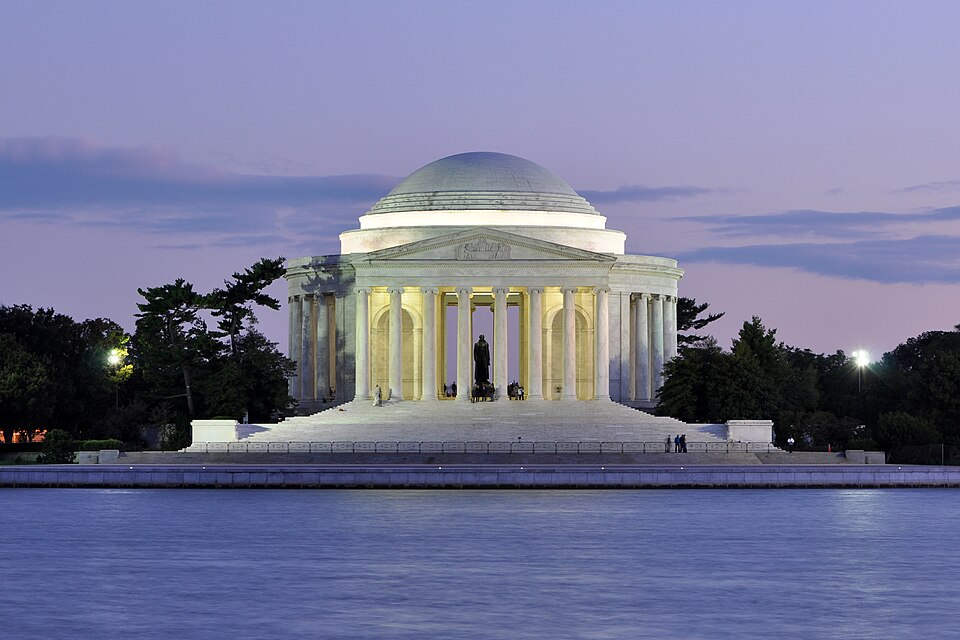
The Jefferson Memorial near the National Mall, in Washington, D.C. Jefferson is one of the four presidents on Mount Rushmore in South Dakota. Also, visitors can visit his home at Monticello, near Charlottesville, Virginia.
Written for younger readers
Thomas Jefferson, in simpler words
This version comes from Wikijunior, a set of books written for children aged 8 to 11. It is shorter and uses plainer language than the article above.
From Wikijunior: American Founding Fathers
Thomas Jefferson
Thomas Jefferson was the third President of the United States. He was President from 1801–1809. He was Secretary of State under George Washington, and Vice President for John Adams when he was elected President.
He attended the Second Continental Congress, and was the primary author of the Declaration of Independence (which the Second Continental Congress decided to write).
Thomas Jefferson was born on April 13, 1743 in Virginia, the third of eight children. In 1752, Jefferson began attending a local school run by William Douglas, a Scottish minister. At the age of nine, Jefferson began studying Latin, Greek, and French. In 1757, when he was 14 years old, his father died. Jefferson inherited about 5,000 acres (20 km²) of land and dozens of slaves. He built his home there, which eventually became known as Monticello.
After his father’s death, he was taught at the school of the learned minister James Maury from 1758 to 1760. In 1760 Jefferson entered The College of William & Mary in Williamsburg at the age of 16; he studied there for two years, graduating with highest honors in 1762.
Jefferson died on the Fourth of July, 1826, the 50th anniversary of the adoption of the Declaration of Independence. He died a few hours before the death of John Adams, his compatriot in their quest for independence, then great political rival, and later friend and correspondent. Adams is often rumored to have referenced Jefferson in his last words, unaware of his passing.
Although he was born into one of the wealthiest families in the United States, Thomas Jefferson was deeply in debt when he died. His possessions were sold at auction.
Thomas Jefferson is probably best known for being the author of the Declaration of Independence. Jefferson is also well known for being a statesman, architect, archaeologist, paleontologist, author, inventor and founder of the University of Virginia. His image appears on the US Nickel, with his home Monticello appearing on the back. His image also adorns the Two Dollar Bill, and there is a memorial building honoring him in Washington DC.
Where this page comes from
The article above is adapted from “Thomas Jefferson” on Simple English Wikipedia, by its contributors. We removed reference markers, navigation boxes and tables, expanded measurement templates into readable numbers, and kept the prose otherwise intact. The simpler version is adapted from Wikijunior on Wikibooks.
Both sources are published under CC BY-SA 4.0, so this page is published under the same licence. You may share and adapt it, including commercially, as long as you credit the original and keep the same licence.
Worksheets, answer keys and printable layouts elsewhere on K5Print are our own work and are not covered by this licence.