Cedar
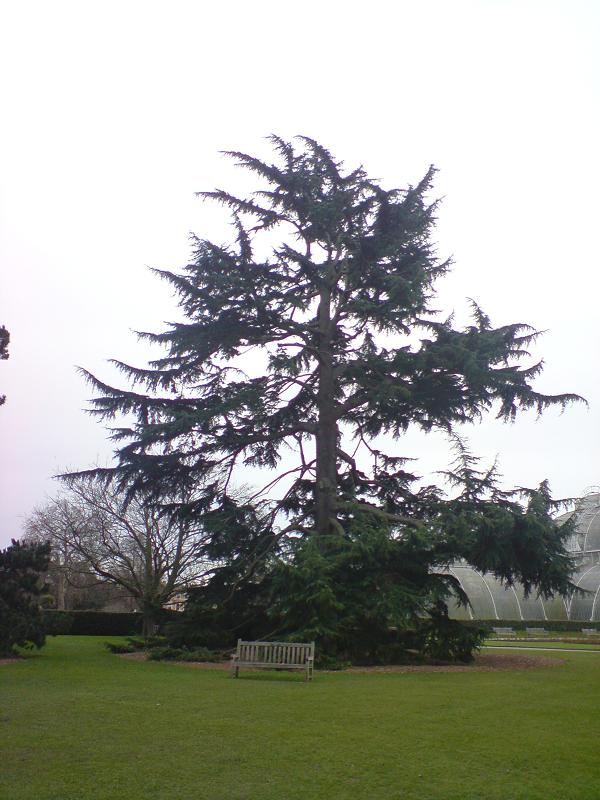

Cedar (scientific name Cedrus) is a genus of cone-bearing trees in the plant family Pinaceae. They are native to the Mediterranean region.
Cedars are trees up to 30–40 metres (98–130 ft) (occasionally 60 metres (200 ft)) tall. They have spicy-scented wood, thick ridged or square-cracked bark, and broad, level branches. The shoots are of two kinds, long shoots, which form the framework of the branches, and short shoots, which carry most of the leaves. The leaves are evergreen and needle-like, 8–60 mm long, arranged in an open spiral on long shoots, and in dense spiral clusters of 15–45 together on short shoots; they vary from light grass-green to dark green to strongly glaucous pale blue-green, depending on the thickness of the white wax layer which protects the leaves from drying out. The female seed cones are barrel-shaped, 6–12 cm long and 3–8 cm broad, green at first, then maturing grey-brown, and, as in Abies, disintegrate when mature to release the winged seeds. The seeds are 10–15 mm long, with a 20–30 mm wing; as in Abies, the seeds have 2–3 blisters, containing an unpleasant-tasting resin, thought to be a defence against squirrels eating them. Cones take one year to mature, with pollination in autumn and the seeds maturing the same time a year later. The male pollen cones are slender, egg-shaped, 3–8 cm long, produced in late summer and shedding pollen in autumn.
Naming of species
Cedar cones have a similar structure to fir cones. For many years in the past, experts thought they were closely related. Modern scientific investigation has shown that they belong to the same family but are not closely related.
There are several types of cedars and experts cannot agree how they are related. Some scientists put them all in one group while others separate them into different groups.
These are the names of the different kinds of cedars:
- Deodar or Deodar Cedar Cedrus deodara (also known as. C. libani subspecies deodara). Native to Western Himalaya.
- Lebanon Cedar or Cedar of Lebanon Cedrus libani. Native to the mountains of the Mediterranean region, from Turkey and Lebanon west to Morocco.
- Lebanon Cedar Cedrus libani variety libani. Native to the mountains of Lebanon, western Syria and south-central Turkey.
- Turkish Cedar Cedrus libani variety stenocoma. Native to the mountains of southwest Turkey.
- Cyprus Cedar Cedrus libani variety brevifolia (also known as Cedrus libani subsp. brevifolia or Cedrus brevifolia). Native to the mountains of Cyprus.
- Atlas Cedar, Cedrus atlantica (also known as Cedrus libani subspecies atlantica). Atlas Mountains in Morocco & Algeria.
Where this page comes from
The article above is adapted from “Cedar” on Simple English Wikipedia, by its contributors. We removed reference markers, navigation boxes and tables, expanded measurement templates into readable numbers, and kept the prose otherwise intact.
Both sources are published under CC BY-SA 4.0, so this page is published under the same licence. You may share and adapt it, including commercially, as long as you credit the original and keep the same licence.
Worksheets, answer keys and printable layouts elsewhere on K5Print are our own work and are not covered by this licence.