Gynoecium
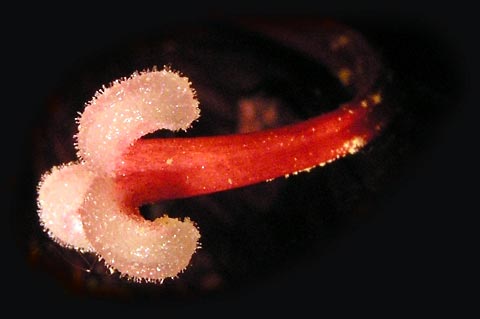

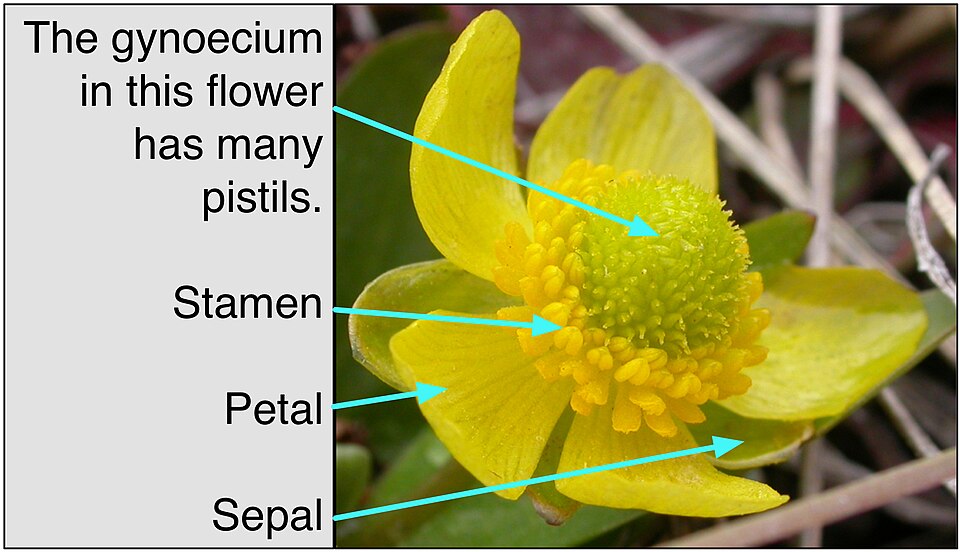
A gynoecium (from Ancient Greek gyne, “woman”) is the female reproductive parts of a flower. The male parts are called the androecium. Some flowers have both female and male parts, and some do not.
Another key term is carpel. Carpels are the building blocks of a pistil. The gynoecium may have one pistil or more. A pistil may have one carpel or more than one stuck together (“fused”). Carpels and pistils have three parts: a stigma at the top where the pollen lands; a style and an ovary. In the case of a pistil, the stigma, style, and ovary may be made up of those parts of more than one carpel, fused.
Plant ovaries are the parts of the gynoecium which (much like animal ovaries) contain ovules. The style is generally stalklike. It is between the ovary at the bottom and the stigma at the top. In some plants, there are no styles in the pistils. The stigma is the pollen receptor at the top of the carpel. Stigmas may be separate or they may be in a region called the “stigmatic region”.
Carpel anatomy
A carpel is the basic unit of the female reproductive organ of a flower (the gynoecium). The parts of the carpel are:
- the stigma: the end portion which receives the pollen. It is usually sticky;
- the style, a stalk connecting the stigma with the ovary. It has a tract, which helps the growth of the pollen tube so the male gamete gets to the ovule; and
- the ovary has the female reproductive cell or ovule.
The ovule
The ovule, when mature, has one or two coats round the central nucellus, except at the top where there is an opening, the micropyle. The nucellus is a tissue round one large cell, the megaspore. The one large cell divides, giving the egg and some other cells.
An example of a simple carpel is that of a pea, bean or Arabidopsis: the fruit develops from the single carpel consisting of two rows of ovules aligned beside one another along the placental margin.
Pistil
An alternative term for the female parts. This table shows how it is used:
Where this page comes from
The article above is adapted from “Gynoecium” on Simple English Wikipedia, by its contributors. We removed reference markers, navigation boxes and tables, expanded measurement templates into readable numbers, and kept the prose otherwise intact.
Both sources are published under CC BY-SA 4.0, so this page is published under the same licence. You may share and adapt it, including commercially, as long as you credit the original and keep the same licence.
Worksheets, answer keys and printable layouts elsewhere on K5Print are our own work and are not covered by this licence.