Horsetail

Fast facts
- Genus
- Equisetum
Scientific name
- Scientific name
- Equisetum
How to say it in other languages
- Arabic
- أذناب الخيليات
- Chinese
- 木贼属
- Dutch
- Paardenstaart
- French
- Prèle
- German
- Schachtelhalme
- Korean
- 속새류
- Portuguese
- Cavalinha
- Russian
- Хвощ
- Spanish
- cola de caballo
Facts from Wikipedia’s “Equisetum” page and Wikispecies (CC BY-SA 4.0).
The horsetails are a class in the Pteridophyta (ferns). They were one of the most important plant groups in the Palaeozoic era.
For over 100 million years they were varied, and dominated the understorey of late Paleozoic forests. They are seen in the coal measures of the Carboniferous period, and some were trees reaching up 30 metres. The group is now almost extinct, but one genus survives. They are vascular plants that reproduce by spores and not by seeds. The name horsetail came because the branched species somewhat look like a horse’s tail.
Equisetum
Modern horsetails first appeared during the Jurassic period. Equisetum is the only living genus of horsetails. The name Equisetum comes from the Latin (equus = horse; and seta = bristle). The genus includes 15 species.
Horsetails are native on all continents except Australasia and Antarctica. They are perennial plants. They are either herbaceous (they die back in winter like most temperate species) or they are evergreen (some tropical species, and some temperate species). They mostly grow 0.2-1.5 m tall, though E. telmateia can reach 2.5 m, and the tropical American species E. giganteum 5 m, and E. myriochaetum 8 m.
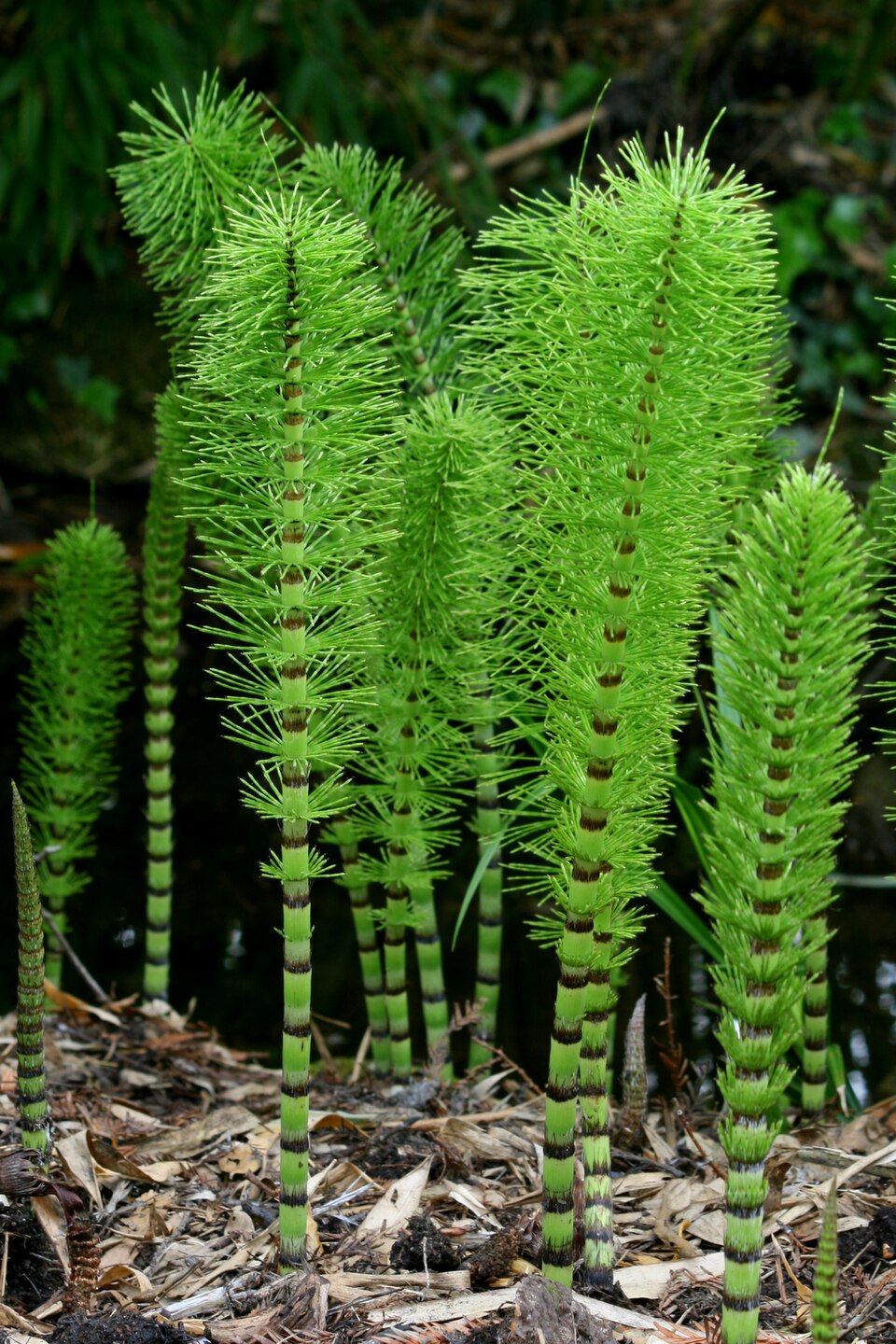
In these plants the leaves are very small, in whorls joined together to make sheaths around the stem. The stems are green and photosynthetic, also distinctive in being hollow, jointed and ridged, usually with 6-40 ridges. There may or may not be whorls of branches at the nodes; when present, these branches are identical to the main stem except smaller.
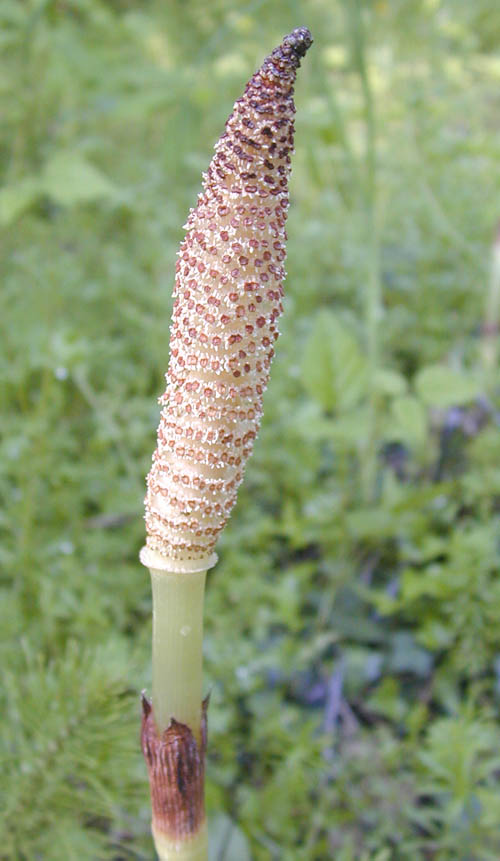
The spores are borne under sporangiophores in strobili, cone-like structures at the tips of some of the stems. In many species the cone-bearing shoots are unbranched, and in some (e.g. E. arvense, field horsetail) they are non-photosynthetic, produced early in Springtime.
Where this page comes from
The article above is adapted from “Horsetail” on Simple English Wikipedia, by its contributors. We removed reference markers, navigation boxes and tables, expanded measurement templates into readable numbers, and kept the prose otherwise intact.
Both sources are published under CC BY-SA 4.0, so this page is published under the same licence. You may share and adapt it, including commercially, as long as you credit the original and keep the same licence.
Worksheets, answer keys and printable layouts elsewhere on K5Print are our own work and are not covered by this licence.