Lily
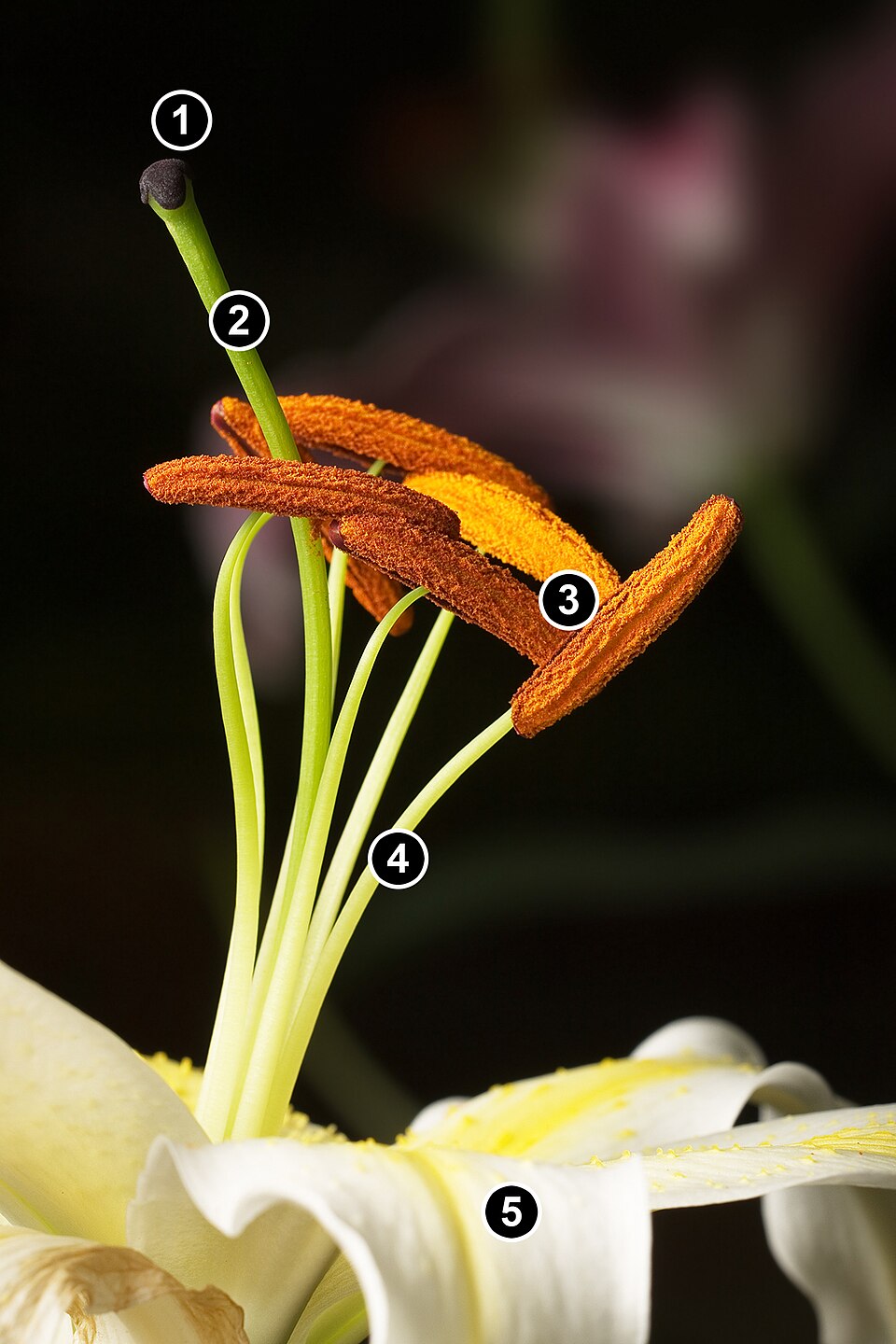

Scientific name
- Scientific name
- Lilium
How to say it in other languages
- Arabic
- زنبق
- Chinese
- 百合属
- Dutch
- Lelie
- French
- Lys
- German
- Lilien
- Hindi
- लिलि
- Italian
- Giglio
- Japanese
- ユリ
- Korean
- 나리속
- Portuguese
- Lírio
- Russian
- Лилия
- Spanish
- Azucenas
Facts from Wikipedia’s “Lilium” page and Wikispecies (CC BY-SA 4.0).
The lily is a genus of flowering plant. There are many species of lilies, like trumpet lilies and tiger lilies. They are usually quite tall, and are perennials.
Most lilies grow from a bulb, which in some species develops into a rhizome, which carries small bulbs. A highly efficient technique for multiple shoot and propagule formation in lilies through plant tissue culture technique was given by Yadav et al., in 2013
Lilies grow in Europe, North America, and Asia. There are more than 100 species, and many cultivated varieties. They also come in various colours. It tends to grow wild in the forest and a grassy plain of a mountainous area, but several kinds grow wild on wet ground. A lily’s petals come in multiples of three. The fleur de lys is a stylized depiction of the lily.
Toxicity
Some Lilium species are toxic to cats, especially Lilium longiflorum.The mechanism is not exactly known but it involves damage to the kidneys, which can cause acute renal failure. Veterinary help should be sought, as a matter of urgency, for any cat that is suspected of eating any part of a lily – including licking pollen that may have brushed onto its coat.
Where this page comes from
The article above is adapted from “Lily” on Simple English Wikipedia, by its contributors. We removed reference markers, navigation boxes and tables, expanded measurement templates into readable numbers, and kept the prose otherwise intact.
Both sources are published under CC BY-SA 4.0, so this page is published under the same licence. You may share and adapt it, including commercially, as long as you credit the original and keep the same licence.
Worksheets, answer keys and printable layouts elsewhere on K5Print are our own work and are not covered by this licence.