Okra

Fast facts
- Genus
- Abelmoschus
- Species
- A. esculentus
Scientific name
- Scientific name
- Abelmoschus esculentus
How to say it in other languages
- Chinese
- 秋葵
- French
- Gombo
- German
- Okra
- Italian
- Gombo
- Japanese
- オクラ
- Korean
- 오크라
- Portuguese
- Quiabo
- Russian
- Бамия
- Spanish
- Gombo
Facts from Wikipedia’s “Okra” page and Wikispecies (CC BY-SA 4.0).
Nutrition facts: raw okra
One serving is 8 pods (3" long) (95 g).
| Nutrient | Per 100 g | Per serving | % Daily Value |
|---|---|---|---|
| Calories | 33 kcal | 31 kcal | — |
| Protein | 1.9 g | 1.8 g | 4% |
| Total fat | 0.2 g | 0.2 g | — |
| Carbohydrate | 7.5 g | 7.1 g | 3% |
| Fiber | 3.2 g | 3.0 g | 11% |
| Sugars | 1.5 g | 1.4 g | — |
| Vitamin C | 23.0 mg | 21.9 mg | 24% |
| Vitamin A | 36 µg | 34 µg | 4% |
| Calcium | 82 mg | 78 mg | 6% |
| Iron | 0.6 mg | 0.6 mg | 3% |
| Potassium | 299 mg | 284 mg | 6% |
| Sodium | 7 mg | 7 mg | — |
One serving has about 24% of the Daily Value for vitamin C, and about 11% of the Daily Value for fiber.
Data: USDA FoodData Central (public domain, CC0) — “Okra, raw”. Percent Daily Values use the FDA’s reference amounts for labels.
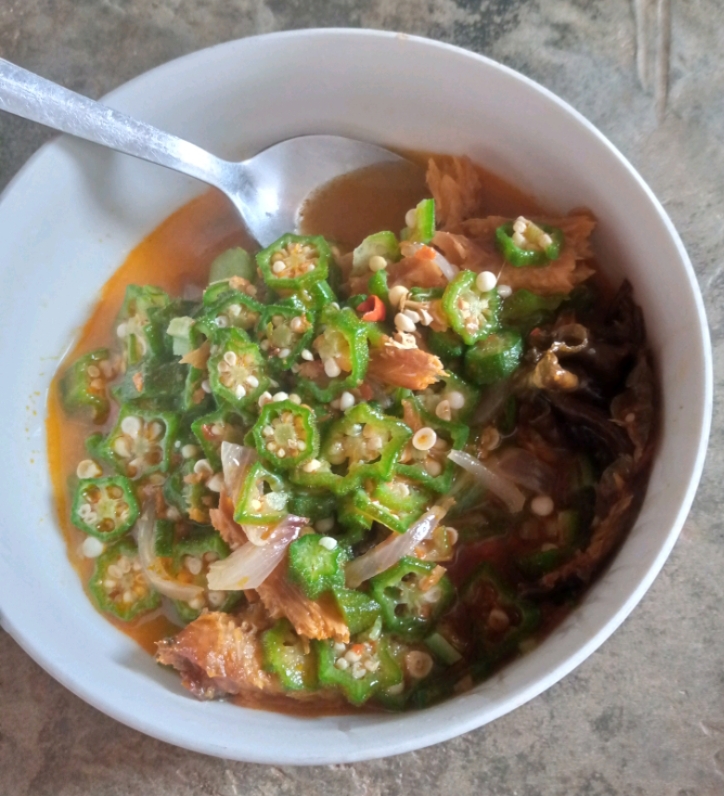
Okra (Abelmoschus esculentus) are known in many English-speaking countries as lady’s fingers or gumbo) is a flowering plant in the mallow family, related to cotton and hibiscus. Okro is native to West Africa. The word (Okro) came from the Igbo Language (South Eastern Nigeria) where okra vegetable is known as “Okro” or “Okworo”. The name adulteration began as the British colonialists came to Southern Nigeria and discovered its great health benefits. The problem was they could not pronounce the Igbo word “Okworo”, so they called it “Okro/Okra” and later, helped export and popularise the vegetable in Europe and in many warm regions across the globe. It is valued for its edible green seed pods which has many health benefits. It is grown for the pods, which are harvested in the immature stage and used in salads, soups and dishes. It is a national vegetable in many West African countries like Nigeria and Ghana, and in Asian countries like India and Pakistan. Some of the ways it is eaten are fried, grilled, or in soup.
Where this page comes from
The article above is adapted from “Okra” on Simple English Wikipedia, by its contributors. We removed reference markers, navigation boxes and tables, expanded measurement templates into readable numbers, and kept the prose otherwise intact.
Both sources are published under CC BY-SA 4.0, so this page is published under the same licence. You may share and adapt it, including commercially, as long as you credit the original and keep the same licence.
Worksheets, answer keys and printable layouts elsewhere on K5Print are our own work and are not covered by this licence.