Pine

Fast facts
- Genus
- Pinus
Scientific name
- Scientific name
- Pinus
How to say it in other languages
- Arabic
- صنوبر
- Chinese
- 松屬
- Dutch
- Den
- French
- Pin
- German
- Kiefern
- Hindi
- चीड़
- Italian
- Pino
- Japanese
- マツ属
- Korean
- 소나무속
- Portuguese
- Pinheiro
- Russian
- Сосна
- Spanish
- Pino
Facts from Wikipedia’s “Pine” page and Wikispecies (CC BY-SA 4.0).
Pines are a large and important genus of conifers in the family Pinaceae. The Plant List of the Royal Botanic Gardens, Kew and Missouri Botanical Garden lists 126 species of pines, plus a lot of synonyms.
Pines live in almost the entire Northern Hemisphere. In North America, they live in the southern part of Arctic to Nicaragua and Hispaniola. In Europe, they live in areas from Portugal and Scotland to Russia. In Asia, they live in areas from Russia to Japan and the Philippines. They also live in the Himalayas, some northern parts of Africa, and north of Majorca (Mallorca) on the rugged mountains.
Pines are long-lived trees (rarely large shrubs), typically reaching heights of 5–70 metres tall and ages of 100–1,000 years, some even more. The longest-lived is the Great Basin bristlecone pine, Pinus longaeva. One individual of this species, named “Methuselah”, is the world’s oldest living tree at around 4,600 years old. This tree can be found in the White Mountains of California.
Cones
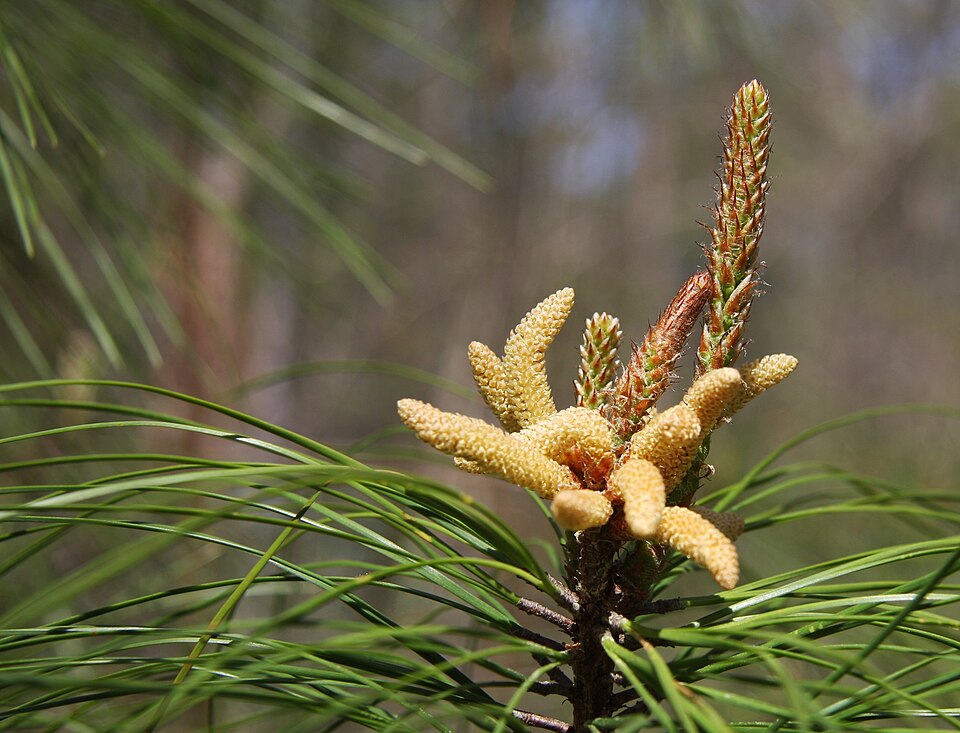
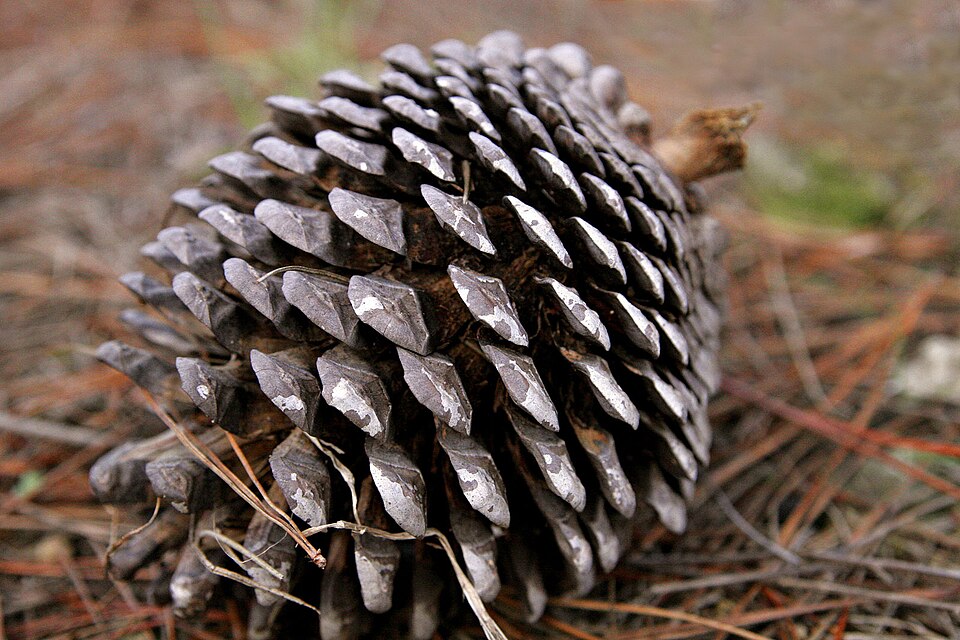
Pines usually have male and female cones on the same tree (monoecious). The male cones are small, typically 1–5 cm long, and are only present for a short period, usually in spring. They fall as soon as they have shed their pollen. The female cones take 1.5–3 years (depending on species) to mature after pollination, with actual fertilization delayed by one year. At maturity, the female cones are 3–60 cm long. Each cone has numerous spirally arranged scales, with two seeds on each fertile scale; the scales at the base and tip of the cone are small and sterile, without seeds. The seeds are mostly small and winged, and are wind-dispersed. Some have larger seeds that look like nuts and are dispersed by birds.
At maturity, the cones usually open to release the seeds, but in some of the bird-dispersed species (e.g. whitebark pine), the seeds are only released by the bird breaking the cones open. In others, the seeds are stored in closed (“serotinous”) cones for many years until a forest fire triggers the cones to open, releasing the seeds. The resin on the cones holds the scales closed until it melts in the fire.
Where this page comes from
The article above is adapted from “Pine” on Simple English Wikipedia, by its contributors. We removed reference markers, navigation boxes and tables, expanded measurement templates into readable numbers, and kept the prose otherwise intact.
Both sources are published under CC BY-SA 4.0, so this page is published under the same licence. You may share and adapt it, including commercially, as long as you credit the original and keep the same licence.
Worksheets, answer keys and printable layouts elsewhere on K5Print are our own work and are not covered by this licence.