Populus

Fast facts
- Genus
- Populus
Scientific name
- Scientific name
- Populus
How to say it in other languages
- Chinese
- 杨属
- Dutch
- populier / sikkeldikblad
- French
- Peuplier
- German
- Pappeln
- Japanese
- ヤマナラシ属(ポプラ)
- Korean
- 사시나무속
- Russian
- Тополь
Facts from Wikipedia’s “Populus” page and Wikispecies (CC BY-SA 4.0).
Populus is a genus of trees common in the northern hemisphere. They are often called just poplars. The genus has 25–35 species in three sub-groups, which are called poplars, aspens, and cottonwoods.
The September 2006 issue of Science announced that the Western balsam poplar (P. trichocarpa) was the first tree to have its full DNA code sequenced.
Reproduction
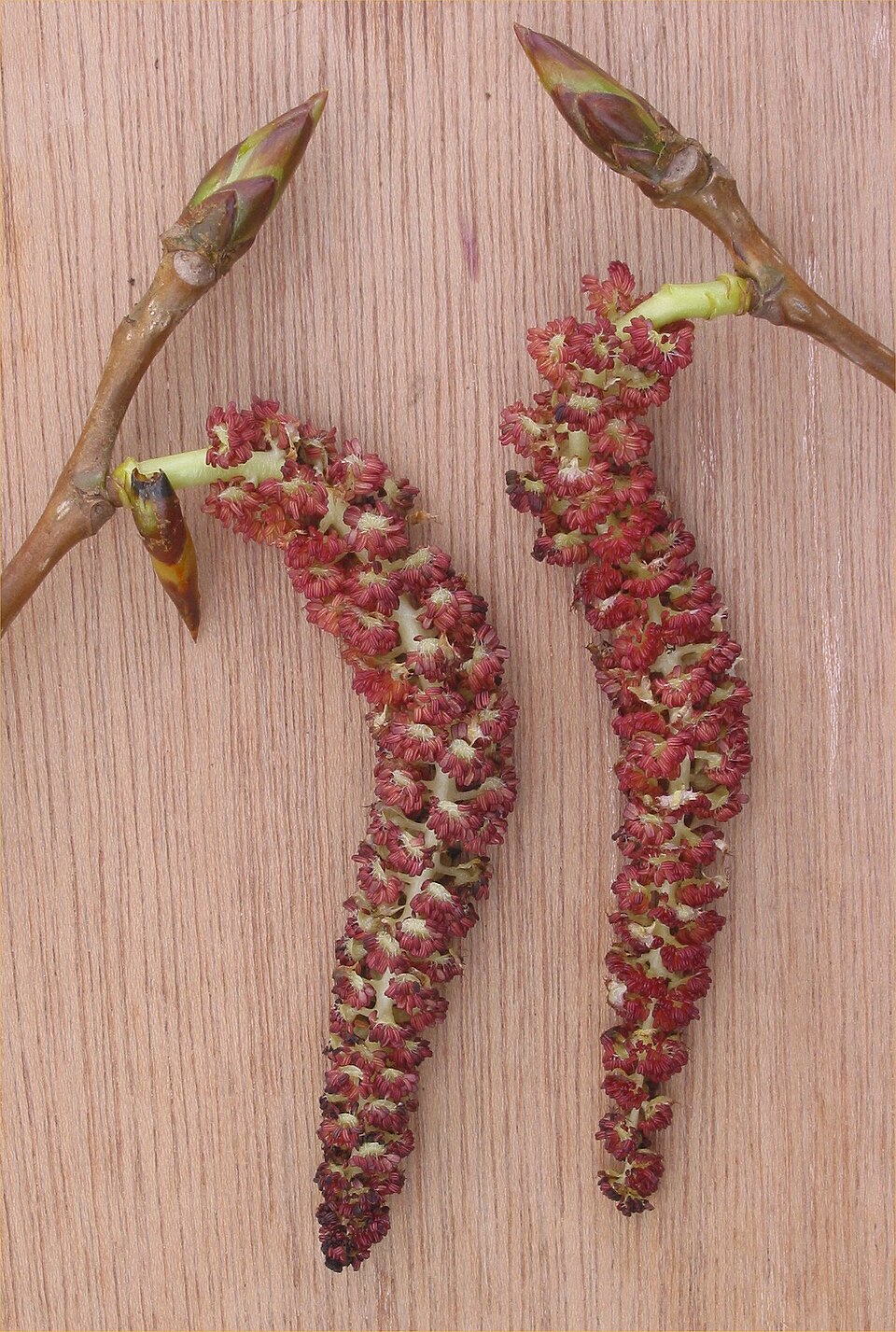
The flowers are mostly dioecious (rarely monoecious) and appear in early spring before the leaves. They are borne in long, drooping catkins. The male flower has a group of 4–60 stamens on a disk. The female flower is a single-celled ovary in a cup-shaped disk.
Pollination is by wind. The fruit is a two-to-four-valved capsule, is green to reddish-brown, and matures in the mid-summer. It contains tiny light brown seeds surrounded by tufts of long, soft, white hairs, which help wind dispersal.
Ecology
Poplars of the cottonwood section are often wetlands or riparian trees. The aspens are among the most important boreal broadleaf trees.
Poplars and aspens are important food plants for the larvae of many Lepidoptera species. Pleurotus populinus, the aspen oyster mushroom, is found exclusively on dead wood of Populus trees in North America.
Where this page comes from
The article above is adapted from “Populus” on Simple English Wikipedia, by its contributors. We removed reference markers, navigation boxes and tables, expanded measurement templates into readable numbers, and kept the prose otherwise intact.
Both sources are published under CC BY-SA 4.0, so this page is published under the same licence. You may share and adapt it, including commercially, as long as you credit the original and keep the same licence.
Worksheets, answer keys and printable layouts elsewhere on K5Print are our own work and are not covered by this licence.