Tuber
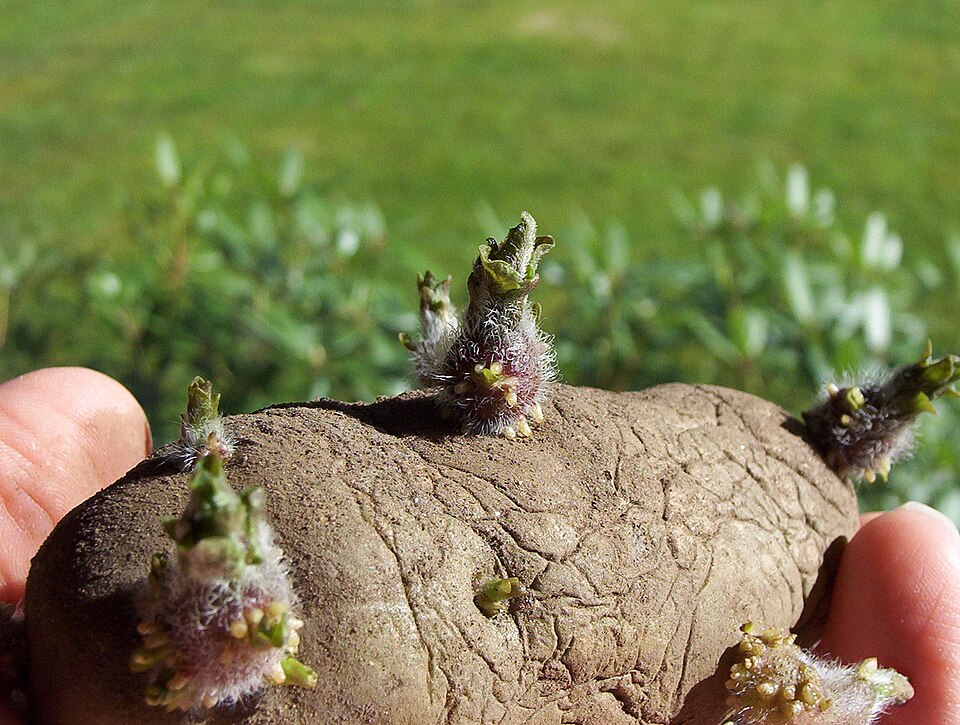

A tuber is the thickened part of an underground stem of a plant, such as the potato, with buds from which new plant shoots (stems and young leaves of a new plant) grow.
Most tubers are formed in the ground, but sometimes they can be formed above the ground, in the aerial stems; that is the case of the air potato (Dioscorea bulbifera).
Functions
Tuber stems (or part of stems) are made bigger to store nutrients. Starch (formed by a lot of glucose molecules) is the most commonly stored food in the tubers, although other carbohydrates, such as inuline (formed by many fructose molecules), are stored in the tubers of certain kinds of plants, like the Jerusalem artichoke (Helianthus tuberosus).
The purpose of tubers are saving food and reproduction. Under natural conditions, the parts of the stem that connect the tubers with the main stem die in the autumn or winter. The tubers are left in the ground and are able to produce shoots from their buds the following spring.
Potatoes are also artificially reproduced by tuber pieces, called “seed pieces”. A tuber is cut into pieces, each with one or more “eyes” (an “eye” of potato is a group of buds covered by very small leaves). These pieces are planted and each produces a new plant from one of its “eyes”. File:Solanum tuberosum 02.jpg|Tuber of potato (Solanum tuberosum). File:Helianthus tuberosus.jpg|Tuber of Jerusalem artichoke (Helianthus tuberosus). File:Oca.jpg|Tuber of oca (Oxalis tuberosa). File:Bulbifera.jpg|Aerial tuber of Dioscorea bulbifera.
Tuberous roots
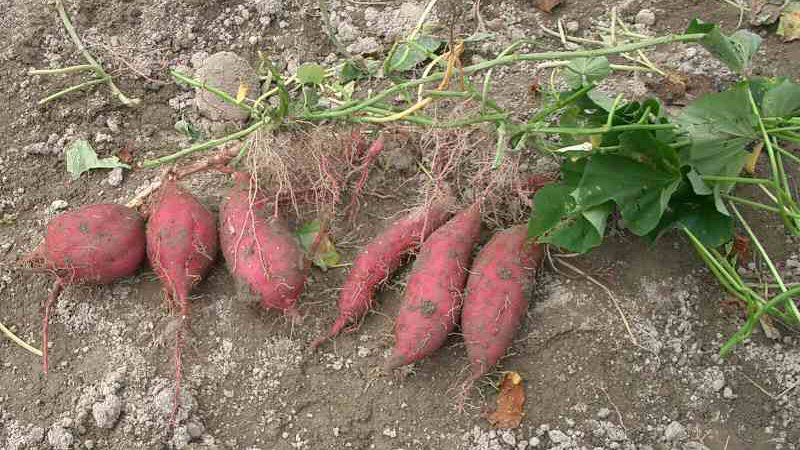
A tuberous root or storage root, is a modified lateral root, made bigger to function as a storage organ; sometimes these roots are called “tubers” but they are roots, not modified stems like the true tubers. They are thus different in origin but similar in function and appearance to tubers. Examples of plants with important tuberous roots include the sweet potato, cassava, yam and dahlia.
Where this page comes from
The article above is adapted from “Tuber” on Simple English Wikipedia, by its contributors. We removed reference markers, navigation boxes and tables, expanded measurement templates into readable numbers, and kept the prose otherwise intact.
Both sources are published under CC BY-SA 4.0, so this page is published under the same licence. You may share and adapt it, including commercially, as long as you credit the original and keep the same licence.
Worksheets, answer keys and printable layouts elsewhere on K5Print are our own work and are not covered by this licence.