Alkali
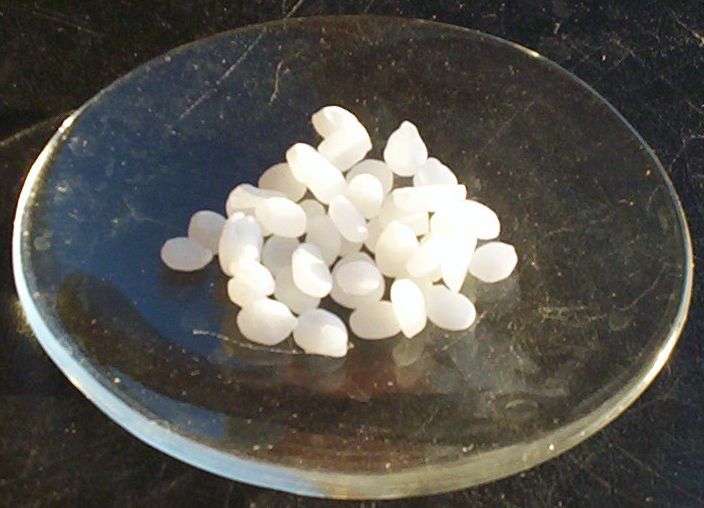

In chemistry, an alkali is an aqueous (from water) solution with a pH value of more than seven. The word ‘alkali’ comes from the Arabic ‘qali’ meaning ‘from the ashes’ since ashes mixed with water used as cleaning products (such as soaps) are made of alkali materials.
Example
- An alkali is where a base is dissolved in water. Often it is the salt of an Alkali metal.
- An alkali is the opposite to an acid and can be neutralized (brought down to pH seven) by adding acid.
Characteristics
- It feels soapy.
- It is corrosive (it can burn your skin away).
- The higher the number is over seven on the pH scale the stronger the alkali is.
- Highly soluble (can be dissolved) in water.
- They have a bitter taste.
- Turns red litmus paper blue.
- Can conduct electricity due to the presence of mobile ions.
- Is it blue or purple on a universal indicator?
Strength
Like acids, alkalis can be weak or strong, depending on the nature and the concentration of the ionic salt composing it. The strength of an alkali can be found using universal indicator. Also like acids, the strength of an alkali is rated using the pH scale.
For example, soap and toothpaste contain weak alkalis, while cleaning products often contain strong ones.
Examples of common alkalis
- Sodium hydroxide, NaOH
- Potassium hydroxide, KOH
- Calcium hydroxide, Ca(OH) 2
- Aqueous ammonia, NH 3 (aq)
- Magnesium hydroxide, Mg(OH) 2
Uses of common alkalis
- Sodium hydroxide is used to make paper, detergents and soap.
- Potassium hydroxide is used by farmers to make acidic soil more alkaline so that plants will grow better in it, and is also used as the electrolyte in alkaline, Ni-Cd, and Ni-MH batteries.
- Calcium hydroxide is used to neutralize acidic soil.
- Ammonium hydroxide is used as a cleaning agent.
Oxides and hydroxides
Metal oxides and metal hydroxides are two types of base. When neutralized (an acid is added), they produce salt and water. The type of salt produced depends on the acid and base.
Where this page comes from
The article above is adapted from “Alkali” on Simple English Wikipedia, by its contributors. We removed reference markers, navigation boxes and tables, expanded measurement templates into readable numbers, and kept the prose otherwise intact.
Both sources are published under CC BY-SA 4.0, so this page is published under the same licence. You may share and adapt it, including commercially, as long as you credit the original and keep the same licence.
Worksheets, answer keys and printable layouts elsewhere on K5Print are our own work and are not covered by this licence.