Arsenic
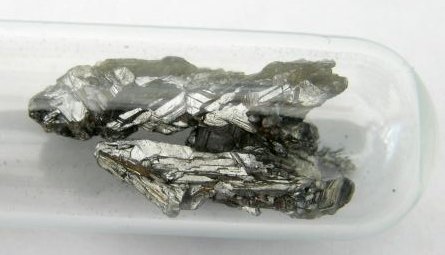

Arsenic is chemical element 33 on the periodic table. Its symbol is As. Its atomic number is 33 and its atomic mass is 74.92. It is a toxic metalloid. It is in the pnictogen group on the periodic table.
Physical properties
Arsenic is found in three allotropes. Gray arsenic is the most common. It is a brittle, somewhat soft metalloid that is a little shiny. It has a density of 5.73g/cm 3 . It is a semiconductor. Yellow arsenic is unstable and rare. It is the most toxic allotrope. It is a soft and waxy nonmetal, similar to white phosphorus. It turns into gray arsenic in light. Its density is 1.97g/cm 3 , much lighter than gray arsenic. It is created when arsenic vapor (made by heating arsenic very hot) is cooled very fast by something like liquid nitrogen. Black arsenic is similar to red phosphorus. It is a brittle, black, and shiny nonmetal. It does not conduct electricity. Since gray arsenic is the most common, it is usually referred to as arsenic.
Arsenic is found as one stable (nonradioactive) isotope, 75 As. There are about 33 radioactive isotopes found. The longest lasting one is 73 As, which has a half life of about 80 days.
Chemical properties
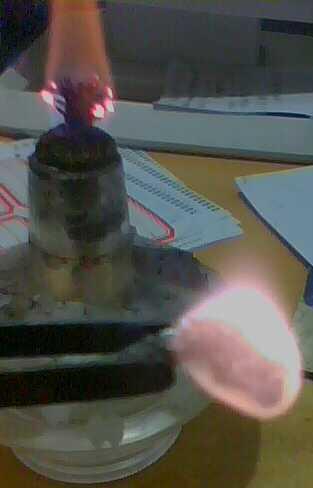
Arsenic is a relatively chemically inert element, similar to copper in reactivity. It burns in air to make garlic-smelling arsenic trioxide. Arsenic, as well as some of its compounds, do not have a liquid state; they sublime. Arsenic reacts with fluorine to make arsenic pentafluoride. It reacts with the rest of the halogens to make the arsenic trihalides. Arsenic does not dissolve in hydrochloric acid. It dissolves in concentrated nitric acid to make arsenic acid and in dilute nitric acid to make arsenious acid. It reacts with concentrated sulfuric acid to make arsenic trioxide. Arsenic burns with a pale lavender flame.
Chemical compounds
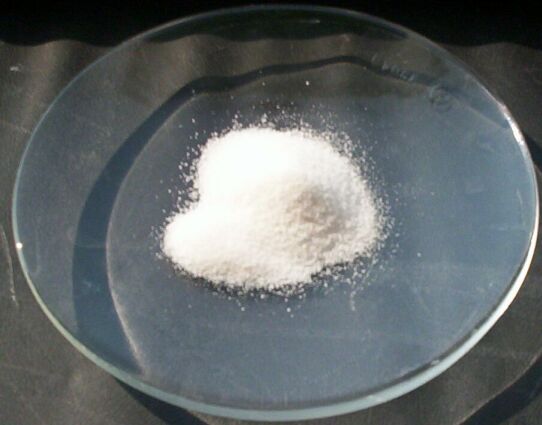
Arsenic forms chemical compounds in three oxidation states: -3, +3, and +5. -3 compounds are reducing agents. They are the main form of arsenic in the ground (as arsenides). Arsine is a colorless, highly toxic gas with a garlic odor. The +3 state is the most common. They are weak oxidizing agents. Arsenic trioxide is a white solid. It dissolves in water to make a solution of arsenious acid. The arsenic trichlorides are low melting covalent solids. The +5 state is common, too. They are strong oxidizing agents. Arsenic pentafluoride, a colorless and highly reactive gas, is the only stable arsenic pentahalide. Arsenic pentoxide dissolves in water to make arsenic acid, which can make arsenate salts.
-3 compounds are reducing agents. They are found as arsenides and arsine. The metal arsenides have properties between an alloy and a salt.
- Aluminum arsenide
- Arsenide, the ion
- Arsine, colorless highly toxic flammable gas
- Gallium arsenide, used in LEDs
- Zinc arsenide
+3 compounds are weak oxidizing agents. Many are colorless, although some are orange.
- Arsenic tribromide, white solid
- Arsenic trichloride, colorless liquid
- Arsenic trifluoride, colorless liquid
- Arsenic triiodide, red-orange solid
- Arsenic trioxide, white solid
- Arsenic trisulfide, yellow solid
Arsenates are salts of arsenious acid.
- Arsenious acid, weak acid
- Arsenate, the ion
- Paris green, copper acetoarsenite (copper acetate arsenite), green solid
- Potassium arsenite
- Sodium arsenate
+5 compounds are strong oxidizing agents.
- Arsenic pentafluoride, colorless gas
- Arsenic pentoxide, white solid
Arsenates are salts of arsenic acid.
- Arsenate, the ion
- Arsenic acid, white solid or colorless solution
- Lead arsenate
- Potassium arsenate
Occurrence
File:Realgar-62282.jpg|Realgar, arsenic sulfide File:Native arsenic.jpg|Arsenic as an element File:Arsenopyrite.jpg|Arsenopyrite, iron arsenic sulfide File:Erythrite-180812.jpg|Erythrite, cobalt arsenide Arsenic is found sometimes as an element in the ground, but is normally found in minerals. Some arsenic minerals have a metal and sulfur along with arsenic. Arsenopyrite is iron arsenic sulfide. It is the same as pyrite with arsenic added. Other arsenic minerals have a metal and arsenic. Erythrite, a cobalt arsenide mineral, is an example. Other arsenic minerals are simple. Realgar and orpiment (arsenic sulfides), simple arsenic minerals, are ores of arsenic.
Arsenic is found as a less toxic variety in fish and mushrooms. Some people think that humans need very small amounts of arsenic to be healthy. Some bacteria can use arsenic instead of phosphorus for some things; they are called arsenic bacteria.
Preparation
Most arsenic is made from the waste products after other metals are processed. Only China actually mines arsenic.
Arsenic is made from arsenopyrite by heating it. This makes arsenic trioxide which sublimes (along with sulfur dioxide), while the iron oxide stays behind. The arsenic trioxide is condensed, while the sulfur dioxide does not condense. The arsenic trioxide can be reduced with carbon. Another way is to heat the arsenopyrite without air. Then gray arsenic is made. Realgar can be heated to make arsenic trioxide as well.
History
Arsenic was known since antiquity. It was alloyed with bronze to make the bronze harder. Some people used arsenic as make-up, although it was toxic. Arsenic was well known as a poison. Since people used it to kill royalty and it was hard to detect, it was called the “Poison of Kings” and the “King of Poisons”. An arsenic compound could have been the first organometallic compound (a metal bonded to an organic compound).
Uses
Arsenic compounds were used as a preservative for wood. Once people saw how toxic arsenic was, they stopped using it to preserve wood. Some feed for animals had arsenic in it to prevent disease. Lead arsenate was used as an insecticide in orchards but damaged the brains of those who put the insecticide on the trees.
Arsenic was used in medicines in the 1700s, 1800s, and 1900s. Arsenic trioxide was used to treat cancer. Very tiny doses of arsenic compounds can act as stimulants. Some arsenic compounds are used as poison gases.
Arsenic as an element is used in alloys. The lead in lead acid batteries has some arsenic in it to make it stronger. Some semiconductors have arsenic in them.
Copper arsenate was used as a coloring for sweets. Paris green, a green pigment having arsenic in it, made many people sick. Some bullets have arsenic in them. Arsenic is sometimes added to brass to prevent the zinc from coming out. Arsenic was used in optical glass but was taken out because it was toxic.
The trioxide was once used as a rat poison.
Safety
Arsenic and its compounds are highly toxic. They are carcinogens. Water near arsenic mines is normally contaminated with arsenic. Wood that was preserved with arsenic compounds can leach arsenic into the soil. Emissions from coke ovens have arsenic in them.
Written for younger readers
Arsenic, in simpler words
This version comes from Wikijunior, a set of books written for children aged 8 to 11. It is shorter and uses plainer language than the article above.
From Wikijunior: The Elements
NOTOC
Arsenic is a poisonous metalloid.
The most stable — and therefore the most common — form of pure arsenic is gray. There are also yellow and black forms. Yellow arsenic is the most unstable and the most toxic.
Compounds of arsenic have been known since ancient times — arsenic sulfates, and arsenic oxides. Pure arsenic is rare in nature. As far as we know, the first person to isolate pure arsenic was Albertus Magnus, a German friar and bishop, around the year 1250 CE.
The Greek word arsenikos, meaning “male”, “virile” was adopted in Latin as arsenicum, which in French became arsenic, from which the English word arsenic is taken. Did You Know?
- Arsenic has metallic and nonmetallic properties. It is a metalloid.
- Arsenic comprises about 1.5 ppm (0.00015%) of the Earth’s crust.
- Arsenite of lime and arsenate of lead were used widely as insecticides until the discovery of DDT in 1942.
Arsenic is a fairly common element on Earth. A lot of it is mined in China. Other countries that mine a fair amount of arsenic are Chile, Peru, and Morocco.
Arsenic is used in some alloys to make them harder. It was sometimes used in ancient times to make bronze harder. It is also used in some pesticides, although these are not used as much as they used to be because of concerns it could hurt people if it gets on their food.
Arsenic is poisonous. It is used in pesticides and other poisons.
Where this page comes from
The article above is adapted from “Arsenic” on Simple English Wikipedia, by its contributors. We removed reference markers, navigation boxes and tables, expanded measurement templates into readable numbers, and kept the prose otherwise intact. The simpler version is adapted from Wikijunior on Wikibooks.
Both sources are published under CC BY-SA 4.0, so this page is published under the same licence. You may share and adapt it, including commercially, as long as you credit the original and keep the same licence.
Worksheets, answer keys and printable layouts elsewhere on K5Print are our own work and are not covered by this licence.