Barium
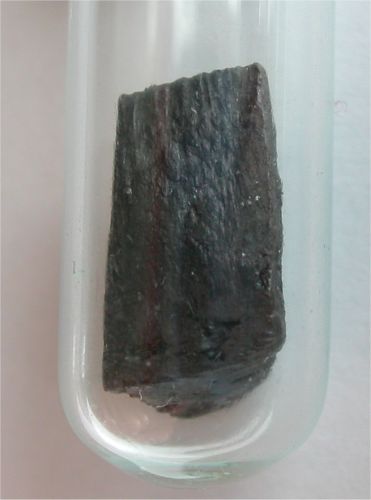

Barium is chemical element 56 on the periodic table. Its symbol is Ba. It contains 56 protons and 56 electrons. Its mass number is about 137.3. It is a metal.
Physical properties
Barium is part of a group of elements known as the alkaline earth metals. It is a silvery metal that easily turns black. It is soft and ductile. It can form alloys with some metals that are partially alloys and partially chemical compounds.
Chemical properties
Barium is reactive, and if you put pure barium metal in the air, it will react with oxygen. At first it will turn black, then white as barium oxide is formed. Barium reacts with water to make barium hydroxide and hydrogen gas. Barium also reacts very fast with acids to make a barium salt and hydrogen. Barium can form barium peroxide if it is burned in air.
Barium reacts with many other metal oxides and sulfides to make barium oxide or sulfide and the metal. It also reacts with carbon and nitrogen at a high temperature to make barium cyanide.
Chemical compounds
Barium compounds
Barium is too reactive as a metal, so it is not found in the earth as a metal. It is found in chemical compounds. Barium only occurs in one oxidation state: +2. Most barium compounds are colorless. The ones that dissolve in water or stomach acid are very toxic. Barium sulfate is well known because it does not dissolve in water or acids. Barium compounds are quite heavy. Barium compounds put out a greenish flame when heated red-hot. File:Barium chloride dihydrate.jpg|Barium chloride File:Bariumsulfatpulver.png|Barium sulfate
Occurrence
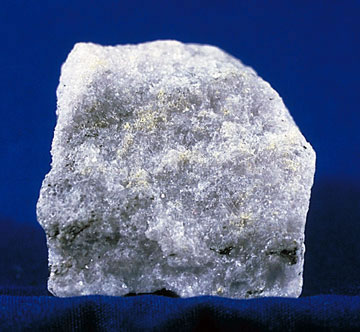
Barium is found as barium sulfate (barite) and barium carbonate (witherite) in the ground. Both of these minerals do not dissolve in water. Barium sulfate hardly dissolves in anything. Barium is found mainly in China, Germany, India, Morocco, and the US.
Preparation
It is very hard to get barium from barium sulfate. So barium sulfate is reduced by carbon to make barium sulfide and carbon dioxide. The barium sulfide is dissolved in hydrochloric acid. This makes hydrogen sulfide and barium chloride. The barium chloride is melted and electrolyzed to get liquid barium metal. The barium metal is solidified and stored in oil.
Barium carbonate, the other ore of barium, is dissolved in hydrochloric acid to make barium chloride and carbon dioxide. The barium chloride is melted and electrolyzed, making barium metal.
As a metal
Barium is used to remove oxygen from cathode ray tubes and vacuum tubes. It is placed inside and reacts with all of the oxygen, using it up. Barium is also used in spark plug wire.
As chemical compounds
Certain compounds of barium, such as barium sulfate, are not toxic and can be put in the body. We can see where the barium travels in the body by X-rays and this can tell us whether there are problems, such as blockages. The barium sulfate builds up inside the body accumulating in organ systems. Barium sulfate absorbs the X-Rays as they pass through the body and an image is formed from the points where the rays have not passed through. It is useful because it provides a reasonably detailed image from very limited radiation exposure, compared with a CT scan for instance. Barium sulfate can be used as a pigment, too.
Other barium compounds have several other uses.
Safety
Barium is a very toxic element, and is dangerous. There is a really small amount of barium in our food, and this does not cause problems. If we get barium from other places, though, it can cause many problems. Even 1 gram of barium can kill you. It is dangerous because it acts like other really important elements, such as calcium and magnesium. If barium replaces these elements, it messes up the body.
Written for younger readers
Barium, in simpler words
This version comes from Wikijunior, a set of books written for children aged 8 to 11. It is shorter and uses plainer language than the article above.
From Wikijunior: The Elements
NOTOC
Barium is classified as an alkaline earth metal on the periodic table. The periodic table arranges chemical elements into periods (rows) and groups (columns). The element barium is in period 6 and group 2. Its atomic number is 56 and its symbol is Ba.
In addition to barium, there are 5 other alkaline earth metals: beryllium, magnesium, calcium, strontium, and radium. These elements have similar properties. They are highly reactive and form useful compounds.
Barium is a soft, silvery-white metal. When exposed to air, a dark gray coating appears on its surface. This process is called oxidation. Barium is typically stored in high-purity mineral oil or paraffin oil. These oils provide a protective barrier against oxidation by air or water.
In its pure metallic form, barium has no odor. It is highly toxic and should never be tasted. The compound barium sulfide has a “rotten egg” smell when exposed to moisture. This compound is highly toxic. The compound barium sulfate is non-toxic and safely used by doctors for medical imaging.
A shoemaker named Vincentius Casciorolus learned about the heavy, silvery-white mineral which was impure barium sulfate (BaS04). He noticed that after being heated up, this mineral would change into unusual pebbles that glowed for years. He named these pebbles “Bologna stones”, and they were later determined to be barium sulfate. Then, barium was first discovered in barite by German chemist Carl Scheele and English chemist William Withering in the late 18th century.
In 1808, English chemist Sir Humphry Davy isolated barium metal. He passed an electric current through molten barium chloride. This method is known as “electrolysis”.
Where did its name come from?
The name barium comes from the Greek word βαρὺς (barys), meaning “heavy.” Sir Humphry Davy officially named the new element barium. The -ium suffix indicates a metallic element.
The name barium comes from the Greek word βαρὺς (barys), meaning “heavy.” Sir Humphry Davy officially named the new element barium. The -ium suffix indicates a metallic element. Did You Know?
- Hydrogen gas is released when barium reacts exothermically with water.
- Barium makes up only 0.0425% of the Earth’s crust.
- Breathing in pure barium can irritate the lungs.
- Barium creates a dark gray coating when it is oxidized in air.
- Barium is commonly alloyed with metals such as aluminum.
Barium has a high chemical reactivity. As such, it is never found naturally in its pure form. In nature, it reacts with water to form barium hydroxide, and oxygen to form barium oxide.
Barium is found in barite and witherite. Barium is mined in China, India, Germany, and Morocco. In the United States, it is mined in Alabama, Alaska, Arizona and Arkansas.
Barium is used to color fireworks green. It can also be used to help create a vacuum in television tubes by removing unwanted gas from the tube. Barium compounds are used in various industries including electronics, ceramics, paints, oil and gas. In medicine, barium sulfate is used in contrast imaging to help doctors see inside the body.
Barium is very toxic in its elemental form. A very small amount can be deadly. The compounds barium chloride and barium nitrate are highly toxic. Swallowing or inhaling these compounds can lead to muscle weakness, difficulty breathing, and paralysis.
Where this page comes from
The article above is adapted from “Barium” on Simple English Wikipedia, by its contributors. We removed reference markers, navigation boxes and tables, expanded measurement templates into readable numbers, and kept the prose otherwise intact. The simpler version is adapted from Wikijunior on Wikibooks.
Both sources are published under CC BY-SA 4.0, so this page is published under the same licence. You may share and adapt it, including commercially, as long as you credit the original and keep the same licence.
Worksheets, answer keys and printable layouts elsewhere on K5Print are our own work and are not covered by this licence.