Bicarbonate and vinegar
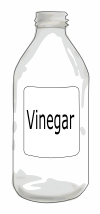

Popping Cork
you will need:
a small glass bottle,
a cork that fits in the bottle,
baking soda,
vinegar,
piece of paper,
water.
Pour some baking soda in the bottle by folding the paper and putting the baking soda in it and then slowly slide the baking soda into the bottle.
Wet the cork in the water so it is wet. Pour some vinegar into the bottle, shove the cork in and stand really far from it!
The cork will pop out because baking soda is a chemical, called sodium bicarbonate. When it is mixed with vinegar it makes a gas called carbon dioxide, so the cork flies out!
Stink Bomb
You will need:
- Wine vinegar
- Bicarbonate of soda
The more of the ingredients the bigger the fizz and the stinkier it will get!
- Pour the wine vinegar into a container followed by the bicarbonate of soda.
- Watch the mixture fizz and bubble
- Smell the mixture then run away because it will stink!
Bubbley Bang
What you need:
- water
- measuring cup
- zip-lock bag
- tablespoon
- baking soda
- vinegar
Warning! Only do this experiment outside or somewhere where it doesn’t matter if things get wet!
- Mix a tablespoon of baking soda with some water, and pour the mixture into the zip-lock bag.
- Add a tablespoon of vinegar, close the bag, and move away.
- If the experiment has worked, the zip-lock bag should explode.
Principle
When the vinegar and baking soda come in contact, a chemical reaction occurs. A gas called carbon dioxide is released. When this happens, bubbles form, and pressure builds, because the density of carbon dioxide is much less than the density of the baking soda or vinegar. Eventually this pressure cannot be contained within the container and the weakest part of the container (in this case, the cork) bursts.
This experiment demonstrates an acid-base reaction. Acids and bases are measured on something called the “pH” scale, where anything below a 7 is an acid, anything above a 7 is a base. When the acid and base mix, they create a reaction, which breaks bonds between the molecules of the acids and bases. In some cases, this reaction can produce heat (which is why many cartoons show acids as being able to burn through steel and other materials) or and it always releases some molecule, in this case carbon dioxide.
Written for younger readers
Bicarbonate and vinegar, in simpler words
This version comes from Wikijunior, a set of books written for children aged 8 to 11. It is shorter and uses plainer language than the article above.
From Wikijunior: Big Book of Fun Science Experiments
you will need:
a small glass bottle,
a cork that fits in the bottle,
baking soda,
vinegar,
piece of paper,
water.
Pour some baking soda in the bottle by folding the paper and putting the baking soda in it and then slowly slide the baking soda into the bottle.
Wet the cork in the water so it is wet. Pour some vinegar into the bottle, shove the cork in and stand really far from it!
The cork will pop out because baking soda is a chemical, called sodium bicarbonate. When it is mixed with vinegar it makes a gas called carbon dioxide, so the cork flies out!
You will need:
- Wine vinegar
- Bicarbonate of soda
The more of the ingredients the bigger the fizz and the stinkier it will get!
- Pour the wine vinegar into a container followed by the bicarbonate of soda.
- Watch the mixture fizz and bubble
- Smell the mixture then run away because it will stink!
What you need:
- water
- measuring cup
- zip-lock bag
- tablespoon
- baking soda
- vinegar
Warning! Only do this experiment outside or somewhere where it doesn’t matter if things get wet!
- Mix a tablespoon of baking soda with some water, and pour the mixture into the zip-lock bag.
- Add a tablespoon of vinegar, close the bag, and move away.
- If the experiment has worked, the zip-lock bag should explode.
When the vinegar and baking soda come in contact, a chemical reaction occurs. A gas called carbon dioxide is released. When this happens, bubbles form, and pressure builds, because the density of carbon dioxide is much less than the density of the baking soda or vinegar. Eventually this pressure cannot be contained within the container and the weakest part of the container (in this case, the cork) bursts.
This experiment demonstrates an acid-base reaction. Acids and bases are measured on something called the “pH” scale, where anything below a 7 is an acid, anything above a 7 is a base. When the acid and base mix, they create a reaction, which breaks bonds between the molecules of the acids and bases. In some cases, this reaction can produce heat (which is why many cartoons show acids as being able to burn through steel and other materials) or and it always releases some molecule, in this case carbon dioxide.
Where this page comes from
The article above is adapted from “Bicarbonate and vinegar” on Simple English Wikipedia, by its contributors. We removed reference markers, navigation boxes and tables, expanded measurement templates into readable numbers, and kept the prose otherwise intact. The simpler version is adapted from Wikijunior on Wikibooks.
Both sources are published under CC BY-SA 4.0, so this page is published under the same licence. You may share and adapt it, including commercially, as long as you credit the original and keep the same licence.
Worksheets, answer keys and printable layouts elsewhere on K5Print are our own work and are not covered by this licence.