Bismuth
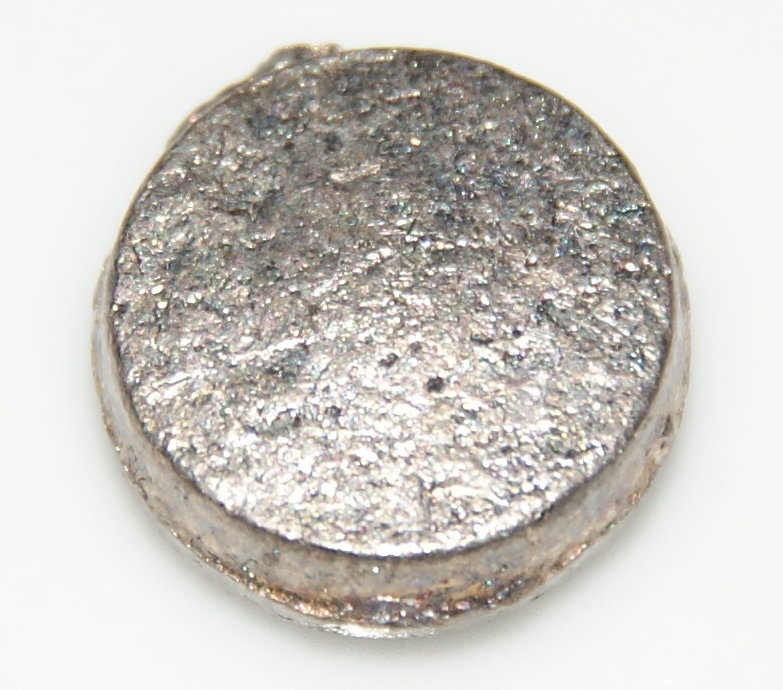

Bismuth is a chemical element. It is element 83 on the periodic table and its symbol is Bi. Its atomic mass is 209. It is only slightly radioactive. The radioactivity is minimal so it is typically seen as nonradioactive. Bismuth is only naturally found as one isotope, which is the almost nonradioactive one. Its radioactivity was predicted by scientists and proven by analyzing the metal. It is in Group 15 on the periodic table.
Physical properties
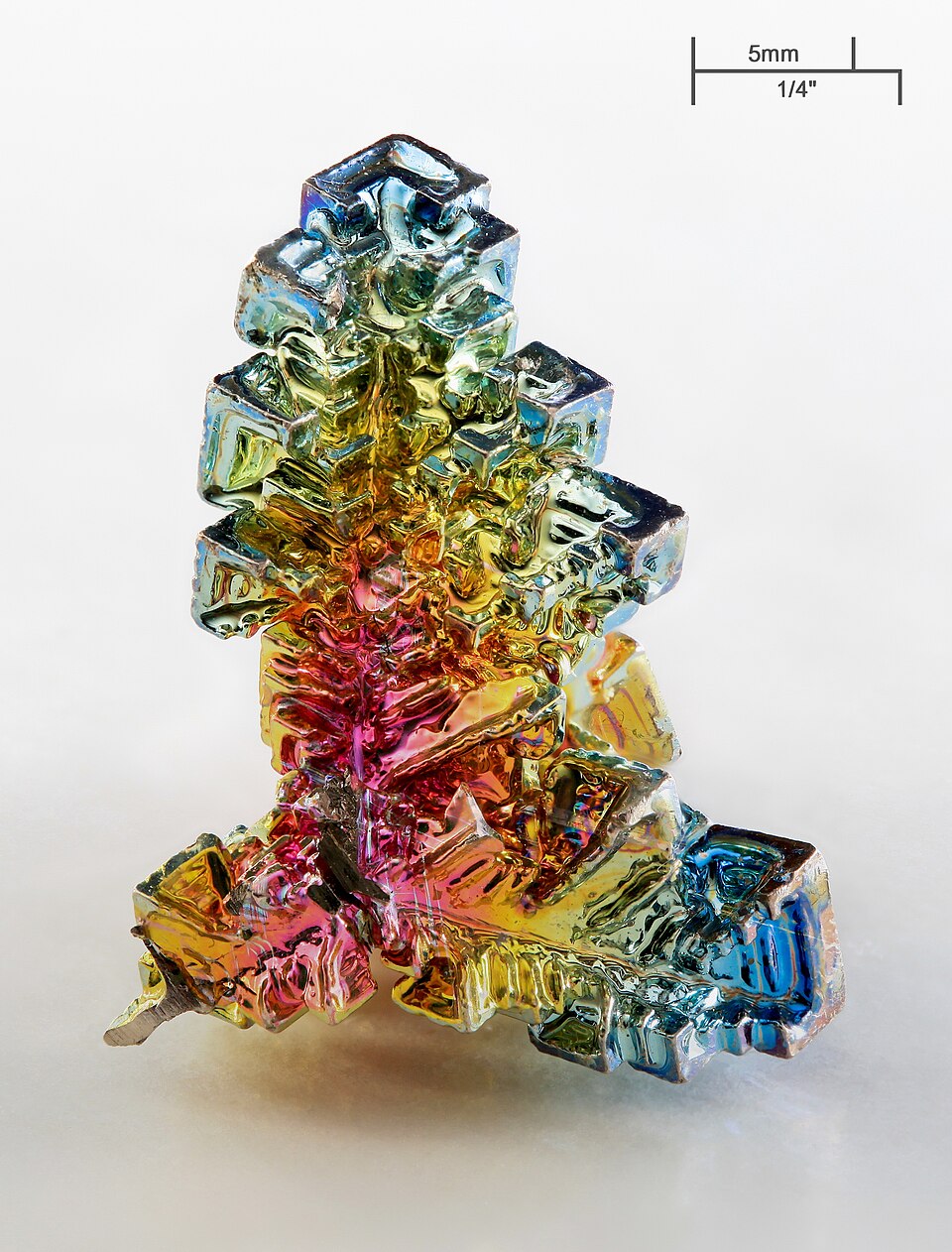
Bismuth is a silver metal with a pink tinge to it. This pink color is because of its oxide coating. Bismuth is a post-transition metal. It is one of the strongest diamagnetic metals. It is almost as heavy as lead. It is quite brittle. It can make crystals with a shiny surface. Its melting point is quite low: 271.5 degrees Celsius (520.7 °F), which is normal for post-transition metals. As a liquid it is denser and has a smaller volume than as a solid. Another chemical that does this is water. It does not conduct electricity or heat very well.
Chemical properties
Bismuth is somewhat similar to antimony. Bismuth makes a thin coating of bismuth(III) oxide when it is in air. This makes the colors on the crystals. It does not oxidize any more than the oxide layer. It burns when powdered with a bright blue flame, making yellow bismuth(III) oxide fumes. Bismuth also reacts with sulfur, when molten. Bismuth reacts with nitric acid to make bismuth(III) nitrate and concentrated sulfuric acid to make bismuth(III) sulfate and sulfur dioxide. It reacts with halogens to make bismuth(III) halides but with fluorine it makes bismuth(V) fluoride unless the fluorine is diluted.
Chemical compounds
Bismuth forms chemical compounds in two main oxidation states: +3 and +5. +3 is more common. +3 compounds are weak oxidizing agents and are normally light yellow. +5 compounds are strong oxidizing agents. Bismuthates are the most common +5 compounds. Bismuth(V) fluoride is another +5 compound. Bismuth(V) oxide is an unstable red solid. Bismuth sulfide is a common ore of bismuth. Bismuthine, a bismuth hydride, is very unstable and only can be made at very cold temperatures. Bismuth makes many oxy- compounds like bismuth oxychloride. These compounds are made when bismuth halides dissolve in water.
Bismuth(III) compounds
+3 compounds are weak oxidizing agents except for bismuthine. They are normally pale yellow.
- Bismuthine, unstable gas
- Bismuth(III) bromide, pale yellow solid
- Bismuth(III) chloride, pale yellow solid
- Bismuth(III) fluoride, gray white solid
- Bismuth(III) iodide, dark gray solid
- Bismuth(III) oxide, pale yellow solid
- Bismuth(III) oxychloride, whitish solid
- Bismuth(III) sulfide, brown solid
Bismuth(V) compounds
Bismuth(V) compounds (+5 compounds) are very strong oxidizing agents.
- Bismuth(V) fluoride, colorless solid
- Bismuth(V) oxide, unstable red solid
- Bismuthate, the ion
- Sodium bismuthate, light brown solid, insoluble in water
File:Bismuth(III) oxide.jpg|Bismuth(III) oxide File:Sulfid bismutitý.PNG|Bismuth(III) sulfide File:Dusičnan bismutitý.JPG|Bismuth(III) nitrate File:Chlorid bismutitý.PNG|Bismuth(III) chloride File:Sodium bismuthate.JPG|Sodium bismuthate
History
Bismuth was known since ancient times. It was confused with tin and lead, though. No one is credited for discovering bismuth. In the 1500s, people started realizing that bismuth was different than tin or lead.
Occurrence
File:Bismite.jpg|Bismite File:Bismuth-243433.jpg|Bismuth as a mineral File:Bismuthinite-136224.jpg|Bismuthinite Bismuth is not very common in the earth. It is only about twice as common as gold. Bismite, a bismuth oxide mineral, and bismuthinite, a bismuth sulfide, are two common ores. Bismuth is sometimes found as a metal, too.
Preparation
Bismuth and its minerals are too rare to be mined. They are gotten by “secondary extraction”. It is normally found in lead metal. The lead metal is purified by electrolysis, leaving the bismuth behind as a sludge on the bottom of the container. The copper is taken out of the sludge and the bismuth is purified by being reduced in a furnace and all the impurities are filtered out.
China makes the most bismuth. Peru, Mexico, and Japan also make bismuth.
Bismuth can be recycled, but the process is challenging in many regions. This difficulty arises because bismuth is often used in applications such as bullets, solder, and stomach medications, which tend to disperse widely and are not easily recoverable.
As an element
Bismuth is used in alloys with very low melting points. Some of them melt in hot water. They are also found in solder that does not have lead in it. It can make alloys with other metals to make them more malleable. It is also used in bullets to replace lead. In some places lead bullets are outlawed as birds eat them and get lead poisoning. It is also used in alloys for plumbing. It is used in fishing sinkers.
As chemical compounds
Bismuth is used in some medicines such as Pepto-Bismol. This medicine has bismuth subsalicylate in it. It is also used as an internal deodorant and to treat eye infections and peptic ulcers.
Bismuth oxychloride is used in cosmetics. Bismuth telluride is used in electronic thermometers. Another compound is used in superconductors and becomes a superconductor at a high temperature. It can be used as a pigment and in fireworks to make crackling sounds. It is used in the nuclear fuel of a nuclear reactor.
Safety
Bismuth is much less toxic than other heavy metals. This is why it is replacing lead in many things. It does not add up in the body like other heavy metals do. A very large amount of bismuth can poison the kidneys and liver, though. Because its oxide does not dissolve in water, it is considered safe for the environment. Bismuth’s radioactivity is so weak that it’s not considered a hazard.
Written for younger readers
Bismuth, in simpler words
This version comes from Wikijunior, a set of books written for children aged 8 to 11. It is shorter and uses plainer language than the article above.
From Wikijunior: The Elements
NOTOC
Bismuth is a soft brittle, heavy, pinkish-tinged silver metal that tarnishes easily in air. The crystal form gives off a reflection of rainbow-like colors. The smell is undetermined.
Bismuth was used for centuries without people knowing what it was, and they confused it with tin or lead. In 1753, Claude François Geoffroy showed that it was neither tin nor lead but an element in its own right.
Bismuth comes from the Latin bisemutum, which itself comes from the German Wismuth, apparently meaning “white mass”. That’s a reference to a material mass and not to a religious service.
Did You Know?
- Bismuth is the heaviest element that isn’t strongly radioactive.
- It forms beautiful crystals.
- It’s about twice as common as gold.
It’s found in many places, but usually in ores of elements more valuable than bismuth. The bismuth is separated from the other elements.
Pure bismuth isn’t very useful even if it is pretty.
It’s heavily used in soldering – that is, putting two pieces together with a molten metal that then cools and binds the two metal objects. Some of its alloys are used in printing type, as some of its special combinations with other metals melt at low temperatures for metals and can easily be re-used. Some of it appears (with other metals)in fire alarms. It also appears in very common medicines, including some intended to settle an upset stomach. Where lead cause trouble because it is poisonous (like sinkers for fishing), people are now often using bismuth instead.
A fine powder of the metal can burn.
Most bismuth compounds are safe unless they are strongly acidic or contain something otherwise toxic. But you don’t want to get too much of them. With any medicines, follow directions carefully.
It is very slightly radioactive – but so slightly radioactive that it is less radioactive than some of the carbon and potassium in your cells, and its radioactivity does no real harm.
Where this page comes from
The article above is adapted from “Bismuth” on Simple English Wikipedia, by its contributors. We removed reference markers, navigation boxes and tables, expanded measurement templates into readable numbers, and kept the prose otherwise intact. The simpler version is adapted from Wikijunior on Wikibooks.
Both sources are published under CC BY-SA 4.0, so this page is published under the same licence. You may share and adapt it, including commercially, as long as you credit the original and keep the same licence.
Worksheets, answer keys and printable layouts elsewhere on K5Print are our own work and are not covered by this licence.