Brownian motion
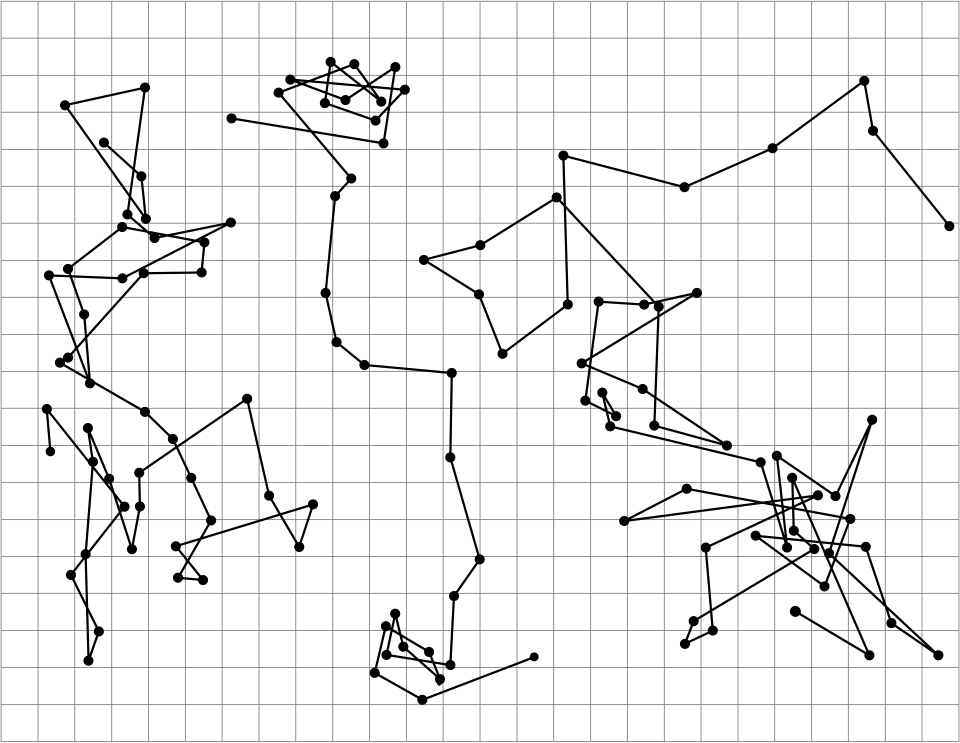

Brownian motion is the random motion of particles suspended in a medium (a liquid or a gas). The motion is caused by fast-moving atoms or molecules that hit the particles. Brownian Motion was discovered in 1827 by the botanist Robert Brown. In 1827, while looking through a microscope at particles trapped in cavities inside pollen grains in water, he noted that the particles moved through the water; but he was not able to find out what was causing this motion.
Atoms and molecules had long been theorised as the main parts of matter. Albert Einstein published a paper in 1905 that explained in precise detail how the motion that Brown had observed was a result of the pollen being moved by individual water molecules. This was one of his first big contributions to science, and convinced many scientists that atoms and molecules exist. It was further verified experimentally by Jean Perrin in 1908. The direction of the force of atomic bombardment is constantly changing, and at different times the particle is hit more on one side than another, leading to the seemingly random nature of the motion.
There are too many molecular impacts making the Brownian pattern, so no scientific model can account for all of them. That is why only probabilistic models of molecular populations can be used to describe it. Two such models of the statistical mechanics were made by Einstein and Smoluchowski. Another, pure probabilistic kind of models are stochastic process models. There exist both simpler and more complicated stochastic processes which in extreme (“taken to the limit”) may describe the Brownian Motion (see random walk and Donsker’s theorem).
Norbert Wiener also studied Brownian Movement, with greater mathematical precision.
History
The Roman Lucretius’s scientific poem “On the Nature of Things” (c. 60 BC) has a description of Brownian motion of dust particles in verses 113–140 from Book II. He uses this to help people know for sure of the existence of atoms:
“Observe what happens when sunlight is let into a building and small building light on its shadowy places. You will see an amount of tiny particles moving in an amount of ways…”
While Jan Ingenhousz described the strange motion of coal dust particles on the top of alcohol in 1785, the discovery of this is often given to the botanist Robert Brown in 1827. Brown was studying pollen grains of the plant Clarkia pulchella suspended in water under a microscope when he observed minute particles, ejected by the pollen grains, executing a jittery motion. By repeating the experiment with particles of inorganic matter he was able to rule out that the motion was life-related, although its origin was not known yet.
The first person to describe the mathematics behind Brownian motion was Thorvald N. Thiele in a paper on the method of least squares published in 1880. This was followed by Louis Bachelier in 1900 in his PhD thesis “The Theory of Speculation”, in which he presented an analysis of the stock and option markets. The Brownian motion model of the stock market is often used, but Benoit Mandelbrot denied its applicability to stock movements.
Albert Einstein (in one of his 1905 papers) and Marian Smoluchowski (1906) brought the solution of the problem to the attention of physicists, and presented it as a way to indirectly confirm the existence of atoms and molecules. Their equations describing Brownian motion were checked by the experimental work of Jean Baptiste Perrin in 1908. Perrin was awarded the Nobel Prize in Physics in 1926 “for his work on the discontinuous structure of matter”.
Written for younger readers
Brownian motion, in simpler words
This version comes from Wikijunior, a set of books written for children aged 8 to 11. It is shorter and uses plainer language than the article above.
From Wikijunior: Particles
Apart from diffusion, there is another interesting phenomenon that can be observed. It is called the Brownian motion, discovered by a scientist called Brown.
Before we start on Brownian motion, let’s look at an interesting experiment. A smoke cell is a small box full of smoke and air. If you have one (or your teacher gives you one), place it under a microscope. Otherwise, there is a short clip here. As you can see, the bits of smoke move at random directions, unassisted. Or do they?
Smoke particles are larger than air particles. That’s why we can see the smoke particles better than the air particles. As you will learn later, gas particles always move at high speed, in random directions. The same things is happening to the air particles. When an air particle bombards a smoke particles, the smoke particle moves to the same direction as the air particle that hit it. When another air particle hits the smoke particle, it changes its direction to that of the second air particle, and so on. This is called Brownian motion.
Image:Brownian motion 1.svg|What will happen to the small black particle on top and the large blue particle when they collide? Image:Brownian motion 2.svg|Their directions will change.
The Brownian motion was discovered by, and named after, a botanist called Robert Brown. A botanist is a person who studies plants. In 1827, he was observing some pollen grains when he saw that the pollen grains were moving mysteriously. Do you know why the pollen grains were moving like that? The movement of the water particles causes that of the pollen grains, enabling them to move in random, constantly changing directions. This is what Robert Brown later figured out.
- Brownian motion is named after:
- Charlie Brown
- Gordon Brown
- Robert Brown
- John Brown
- Which of the statements below best describes of movements of particles in a smoke cell?
- The smoke particles flow to places of higher concentration
- The air particles flow to places of lower concentration
- The smoke particles dodge the air particles, thereby causing the smoke particles to rotate
- The air particles hit the smoke particles, thereby causing them to move in random directions
Answers:
- 3
- 4
Where this page comes from
The article above is adapted from “Brownian motion” on Simple English Wikipedia, by its contributors. We removed reference markers, navigation boxes and tables, expanded measurement templates into readable numbers, and kept the prose otherwise intact. The simpler version is adapted from Wikijunior on Wikibooks.
Both sources are published under CC BY-SA 4.0, so this page is published under the same licence. You may share and adapt it, including commercially, as long as you credit the original and keep the same licence.
Worksheets, answer keys and printable layouts elsewhere on K5Print are our own work and are not covered by this licence.