Chlorine
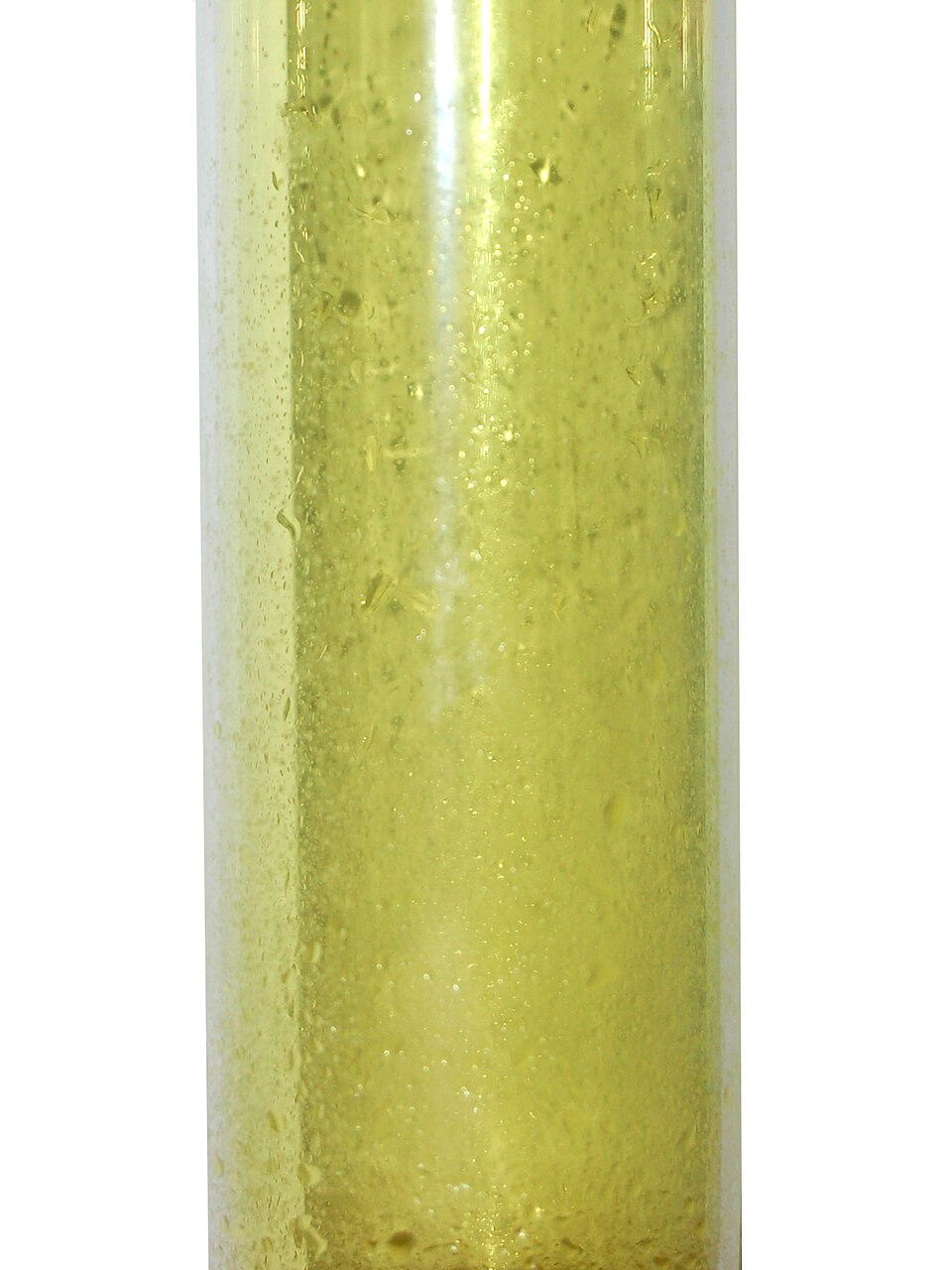

Chlorine (chemical symbol Cl) is a chemical element. Its atomic number (which is the number of protons in it) is 17, and its atomic mass is 35.45. It is part of the 7th column (halogens) on the periodic table of elements.
Physical properties
Chlorine is a very irritating and greenish-yellow gas. It has a strong, bleach-like smell. It is toxic and bad for you. It can be made into a liquid when cooled. It is heavier than air.
Chemical properties
Chlorine is highly reactive. It is more reactive than bromine but less reactive than fluorine. It reacts with most things to make chlorides. It can even burn things instead of oxygen. It dissolves in water to make a mixture of hypochlorous acid and hydrochloric acid. The more acidic it is, the more chlorine is made; the more basic it is, the more hypochlorous acid (normally turned into hypochlorite) and hydrochloric acid (normally turned into chlorides) are there. Chlorine reacts with bromides and iodides to make bromine and iodine.
Chlorine compounds
Chlorine exists in several oxidation states: -1, +1, +3, +4, +5, and +7. The -1 state is most often in chloride. Chlorides are not reactive. Compounds containing chlorine in its +1 oxidation state are hypochlorites. Only one is common. They are a strong oxidizing agent, as are all + oxidation state compounds. +3 is in chlorites. +4 is in chlorine dioxide, a common chlorine compound that is not a chloride. +5 is in chlorates. +7 is in perchlorates. Hypochlorites are most reactive, while perchlorates are the least reactive.
Many organic compounds have chlorine in them. Freon has chlorine in it. PVC (poly-vinyl chloride), a common plastic, has chlorine in it.
Chlorine oxides can be made, but most of them are very reactive and unstable.
File:Chloroform_by_Danny_S._-_002.JPG|Chloroform is 89% chlorine by molecular weight File:PVC pressure.jpg|PVC pipe, a plastic that has chlorine in it File:Selpologne.jpg|Sodium chloride File:KClO3.jpg|Potassium chlorate File:Perclorato de Potássio.jpg|Potassium perchlorate
Occurrence
Chlorine is not found as an element. Sodium chloride is the most common chlorine ore. It is in the ocean (sea salt) and in the ground (rock salt). There are some organic compounds that have chlorine in them, too.
Preparation
It is made by electrolysis (the passing of electricity through a solution to make chemical reactions happen) of sodium chloride. This is known as the chloralkali process. It can also be made by reacting hydrogen chloride with oxygen and a catalyst. It can be made in the laboratory by reacting manganese dioxide with hydrochloric acid. It is made when sodium hypochlorite reacts with hydrochloric acid. This is a dangerous reaction that can happen without anyone knowing.
For water purification
As of 2021, the main use of chlorine is for bleach. It is also added to water, as a way of purifying it. Chlorine is both very reactive, and very poisonous. It will act as a disinfectant: if it is added to water, it will kill off bacteria and other organisms. Swimming pools are often filled with water that has been treated that way.
As a chemical weapon
Germany used chlorine as a chemical weapon in the First World War. They used it at the Second Battle of Ypres in 1915. According to soldiers, which were present at the battle, the chlorine smelled like a mixture of pepper and pineapple. It also tasted metallic and stung the back of the throat and chest. Chlorine reacts with water in the mucosa of the lungs to form hydrochloric acid. Hydrochloric acid will destroy living tissue. It often kills. Gas masks with activated charcoal or other filters can protect the respiratory system. This makes chlorine gas much less deadly than other chemical weapons. German scientist Fritz Haber of the Kaiser Wilhelm Institute in Berlin was the first to use it. Together with IG Farben, he developed methods of how to use chlorine gas against an entrenched enemy. Chlorine is heavier than air, so it will stay in the trenches. On 22nd April, 1915, German forces attacked the French army. With 150 tonnes of chlorine, they only killed about 1.200 French soldiers. For this reason, chlorine was soon replaced with the more deadly phosgene and mustard gas.
Because it is easily available, chlorine is still used as a chemical weapon in war. That way, it has been used in the Syrian civil war. It has also been used in an improvised explosive device in Iraq, in 2015.
Other uses
Chlorine is used to make many compounds that are important: both chloroform and carbon tetrachloride contain chlorine.
History
It was discovered in 1774 by Carl Wilhelm Scheele who thought it had oxygen in it. Chlorine was named in 1810 by Humphry Davy who insisted it was an element. The US made all water chlorinated (added chlorine to water) by 1918.
Safety
It is poisonous in large amounts and can damage skin. When it is inhaled (breathed in), it irritates the lungs, eyes, and skin badly. It can cause fire with some things because it is very reactive. It is heavier than air, so it can fill up enclosed spaces.
Written for younger readers
Chlorine, in simpler words
This version comes from Wikijunior, a set of books written for children aged 8 to 11. It is shorter and uses plainer language than the article above.
From Wikijunior: The Elements
NOTOC
Chlorine as an element is a pale green, poisonous gas with a suffocating odor. Chlorine as a chemical cleaner (in a solution with water) is a liquid, which is colorless with little odor, and a distinctly chemical taste. Chlorine can cause a burning sensation on the skin.
Chlorine was discovered in 1774 by Swedish chemist Carl Wilhelm Scheele.
Chlorine gets its name from the Greek word chloros, which means “pale green”.
Did You Know?
- Rock salt was used as early as 3000 BC and brine as early as 6000 BC.
- Chloride, the ionic form of Chlorine, is the most abundant dissolved substance in seawater.
- Nearly all elements in the periodic table form binary chlorides.
- Elemental chlorine is commercially produced from brine by electrolysis,
In nature, chlorine is mostly found as chloride, the ionic form of chlorine. Chloride is very common in seawater as part of sodium chloride, the scientific name for salt. In a laboratory, chlorine gas can be generated by the rapid combination of a strong base and a strong acid, or by running electricity through a solution of table salt (which is NaCl, the most common salt in seawater and the best-known, and probably the most common, chlorine compound n the world.)
Chlorine is commonly used to purify water so it is clean enough to bath in. Almost all public pools use chlorine as a cleaning chemical for water. Chlorinated water can be toxic at high concentrations. Chlorine as a gas is incredibly dangerous, and has been used as a chemical weapon. Chlorine is also used in bleaches.
Yes, when chlorine is concentrated in a gaseous form, it is extremely toxic to humans, killing within minutes of exposure. The gas burns lungs when it is inhaled, and victims of inhalation most often die of a combination of asphyxiations and internal bleeding from damage to the airways.
Where this page comes from
The article above is adapted from “Chlorine” on Simple English Wikipedia, by its contributors. We removed reference markers, navigation boxes and tables, expanded measurement templates into readable numbers, and kept the prose otherwise intact. The simpler version is adapted from Wikijunior on Wikibooks.
Both sources are published under CC BY-SA 4.0, so this page is published under the same licence. You may share and adapt it, including commercially, as long as you credit the original and keep the same licence.
Worksheets, answer keys and printable layouts elsewhere on K5Print are our own work and are not covered by this licence.