Diffusion
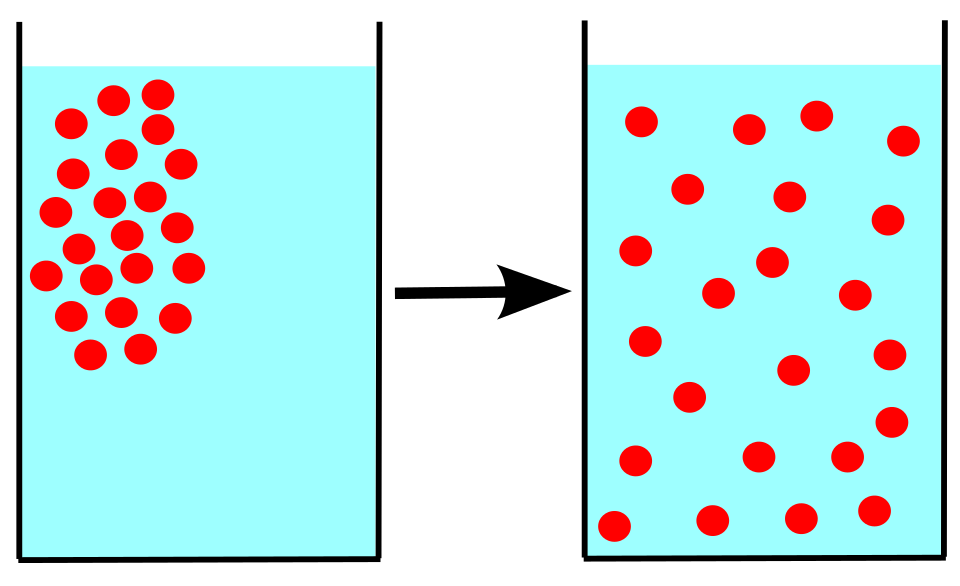

Diffusion is a process where molecules of a material move from an area of high concentration (where there are many molecules) to an area of low concentration (where there are fewer molecules)until it has reached equilibrium (molecules evenly spread).
Diffusion usually happens in a mixture in gas, a liquid and occasionally colloids. It is possible to see diffusion happening when two liquids are mixed in a transparent container. It describes the constant movement of particles in all liquids, gases and colloids. These particles move in all directions bumping into each other.
Examples
- A sugar cube is left in a beaker of water for a while.
- The smell of ammonia spreads from the front of the classroom to the back of the room.
- Fumes of perfume rise from the bottle when the top is removed.
- Food coloring dropped on the beaker spreads out.
- the smell of food spread in the whole house
Molecules tend to move from places of high concentration to places of low concentration, just by moving randomly. For example, there is more oxygen in a lung than there is oxygen in the blood so oxygen molecules will tend to move into the blood. Similarly, there is more carbon dioxide molecules in the blood than in the lung so carbon dioxide molecules will tend to move into the lung. It happens in cell biology, where small molecules simply diffuse through the cell membrane, but larger molecules only get through by using energy: see active transport.
The random movement of fluid molecules makes them spread out until a boundary stops them.
Diffusion is a passive process, therefore does not require energy as it occurs down a concentration gradient.
Osmosis and heat transfer are types of diffusion.
Rate of diffusion
Diffusion is affected by:
- the concentration gradient - diffusion will be greater when the gradient is larger
- the temperatures - diffusion will happen faster when temperatures are higher as there is more kinetic energy
- the surface area - diffusion will be greater where the surface area is greater
- the diffusion distance - diffusion will be greater where there is a short diffusion distance
Surface area and volume
In small unicellular organism s, simple diffusion can exchange molecules quickly enough to keep them alive. A high surface area to volume ratio helps.
However, for multicellular organism simple diffusion is not enough. They need to move more material over longer distances to remain alive. They have evolved to have internal structures and systems for rapid distribution movement. For example, humans have lungs to make diffusion happen rapidly. The same happens in plants with the leaf.
Written for younger readers
Diffusion, in simpler words
This version comes from Wikijunior, a set of books written for children aged 8 to 11. It is shorter and uses plainer language than the article above.
From Wikijunior: Particles
As we have found in the last chapter, particles are always moving. However, how exactly would they move? A common phenomenon observed from the movement of particles is diffusion. Diffusion means a kind of particles going from a place of higher concentration to a place of lower concentration. Imagine a herd of lions and a herd of tigers mixed together. If diffusion happens, lions will go to a place with more tigers than lions, and tigers will go to a place with less tigers than lions. At the end, the tigers and lions will be mixed more thoroughly. That is what particles are like during diffusion.
If you dip a paintbrush with a bit of red paint on the tip into a cup of water, the paint will spread all over the cup. The red will spread to places that are more transparent, while the transparency spreads to places that are redder. At the end, the paint and water will be thoroughly mixed so the water is red. (Here we assume that the paint is soluble in water.)
Another example is smell. Imagine a piece of stilton cheese is placed on a table in a corner of a room. You are standing on the opposite corner, a friend of yours is standing in the centre, and another friend is standing right next to the stilton cheese. You must be the last to smell it.
This experiment is inspired from an experiment from the following source:
- Put a drop of perfume into a plastic bag, then tie up its opening.
- Sniff. You can’t smell perfume yet.
- Wait a little bit, sniff again. You should be able to smell perfume now.
This experiment proves that there are spaces between the particles of the wall of the plastic bag, and that the perfume diffuses. When the perfume on the bottom of the bag diffuses, it flies to the wall of the bag. As the perfume particles are small enough, they escape through the gaps between the plastic particles and into your nose.
If A and B are to meet, do you think A will come to B or B will come to A? Why?
Answer: B will come to A. This is because A is in a place of lower concentration while B is in a place of higher concentration. B will flow to A’s place because of diffusion.
Where this page comes from
The article above is adapted from “Diffusion” on Simple English Wikipedia, by its contributors. We removed reference markers, navigation boxes and tables, expanded measurement templates into readable numbers, and kept the prose otherwise intact. The simpler version is adapted from Wikijunior on Wikibooks.
Both sources are published under CC BY-SA 4.0, so this page is published under the same licence. You may share and adapt it, including commercially, as long as you credit the original and keep the same licence.
Worksheets, answer keys and printable layouts elsewhere on K5Print are our own work and are not covered by this licence.