Frequency
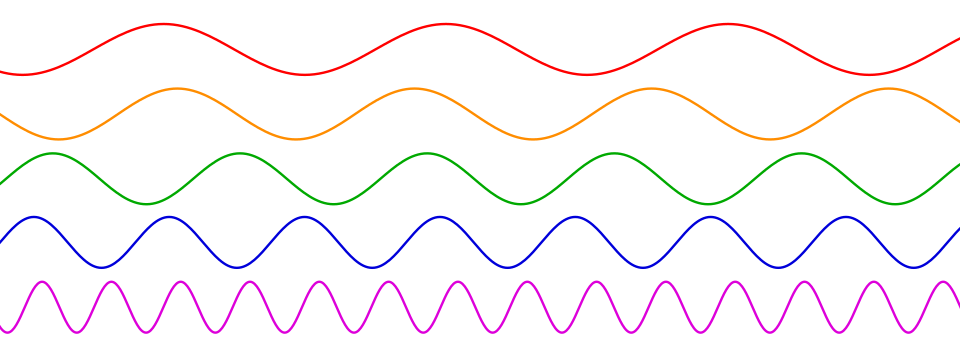

Frequency is how often an event repeats itself over a set amount of time.
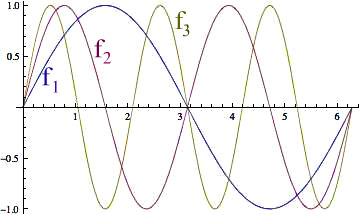
In physics, the frequency of a wave is the number of wave crests that pass a point in one second (a wave crest is the peak of the wave).
Hertz (symbol Hz) is the unit of frequency.
The relationship between frequency and wavelength is expressed by the formula:
where v is speed and \lambda (lambda) is wavelength. The formula for the frequency of light waves is f = c/\lambda where the c is the speed of light.
All electromagnetic waves travel at the speed of light in a vacuum but they travel at slower speeds when they travel through a medium that is not a vacuum. Other waves, such as sound waves, travel at much much lower speeds and can not travel through a vacuum.
Examples of electromagnetic waves are: light waves, radio waves, infrared radiation, microwaves, and gamma waves.
Visualizing electromagnetic waves
Different types of electromagnetic waves have different frequencies.
Example
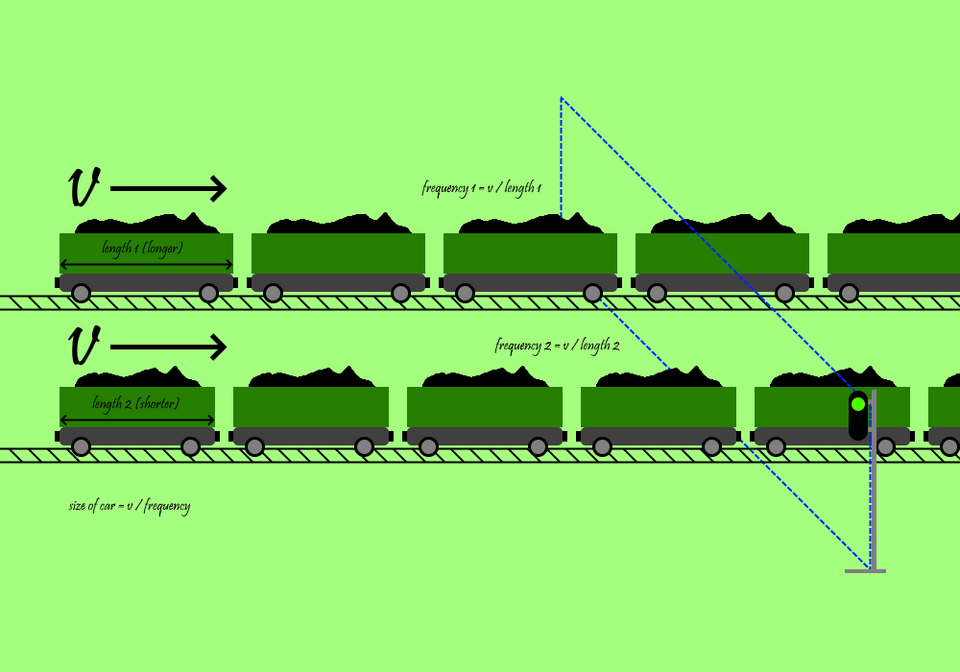
One way to visualize this is if there were two trains traveling at the same speed, but the size of the train cars was smaller on one train than the other. If someone picked something that was not moving, like a signpost, and then counted how many train cars passed the sign post in one second for each train, they would know the frequency of cars passing in each train. The number and frequency of train cars passing the sign post would be different, because the train with smaller train cars would have more train cars passing the sign post in a second than the train with larger train cars. Knowing how many cars passed the sign post in one second, and knowing the speed of the train, one could figure out mathematically the size of each train car for each train.
For example, if the train was moving at 10 miles per second, and 10 train cars passed in one second, then each train car would be 1 mile long. If the other train was also moving at 10 miles per second and 20 train cars passed in one second, then one would know that each train car was 1/2 of a mile long for that train. This example shows that knowing the frequency of an electromagnetic wave gives you the wavelength, since all electromagnetic waves travel at the speed of light so that c = v (lambda) where v is frequency and lambda is wavelength, and c is the speed of light. Therefore, another way of expressing frequency is to say frequency is c over lambda.
Where this page comes from
The article above is adapted from “Frequency” on Simple English Wikipedia, by its contributors. We removed reference markers, navigation boxes and tables, expanded measurement templates into readable numbers, and kept the prose otherwise intact.
Both sources are published under CC BY-SA 4.0, so this page is published under the same licence. You may share and adapt it, including commercially, as long as you credit the original and keep the same licence.
Worksheets, answer keys and printable layouts elsewhere on K5Print are our own work and are not covered by this licence.