Half-life
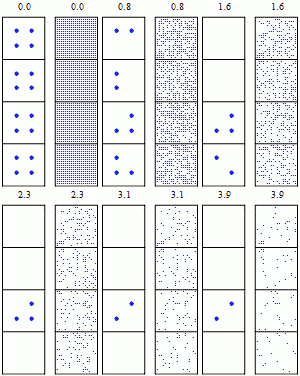

The half-life of a substance is the time it takes for half of the substance to decay. The word “half-life” was first used when talking about radioactive elements where the number of atoms get smaller over time by changing into different atoms. It is now used in other situations, such as the time it takes for a drug in the body to be half gone. A Geiger-Muller detector can be used to measure the radioactive half-life; it is the time when the activity is half the original.
Half-life depends on probability because the atoms decay at a random time. Half-life is the expected time when half the number of atoms have decayed, on average.
Radioactive isotopes are atoms that have unstable nuclei, meaning that the nucleus of each atom will decay after enough time has passed. Their nuclei are unstable because the arrangement of protons and neutrons in them change. This is known as radioactive decay. When they decay, they release particles such as alpha particles, beta particles, gamma rays. Sometimes they decay by fission, which means to break into pieces, to make smaller nuclei. For example, a radioactive carbon-14 atom releases a beta particle to become nitrogen-14. As an example of fission decay, a fermium-256 atom can split into xenon-140 and palladium-112 atoms, releasing four neutrons in the process.
Uranium-232 has a half-life of about 69 years. Plutonium-238 has a half-life of 88 years. Carbon-14, which is used to find the age of recent fossils, has a half-life of 5,730 years.
After ten half-lives, about 99.9% of the atoms have decayed into different atoms, so only 0.1% of the original atoms are left, and 99.9% of the radioactivity from the original kind of atom is gone. Some atoms decay into other atoms that are also radioactive, so the remaining radioactivity depends on the type of atom.
An example of a short half-life: the isotope, 260 Sg, has a half-life of approximately 4 ms (or 4 thousandths of a second).
Where this page comes from
The article above is adapted from “Half-life” on Simple English Wikipedia, by its contributors. We removed reference markers, navigation boxes and tables, expanded measurement templates into readable numbers, and kept the prose otherwise intact.
Both sources are published under CC BY-SA 4.0, so this page is published under the same licence. You may share and adapt it, including commercially, as long as you credit the original and keep the same licence.
Worksheets, answer keys and printable layouts elsewhere on K5Print are our own work and are not covered by this licence.