Hydrogen

Hydrogen is the lightest and most abundant element in the universe. It is the simplest element and the first in the periodic table. It has the chemical symbol H and atomic number 1, which means it has just one proton in its nucleus. Hydrogen also has a standard atomic weight of 1.008. Hydrogen is a colorless, odorless, and tasteless gas at room temperature. It is also highly flammable. When hydrogen burns in oxygen, it creates water and releases a lot of energy.
Hydrogen can be found as H₂ molecules. This means two hydrogen atoms join together to make a stable gas. It has a very low boiling and melting point, so it becomes a liquid or solid only at extremely cold temperatures. There are also different forms, or isotopes of hydrogen. The most common is protium, which has just one proton. There is also deuterium, which has one proton and one neutron, and tritium, which has one proton and two neutrons and is radioactive. Hydrogen is very reactive, especially with oxygen and other nonmetals. It often forms compounds like water (H₂O), methane (CH₄), and ammonia (NH₃).
Hydrogen is the most common element in the universe. It makes up 75% of all normal matter by mass. Most of the hydrogen is found in stars, including the Sun. It fuels the process of nuclear fusion, giving off light and heat. On Earth, hydrogen is not usually found as a pure gas because it is so light and reactive. Instead, it is most commonly found in compounds. It can be found especially in water (H₂O), which covers about 70% of Earth’s surface. Hydrogen is also found in living things, because it is part of many organic compounds, such as sugars, fats, and proteins. Hydrogen can be found in fossil fuels and in some minerals. It can also be found in volcanic gases and the upper atmosphere, where it slowly escapes into space because of its lightness.
Hydrogen is very reactive, especially because it has only one electron. This makes it easy for hydrogen to form bonds with other elements. It usually forms molecules like H₂, where two hydrogen atoms share their electrons to become more stable. Hydrogen reacts easily with oxygen to form water (H₂O). This reaction releases a lot of energy and is why hydrogen is used as a fuel in rockets and fuel cells. It also reacts with many nonmetals, such as chlorine, to form compounds like hydrogen chloride (HCl). Hydrogen can act as both a reducer (it gives electrons) and, in some cases, as an oxidizer (it takes electrons). Hydrogen can also form acids when combined with certain elements. For example, when it bonds with chlorine, it creates hydrochloric acid when dissolved in water. It can also form hydrides when it reacts with metals, where hydrogen behaves like a negatively charged ion.
The history of hydrogen goes back to the 1700s, when scientists first began studying gases. In 1766, the British scientist Henry Cavendish was the first to recognize hydrogen as a separate gas. He called it “inflammable air” because it burned easily and produced water when it reacted with air. Later, in 1783, the famous French scientist Antoine Lavoisier gave the gas its modern name: hydrogen, which means “water-former” in Greek. He realized that water is not an element but a compound made from hydrogen and oxygen. In the 1800s and 1900s, scientists learned more about hydrogen’s properties and uses. It became important in chemical industries, like making ammonia for fertilizer. It was also used in airships, although this was dangerous because hydrogen can catch fire easily. One tragic example was the Hindenburg disaster in 1937, when a hydrogen-filled airship caught fire. In the 20th and 21st centuries, liquid hydrogen was used as rocket fuel. It has also gained attention as a clean energy source.
Hydrogen does not exist freely in large amounts on Earth, so it must be produced by us. The two main ways to make hydrogen are steam reforming and electrolysis. Steam reforming is the most common method. It involves heating natural gas (mostly methane) with steam to release hydrogen. This process is widely used in industries. Electrolysis is another method that uses electricity to split water into hydrogen and oxygen. However, electrolysis is more expensive than steam reforming. Hydrogen can also be produced using other methods, such as biological processes (using bacteria or algae) and thermochemical reactions that use heat from nuclear or solar energy. Once produced, hydrogen is usually stored as a gas under pressure, or as a liquid at very low temperatures, so it can be used in industries, fuel cells, and rockets.
Hydrogen has many important uses in industry, science, and energy. One of its biggest uses is in making ammonia (NH₃) through the Haber process. Ammonia is used to produce fertilizers, which help grow food for people around the world. Hydrogen is also used in oil refineries to help remove sulfur from fuels. It is used in making methanol, which is a basic chemical for making plastics and other products. In energy, hydrogen is used as a clean fuel. It can power fuel cells, which produce electricity without pollution. The only byproduct is water. Fuel cells are used in some cars, buses, and even spacecrafts. Hydrogen is also important in space exploration. It is used as a rocket fuel because it burns with a lot of energy and produces only water vapor. Liquid hydrogen, combined with liquid oxygen, has been used to launch many rockets.
Properties
Hydrogen is grouped as a reactive nonmetal. This is different from the other elements found in the first group of the periodic table, which are called alkali metals. Only the solid form of hydrogen should behave like a metal, though.
When hydrogen is by itself, it will normally bind with itself to make dihydrogen (H 2 ). Dihydrogen is very stable because of its high bond-dissociation energy of 435.7 kJ/mol.
At normal temperature and pressure, hydrogen gas (H 2 ) has no color, smell, or taste. It is also not poisonous. This is because it is a nonmetal and burns very easily. Hydrogen gas at this state also has low density and is not corrosive.
Combustion
Molecular hydrogen is flammable and reacts with oxygen:
2 H 2 (g) + O 2 (g) → 2 H 2 O(l) + 572 kJ (286 kJ/mol)
Hydrogen gas can be very dangerous. It can explode when mixed with air or certain gases. If hydrogen gas makes up between 4% and 74% of the air, it can catch fire and explode. It can also explode when mixed with chlorine gas. This happens if the mixture has between 5% and 95% hydrogen.
Hydrogen can catch fire by itself if it gets hot enough. This happens at a temperature of about 500°C (932°F). In some cases, if hydrogen leaks out under high pressure, the force of the leak can heat the air around it to that temperature. This can cause the gas to burst into flames or even explode.
Hydrogen flames are hard to see. They burn with a faint blue color and give off ultraviolet light. The human eye cannot see ultraviolet light. In daylight, it is almost impossible to see a hydrogen fire. That is why special flame detectors are used to find hydrogen fires and keep people safe.
Compounds
While hydrogen gas in its natural form is not reactive, it does form compounds with many elements, especially halogens, which are very electronegative, meaning they want an electron very badly. Hydrogen also forms massive arrays with carbon atoms, forming hydrocarbons. The study of the properties of hydrocarbons is known as organic chemistry.
The H - anion (negatively charged atom) is named a hydride, though the word is not commonly used. An example of a hydride is lithium hydride (LiH), which is used as a “spark plug” in nuclear weapons.
Acids
Acids dissolved in water normally contain high levels of hydrogen ions, in other words, free protons. Their level is generally used to determine its pH, that is, the content of hydrogen ions in a volume. For example, hydrochloric acid, found in people’s stomachs, can dissociate into a chloride anion and a free proton, and the property of the free proton is how it can digest food by corroding it.
Though uncommon on Earth, the H 3 + cation is one of the most common ions in the universe.
Isotopes
Hydrogen has 7 known isotopes, two of which are stable ( 1 H and 2 H), which are commonly named protium and deuterium. The isotope 3 H is known as tritium, has a half-life of 12.33 years, and is produced in small amounts by cosmic rays. The 4 isotopes left have half-lives on the scale of yoctoseconds.
Hydrogen in nature
In its natural form on Earth, hydrogen is generally a gas. Hydrogen is also one of the parts that make up a water molecule. Hydrogen is important because it is the fuel that powers the Sun and other stars. Hydrogen makes up about 74% of the complete universe.
Natural hydrogen is normally made of two hydrogen atoms connected together. Scientists name these diatomic molecules. Hydrogen will have a chemical reaction when mixed with most other elements, though it has no color or smell.
Natural hydrogen is very uncommon in the Earth’s atmosphere, because nearly all primordial hydrogen would have escaped into space because of its weight. In nature, it is generally in water. Hydrogen is also in all living things, as a part of the organic compounds that living things are made of. In addition, hydrogen atoms can join with carbon atoms to form hydrocarbons. Petroleum and other fossil fuels are made of these hydrocarbons and commonly used to make energy.
Some other facts about hydrogen:
- It is a gas at room temperature
- It acts like a metal when it is solid.
- It is the lightest element in the Universe.
- It is the most common element in the Universe.
- It burns or explodes at temperatures higher than 1000°F / 528°C, such as in fire.
- It glows purple when it is in plasma state.
Big Bang (or the creation of our universe)
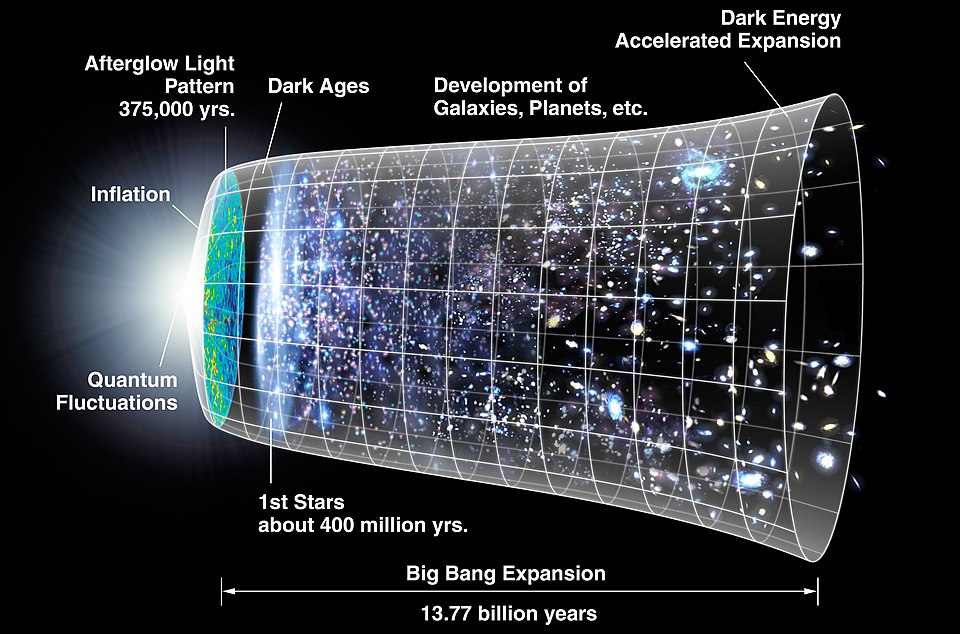
Hydrogen is the simplest element in the universe, made of just one proton and one electron. It is also the most common element, and most of it was formed very early in the history of the universe. Scientists believe that hydrogen was created about three minutes after the Big Bang, when the universe had expanded and cooled enough for protons and neutrons to stick together without being torn apart by high-energy radiation. This moment is known as Big Bang nucleosynthesis.
In the first few seconds after the Big Bang, the universe was so hot that particles like quarks and gluons were free. As things cooled, these particles combined to form protons and neutrons. Because neutrons are less stable, there were fewer of them compared to protons, about one neutron for every six protons. When the universe cooled even more, protons and neutrons could join together to make heavier particles. The first step was forming deuterium, which is one proton plus one neutron. Before this, deuterium could not survive because the universe was still too hot. This stage is called the “deuterium bottleneck.”
Once deuterium could survive, it allowed more nuclear reactions to happen. Most of the neutrons quickly got locked inside helium-4, a stable form of helium. Small amounts of helium-3, lithium-7, and beryllium-7 were also made. However, the majority of matter remained as hydrogen, mostly in the form of single protons. This meant that about 75% of the ordinary matter in the universe was hydrogen. At first, this hydrogen existed as plasma, with free protons and electrons spread everywhere.
It was not until about 380,000 years later that the universe cooled enough for electrons to join protons and form neutral hydrogen atoms. This event is called recombination. Once hydrogen atoms formed, light was able to travel freely through space, making the universe transparent. The leftover glow from this moment is called the cosmic microwave background, and scientists can still detect it today. Almost all hydrogen in the universe comes from this process, and its presence, along with small amounts of deuterium and helium, provides strong evidence that the Big Bang really happened.
Storage of hydrogen
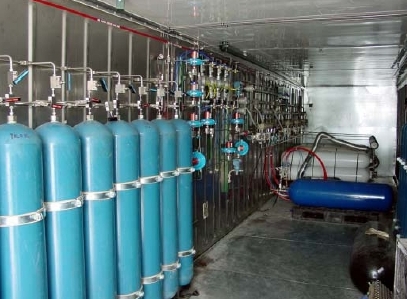
Hydrogen is being studied as a possible fuel of the future, but one of the hardest parts is figuring out how to store it safely and efficiently. Unlike gasoline or diesel, which are dense liquids, hydrogen is the lightest element in the universe. It exists as a gas made of two atoms (H₂). Because it is so light and has a very low density, storing enough hydrogen in a small space is very hard. It does not dissolve well in liquids either, which means you cannot just “mix” it into something like water or other solvents to store it. For example, at normal room temperature and pressure, only a tiny amount of hydrogen can dissolve in a liquid like diethyl ether. This is why scientists focus on other methods of storage, such as gas, liquid, or solid storage.
One common way to store hydrogen is by compressing it into high-pressure tanks. These tanks can hold hydrogen gas at pressures hundreds of times higher than normal air pressure. Cars that run on hydrogen often use this method. But there are problems. It takes a lot of energy to squeeze hydrogen into these tanks, the tanks themselves are heavy and expensive, and hydrogen is so tiny that it can leak out through materials. Another way is to cool hydrogen down until it becomes a liquid. This makes it much denser and easier to store, but hydrogen only becomes liquid at extremely cold temperatures, almost minus 240 °C. Keeping it that cold requires a lot of energy and special equipment, and liquid hydrogen tends to evaporate (called boil-off), wasting fuel.
Because of these problems, researchers have looked at “hydrogen carriers.” These are substances that can absorb hydrogen, hold onto it, and then release it later when needed. One example is metal hydrides, where hydrogen atoms fit into the tiny spaces inside a metal’s structure. This is useful in some ways, but most metals can only hold a small amount of hydrogen by weight, often just around 1%. Hydrogen can also damage metals, making them weaker in a process called embrittlement, which is a problem for pipes and storage containers.
Other chemical carriers can hold more hydrogen. Ammonia borane, for instance, contains about 20% hydrogen by weight, which is much better. However, once it releases hydrogen, the leftovers can’t easily take hydrogen back in, so the process is one-way and not very practical for long-term use. A more promising idea is using liquid organic hydrogen carriers (LOHCs). These are special liquids that can absorb hydrogen and then release it when needed, over and over again. The advantage is that they can be stored and transported using the same systems we already use for liquid fuels like gasoline, which makes them easier to fit into today’s infrastructure.
In the end, storing hydrogen is still a big challenge. Compressing and cooling it works but costs a lot of energy. Metals can hold it safely but do not store much. Some chemicals can carry a lot of hydrogen but cannot be reused easily. LOHCs look like one of the better solutions, but they are still being developed. Until scientists find the best balance of safety, efficiency, and cost, hydrogen storage will remain one of the key obstacles in making hydrogen a major energy source for the world.
Uses of Hydrogen
The most common uses are in the petroleum industry and in making ammonia by the Haber process. Some is used in other places in the chemical industry. A little of it is used as fuel, for example in rockets for spacecraft. Most of the hydrogen that people use comes from a chemical reaction between natural gas and steam.
Nuclear fusion
Nuclear fusion is a very powerful source of energy. It depends on forcing atoms together to make helium and energy, as in a star like the Sun, or in a hydrogen bomb. This needs a large amount of energy to get started, and is not easy to do currently. A big advantage over nuclear fission, which is used in today’s nuclear power stations, is that it makes less nuclear waste and does not use a poisonous and uncommon fuel like uranium. More than 600 million tons of hydrogen undergo fusion every second on the Sun.
Using hydrogen
Hydrogen is mostly used in the petroleum industry, to change heavy petroleum parts into lighter, more useful ones. It is also used to make ammonia. Smaller amounts are burned as fuel. Most hydrogen is made by a reaction between natural gas and steam.
The electrolysis of water breaks water into hydrogen and oxygen, using electricity. Burning hydrogen joins with oxygen molecules to make steam (natural water vapor). A fuel cell joins hydrogen with an oxygen molecule, releasing an electron as electricity. For these reasons, many people believe hydrogen power will replace other synthetic fuels in the future.
Hydrogen can also be burned to make heat for steam turbines or internal combustion engines. Like other synthetic fuels, hydrogen can be made from natural fuels such as coal or natural gas, or from electricity, and therefore represents a valuable addition to the power grid; in the same role as natural gas. Such a grid and infrastructure with fuel cell vehicles is now planned by a number of countries, such as Japan, Korea and many European countries. This lets these countries buy less petroleum, which is an economic advantage. The other advantage is that, used in a fuel cell or burned in a combustion engine as in a hydrogen car, the engine does not make pollution. Only water, and a small amount of nitrogen oxides, forms.
Written for younger readers
Hydrogen, in simpler words
This version comes from Wikijunior, a set of books written for children aged 8 to 11. It is shorter and uses plainer language than the article above.
From Wikijunior: The Elements
NOTOC
Hydrogen is an atom that contains an electron and a single proton. It is found at the very upper left of the periodic chart. The symbol for Hydrogen is the letter H. Hydrogen is both the lightest and most abundant element in the universe. Here is some data:
- Name: Hydrogen
- Symbol: H
- Atomic Number: 1
- Atomic Mass: 1.00794 amu
- Melting Point: -259.14 °C (14.009985 K, -434.45203 °F)
- Boiling Point: -252.87 °C (20.280005 K, -423.166 °F)
- Number of Protons and Electrons (same number): 1
- Number of Neutrons: 0
- Classification: Non-metal
- Color: Colorless
Hydrogen is the absolute smallest of all elements, so small that four billion atoms, laid end to end, could fit on the head of one pin! At room temperature, hydrogen is a clear gas. Hydrogen gas (H 2 ) is a molecule made of two hydrogen atoms bonded together. It has no taste or odor and is not toxic. It takes a very, very low temperature and/or very high pressure to turn hydrogen into a liquid or a solid. One common molecule formed by hydrogen is water, or scientifically known as H 2 O. It has two hydrogen atoms and one oxygen atom. At room temperature, water is a clear liquid.
Henry Cavendish was the first to understand that hydrogen was a unique substance. In 1776, he produced hydrogen by mixing mercury with an acid. Hydrogen had actually been produced much earlier by the Swiss alchemist Paracelsus. He also added mixes of water samples in it to make water!
Hydrogen comes from Hydrogenes, which comes from Ancient Greek meaning “water-forming”. The element was named by Antoine Lavoisier in 1783. When hydrogen burns, it produces water.
Did You Know?
- Hydrogen is the smallest element.
- Hydrogen is the most abundant element in the universe.
- Hydrogen isn’t common in a pure form on Earth, but is mostly found as part of water.
- Hydrogen is the main fuel of stars and the only fuel for red dwarfs.
- Hydrogen makes a squeaking noise when it is set on fire.
Hydrogen in its atomic form is found commonly in space and stars. There are vast clouds of hydrogen in outer space. However much of the hydrogen in space is missing an electron, which means it is an ion. On Earth, hydrogen is commonly found as part of water molecules. Very little of it is in our atmosphere though, as it is so light that it can simply float to space! Many other molecules also contain hydrogen, such as propane and plastics. Some bacteria produce pure hydrogen gas as waste.
Hydrogen is very important for all living creatures including people to exist. It is found in every living thing on Earth, and also forms the oceans, rivers, lakes and clouds.
Hydrogen gas makes up most of the atmospheres of the gas giant planets Jupiter, Saturn, Uranus, and Neptune, which are massive planets in our solar system that have much stronger gravity and lower temperatures than Earth.
The largest application of hydrogen is for the processing (“upgrading”) of fossil fuels, and in the production of ammonia. Hydrogen can be used as a fuel source by burning it for heat or by using hydrogen fuel cells. A fuel cell is a device that produces electricity by safely combining hydrogen and oxygen.
Hydrogen is lighter than air, which allows it to rise. If it is put into a container such as a balloon, it can lift it very high! In the past, it was used to lift many airships, which are massive balloon-like vehicles that were used to transport people long distances, like we use planes for nowadays. Unfortunately, it is much less safe than Helium, which isn’t flammable, so it is very rarely used for that purpose nowadays.
In the future, non-polluting cars may be fueled by hydrogen. The technology to make a hydrogen car already exists, but there are reasons you don’t see them on the road. Separating hydrogen from water takes energy. The energy needed to produce enough hydrogen to power a car can cause pollution. Also, it’s hard to carry enough hydrogen to power a vehicle for a long trip.
Stars give off light and heat because of the energy made when hydrogen atoms are merged (or fused) together to form heavier elements. Scientists are working to create a reactor that can make energy in the same way. This, however, is a very hard problem to solve and will take many years before we see useful fusion reactors built.
Elemental hydrogen is highly flammable, and when it is mixed with oxygen gas or with air it can burn or even explode. The Hindenburg Disaster was caused by this property, as the ship was filled with hydrogen instead of helium. When it caught fire, the ship was quickly engulfed in flame as the hydrogen inside quickly ignited and took the entire ship down. This terrible disaster could have been avoided if helium was used to lift it instead, but helium was very rare and expensive at the time so the airship’s builders were forced to use hydrogen instead.
While not toxic, hydrogen isn’t safe to breathe alone, as it cannot take the place of the oxygen that our bodies need to survive. As long as it’s mixed with enough normal air, it’s perfectly safe to breathe and it can even raise the pitch of your voice if you inhale some!
Where this page comes from
The article above is adapted from “Hydrogen” on Simple English Wikipedia, by its contributors. We removed reference markers, navigation boxes and tables, expanded measurement templates into readable numbers, and kept the prose otherwise intact. The simpler version is adapted from Wikijunior on Wikibooks.
Both sources are published under CC BY-SA 4.0, so this page is published under the same licence. You may share and adapt it, including commercially, as long as you credit the original and keep the same licence.
Worksheets, answer keys and printable layouts elsewhere on K5Print are our own work and are not covered by this licence.