Krypton
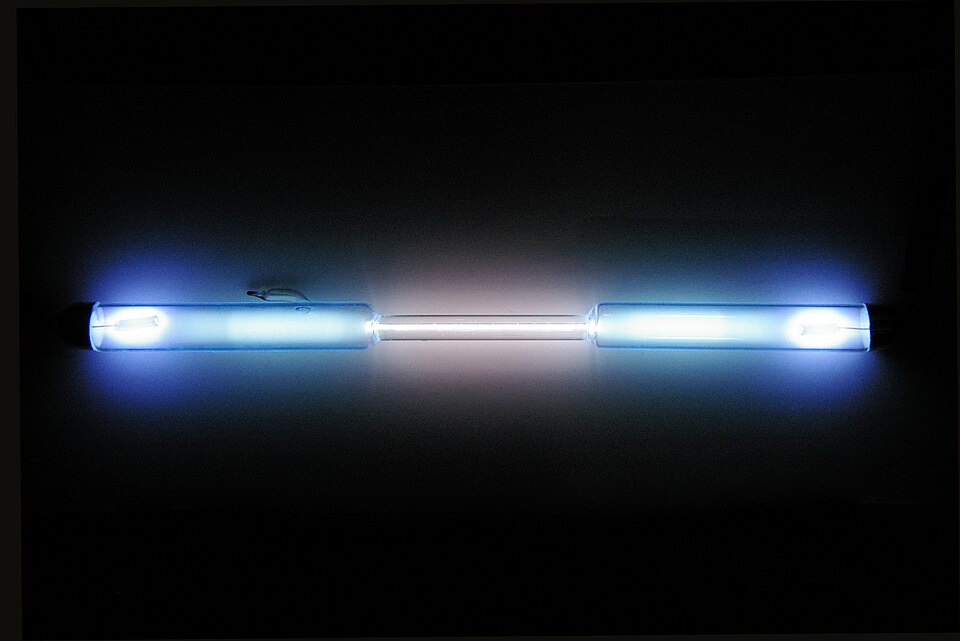

Krypton is a stable noble gas. It has an atomic number of 36. The name krypton comes from the Greek word kryptos meaning hidden. It is used in fluorescent lamps, flashbulbs, and as a wavelength standard. The metre used to be defined as 1,650,763.73 wavelengths in a vacuum of krypton gas.
Chemistry
Because it is a gas, it does not react with many elements. It is clear and has no taste or smell. The atmosphere is only about one millionth part krypton. Krypton has very few compounds.
Uses
The main use for krypton is to make light. There is one main type of krypton light bulbs. This is called a gas discharge lamp. There are three main types of these. First is a low energy gas discharge lamp or “neon light”. Low energy gas discharge lights made from krypton are near white to green. Second is a high energy short length of time gas discharge light or “flash bulb”. These are mostly used for photography. They are bright blue-white. Third is a high energy gas discharge light. This third kind is mostly used to light airport runways. They are also bright blue-white.
History
Krypton was found by Sir William Ramsay and Morris Travers in Great Britain in 1898. Ramsay was given the 1904 Nobel Prize in Chemistry for his work on noble gases. It was a difficult gas to discover; Ramsay suspected it existed but only found it by removing other gases. This is why he gave it the name Krypton. There is no mineral called Kryptonite or planet called Krypton, which both feature in the Superman comics by Jerry Siegel and Joe Shuster. The fictional planet is probably better known than the real chemical element called Krypton. It took until 1962 until a chemical compound containing Krypton was found.
Written for younger readers
Krypton, in simpler words
This version comes from Wikijunior, a set of books written for children aged 8 to 11. It is shorter and uses plainer language than the article above.
From Wikijunior: The Elements
NOTOC
Krypton is an odorless and colorless gas.
It was discovered on May 30, 1898 by Sir William Ramsay, a Scottish chemist, and Morris M. Travers, an English chemist. They discovered it by boiling liquified air and some of the liquid that was left was Krypton. Due to Krypton’s (relatively) high boiling point at -153.415 C, the more abundant gases or low boiling point gases evaporated and what was left was Krypton.
The name comes from the Greek word kryptos, which translates to English as hidden.
The only source for Krypton is the Earth’s atmosphere. It is believed that the Earth’s atmosphere is around 0.0001% Krypton gas.
Krypton is used as a filling gas in fluorescent light. It is also used for flash lamps and high speed photography. It can also be used for lasers and was also used in the Cold War to measure Soviet nuclear production.
Krypton is an odorless and colorless gas. Since it is a noble gas, it is inactive. Noble gases barely react to anything, so they are not considered dangerous. The only gas Krypton reacts to is Fluorine which creates Krypton Difluoride.
Where this page comes from
The article above is adapted from “Krypton” on Simple English Wikipedia, by its contributors. We removed reference markers, navigation boxes and tables, expanded measurement templates into readable numbers, and kept the prose otherwise intact. The simpler version is adapted from Wikijunior on Wikibooks.
Both sources are published under CC BY-SA 4.0, so this page is published under the same licence. You may share and adapt it, including commercially, as long as you credit the original and keep the same licence.
Worksheets, answer keys and printable layouts elsewhere on K5Print are our own work and are not covered by this licence.