Liquids
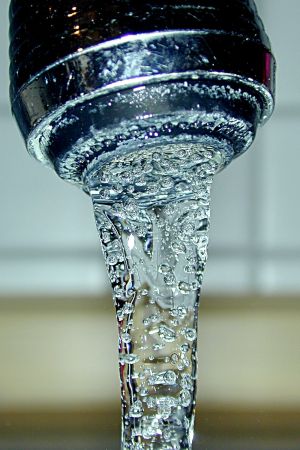

A liquid is a form of matter. It is settled between solid and gas. Liquid has an almost-fixed volume, but no set shape.
Every small force makes a liquid change its shape by flowing. Because of that, gravity makes liquids always take the shape of the container. The molecules that make up the liquid can freely move among themselves.
Fluids that flow slowly have a high viscosity. Some fluids like tar have such a high viscosity that they may seem solid.
It is difficult (near impossible) to compress a liquid. If a liquid is cooled down until it is colder than a certain temperature, it will become a solid. This temperature is called the melting point or freezing point and is different for every different type of liquid. If a liquid is heated up it becomes a gas. The temperature this happens at is called the boiling point.
Examples of liquid are water, oils, tar and blood.
In a liquid, the liquid on the top presses down on the liquid underneath, so at the bottom the pressure, p, is bigger than at the top. The equation for working this out is:
where z is the depth of the point below the surface and g is how strong gravity is pulling on the liquid. ρ is a number that tells us how heavy a set amount of the liquid is. We call this the density and it is different for all liquids.
Written for younger readers
Liquids, in simpler words
This version comes from Wikijunior, a set of books written for children aged 8 to 11. It is shorter and uses plainer language than the article above.
From Wikijunior: The Elements
=Liquids=
The second state of matter we will discuss is a liquid. Solids are hard things you can hold. Gases are floating around you and in bubbles. What is a liquid? Water is a liquid. Your blood is a liquid. Liquids are an in-between state of matter. They can be found in between the solid and gas states. They don’t have to be made up of the same compounds. If you have a variety of materials in a liquid, it is called a solution.
One characteristic of a liquid is that it will fill up the shape of a container. If you pour some water in a cup, it will fill up the bottom of the cup first and then fill the rest. The water will also take the shape of the cup. It fills the bottom first because of gravity. The top part of a liquid will usually have a flat surface. That flat surface is because of gravity too. Putting an ice cube (solid) into a cup will leave you with a cube in the middle of the cup; the shape won’t change until the ice becomes a liquid.
Another trait of liquids is that they are difficult to compress. When you compress something, you take a certain amount and force it into a smaller space. Solids are very difficult to compress and gases are very easy. Liquids are in the middle but tend to be difficult. When you compress something, you force the atoms closer together. When pressure goes up, substances are compressed. Liquids already have their atoms close together, so they are hard to compress. Many shock absorbers in cars compress liquids.
A special force keeps liquids together. Solids are stuck together and you have to force them apart. Gases bounce everywhere and they try to spread themselves out. Liquids actually want to stick together. There will always be the occasional evaporation where extra energy gets a molecule excited and the molecule leaves the system. Overall, liquids have cohesive (sticky) forces at work that hold the molecules together.
A supercooled liquid is a liquid that is put in conditions where the temperature is dropped below zero very rapidly. The result is that the liquid is still liquid, but acts like a solid. It is hard and cannot have its shape changed easily. Glass used in windows is a supercooled liquid. Normal glass is in fact the liquid form of sand, or silicon dioxide. If a pane of glass was left for hundreds of years, it would eventually start to drip, like normal liquids.
Where this page comes from
The article above is adapted from “Liquids” on Simple English Wikipedia, by its contributors. We removed reference markers, navigation boxes and tables, expanded measurement templates into readable numbers, and kept the prose otherwise intact. The simpler version is adapted from Wikijunior on Wikibooks.
Both sources are published under CC BY-SA 4.0, so this page is published under the same licence. You may share and adapt it, including commercially, as long as you credit the original and keep the same licence.
Worksheets, answer keys and printable layouts elsewhere on K5Print are our own work and are not covered by this licence.