Magnesium
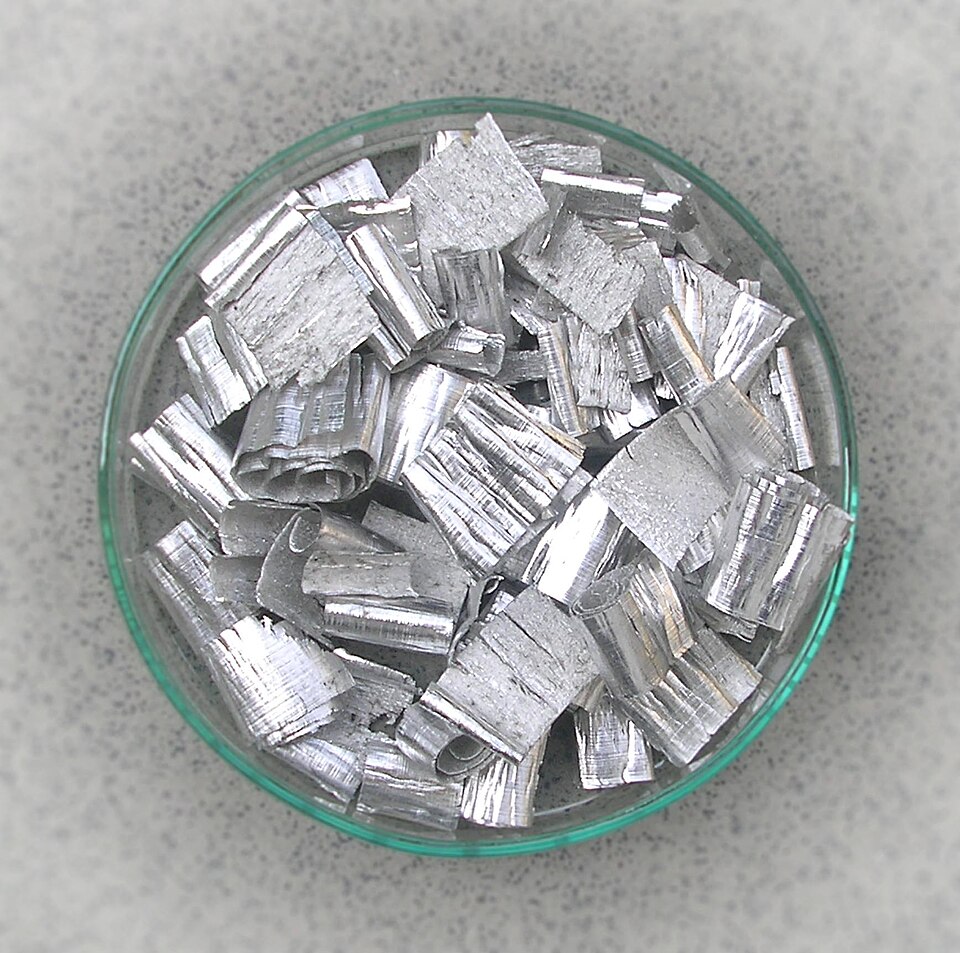

Magnesium ( /mæɡˈniːziəm/ mag-NEE-zee-əm) is a chemical element. It has the symbol Mg, atomic number 12 and common oxidation state +2. It is an alkaline earth metal and the eighth most abundant element in the Earth’s crust. It makes up 2% of the mass of the crust. It is the ninth most common element in the known universe. This is because it is easily built up in supernova stars by addition of three helium nuclei to carbon (which in turn is made from three helium nuclei). Magnesium ion’s high solubility in water helps ensure that it is the third most abundant element dissolved in seawater.
Magnesium is the 11th most abundant element by mass in the human body. Its ions are essential to all living cells. The ions play a major role in manipulating important biological polyphosphate compounds like ATP, DNA, and RNA. Hundreds of enzymes thus require magnesium ions to function. Magnesium is also the metallic ion at the center of chlorophyll. It is a common additive to fertilizers. Magnesium ions are sour to the taste, and in low concentrations help to impart a natural tartness to fresh mineral waters.
The free element (metal) is not found naturally on Earth, as it is highly reactive (though once produced, it is coated in a thin layer of oxide (see passivation), which partly masks this reactivity). The free metal burns with a brilliant white light, making it a useful ingredient in flares. The metal is now mainly obtained by electrolysis of magnesium salts obtained from brine.
Uses
Commercially, the main use for the metal is as an alloying agent to make aluminium-magnesium alloys, sometimes called “magnalium” or “magnelium”. Since magnesium is less dense than aluminium, these alloys are prized for their relative lightness and strength.
Magnesium is used in fireworks to make a brilliant bright light. Another use is to mix it with other metals to make it strong, lightweight alloys such as those used to make bicycle frames.
Magnesium compounds are used medicinally as common laxatives, antacids (i.e. milk of magnesia), and where stabilization of abnormal nerve excitation and blood vessel spasm is required (that is, to treat eclampsia).
Magnesium is used in electronic devices, including: mobile phones, laptop computers, cameras, and other electronic components. Magnesium’s low weight, good mechanical and electrical properties are good for these uses.
Magnesium reacted with an alkyl halide gives a Gringard reagent, which is a very useful tool for preparing alcohols.
Magnesium is also used in incendiary bombs, which are bombs that blow up and spread fire everywhere.
Alloys
As of 2013, magnesium alloys was used less than one million tonnes per year. This was a lot less than aluminium alloys. In the same year, 50 million tonnes of aluminium alloys were used. Using magnesium alloys have limited. This is because magnesium alloys can corrode, creep at high temperatures, and combust.
Compounds
Magnesium can makes many different compound. They are important in industry and biology. Some common magnesium compounds are magnesium carbonate, magnesium chloride, magnesium citrate, magnesium hydroxide, magnesium oxide, magnesium sulfate, and magnesium sulfate heptahydrate (Epsom salts).
Isotopes
Magnesium has three stable isotopes. These isotopes are , and . All of these isotopes are very common in nature. About 79% of Mg is . The isotope is radioactive. In the 1950s to 1970s, many nuclear power plants made for experiments. This isotope has a fairly short half-life of 21 hours.
Safety
Magnesium burns at a very high temperature, and cannot be put out with water or an ordinary fire extinguisher. It must be extinguished with a class D fire extinguisher. Burning magnesium also produces ultraviolet radiation, which can harm the eyes if it is viewed directly.
Written for younger readers
Magnesium, in simpler words
This version comes from Wikijunior, a set of books written for children aged 8 to 11. It is shorter and uses plainer language than the article above.
From Wikijunior: The Elements
NOTOC
Magnesium is the twelth symbol on the Periodic Table.
Magnesium as a metal is silver-white and lightweight. It is pictured here in a stick, but it also comes in powder form. Surprisingly, it can be bought by the average person, usually for medical reasons. Magnesium is also softer than other metals. If you’ve ever tried to bend a metal spoon (these are usually made of steel, a very strong metal) you probably couldn’t. If that same spoon was made of magnesium, you could easily bend it. It doesn’t smell like anything on its own, because metals don’t really smell like anything. The smell you think of when you think of metals is because of a reaction between the oil on your hands and the metal.
Magnesium is a solid at room temperature. It becomes dull or discolored when reacting with oxygen in the air. This process is known as tarnishing. When exposed to water, magnesium produces hydrogen gas.
Magnesium burns with a bright white light.
In 1755, the chemist Joesph Black experimented with magnesia alba (magnesium carbonate) a treatment for digestive disorders. His work was important for chemistry, but he did not determine that magnesium was an element.
Sir Humphry Davy electrolytically isolated pure magnesium metal in 1808. He passed an electric current through a mixture of magnesium oxide and mercuric oxide. The process was called electrolysis. The result was separation of pure magnesium metal from the mixture.
The element magnesium was named by English scientist Sir Humphrey Davy. He named it after the Magnesia region of Greece on the Aegean Sea. The area has numerous mineral deposits rich in magnesium. Did You Know?
- Magnesium is the eighth most abundant element.
- 1.3 kilograms of magnesium can be found in every cubic kilometer of sea water.
- Magnesium is used in marine flares and fireworks to produce a brilliant white light.
Magnesium as a pure metal is not found in nature. Magnesium oxide (MgO) is found in the Earth’s crust. Magnesium is not directly mined from magnesium oxide. Instead, it is primarily extracted from magnesium-rich minerals such as dolomite and magnesite.
Magnesium is the third most common mineral dissolved in ocean water, after chloride and sodium. Much of the magnesium used in the United States is extracted from sea water.
Magnesium can be found in green vegetables, especially darker green ones. This is because chlorophyll, the green pigment in plants, contains magnesium.
Magnesium is necessary for all living cells. It is used to help our body make molecules like DNA. Plants also use magnesium as a part of chlorophyll for photosynthesis. In the human body magnesium helps maintain strong bones and a healthy heart.
Magnesium burns very bright white. In the old days, magnesium could be used as a light source and was used to create the flash for cameras. Now, it is used in some fireworks. It is also used to make incendiary bombs.
Since magnesium is one-third lighter than aluminum, it is combined with other metals to make missiles and aircraft. Many automakers use magnesium alloys in their vehicles. Some car batteries use magnesium.
Magnesium alloys are made with aluminum, silicon, manganese, zinc, and copper. They are suitable for making devices such as cameras, mobile phones, and laptop computers.
Magnesium alloys are used for bicycle frames, wheels, and pedals. They provide strength and a smooth ride.
Magnesium is also used for construction. It is known as one of the lightest metals that can be used for construction.
Some magnesium compounds are important for health care. Magnesium oxide (MgO), also called magnesia, is used in some stomach antacids. Magnesium is also used to make Epsom salts, which is used to treat minor skin abrasions and soothe sore muscles.
A magnesium compound creates the light producing ability of creatures such as fireflies. This ability to produce light is called “bioluminescence”.
In agriculture, magnesium-based fertilizers are used to enhance crop yields. They replenish magnesium lost from the soil and promote healthy plant growth.
Magnesium is highly flammable, and the bright light it gives off can damage the eyes. Never place it in fire, as it burns at an EXTREMELY high temperature, and never throw it into an acid which might cause the release of flammable hydrogen gas. Keep it away from children.
Where this page comes from
The article above is adapted from “Magnesium” on Simple English Wikipedia, by its contributors. We removed reference markers, navigation boxes and tables, expanded measurement templates into readable numbers, and kept the prose otherwise intact. The simpler version is adapted from Wikijunior on Wikibooks.
Both sources are published under CC BY-SA 4.0, so this page is published under the same licence. You may share and adapt it, including commercially, as long as you credit the original and keep the same licence.
Worksheets, answer keys and printable layouts elsewhere on K5Print are our own work and are not covered by this licence.