Neon
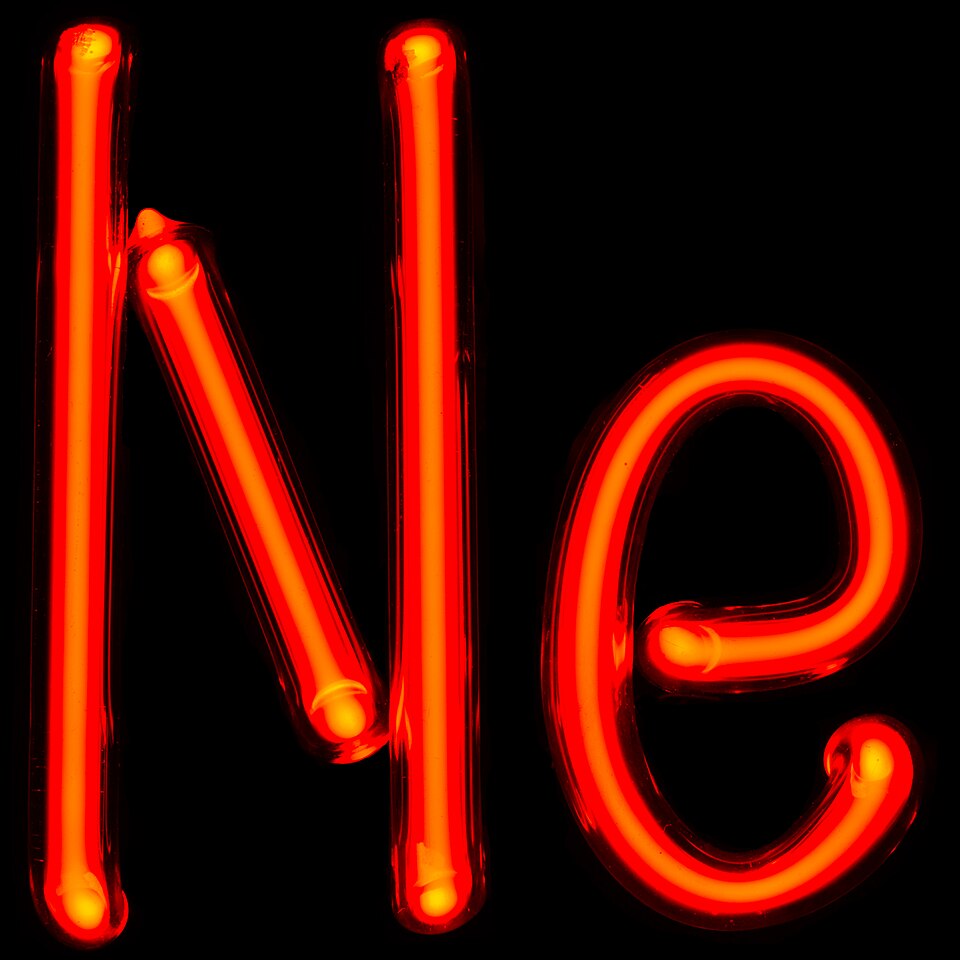

Neon is a chemical element on the periodic table. It is part of the noble gas group and it has an atomic number of 10. It is an odorless and tasteless gas (at 15 degrees Celsius at standard pressure).
Neon does not react with other elements, so it is found by itself. There is not much neon in the air, and it is clear, so we do not see it.
It was previously thought that Neon could not bond with any other elements, creating compounds. However, there have been a few compounds that have been made with neon, such as NeAuF and NeBeS.
History
Two British scientists, Sir William Ramsay and Morris Travers, discovered neon, argon, krypton, and xenon. Together they discovered a brand new gas element in 1898. Four years before, Ramsay, a physical chemist, had found argon and was the first person to isolate helium in 1895. The scientists froze argon, using liquid air, and then evaporated this to collect the gas that is produced. Using a high voltage, they collected the first sample of the gas. To their surprise, the gas illuminated the glass tubes and glowed with bright crimson light.
Upon discovery, the two scientists decided to name the new gas Neon, after the Greek word Neos, meaning the new one. While Ramsay and Travers discovered neon gas, they didn’t invent neon lamps. It wasn’t until 1902 when French engineer and inventor Georges Claude showcased the first neon light.
Uses
Neon gas is used in gas discharge lamps. When electricity goes through the neon, it lights up red. Due to this quality, it is used in light up signs. Similar signs use other gases to make other colors, but they are also often called “neon signs”. Neon is also a term referring to a type of color that is very bright, such as lime green.
Written for younger readers
Neon, in simpler words
This version comes from Wikijunior, a set of books written for children aged 8 to 11. It is shorter and uses plainer language than the article above.
From Wikijunior: The Elements
NOTOC
Neon is a colorless, odorless gas at room temperature.
It was discovered by Scottish chemist William Ramsay and English chemist Morris Travers in 1898 in London, England.
Neon gets its name from Greek neos, meaning “new”. Did You Know?
- Neon is used in lighting.
- Neon, when in a plasma state, emits a reddish-orange glow.
- Air is the only source of Neon.
Neon is a gas that is common in the universe but rare on Earth itself. Neon can be found in the earth’s atmosphere, in small amounts. It is the fourth most common element in the atmosphere behind nitrogen, oxygen and argon. Because it is a noble, inert gas, it forms no compounds.
Neon is used in lighting and some lasers. Below is an example of the characteristic reddish-orange glow emitted by Neon plasma.
No. Neon is an inert gas. It is odorless, and has no effects. Neon lights do get hot, though, so you can burn yourself by touching them. Also, breathing in pure neon gas can cause suffocation because it contains no oxygen, which is what your cells need to produce energy.
Where this page comes from
The article above is adapted from “Neon” on Simple English Wikipedia, by its contributors. We removed reference markers, navigation boxes and tables, expanded measurement templates into readable numbers, and kept the prose otherwise intact. The simpler version is adapted from Wikijunior on Wikibooks.
Both sources are published under CC BY-SA 4.0, so this page is published under the same licence. You may share and adapt it, including commercially, as long as you credit the original and keep the same licence.
Worksheets, answer keys and printable layouts elsewhere on K5Print are our own work and are not covered by this licence.