Niobium
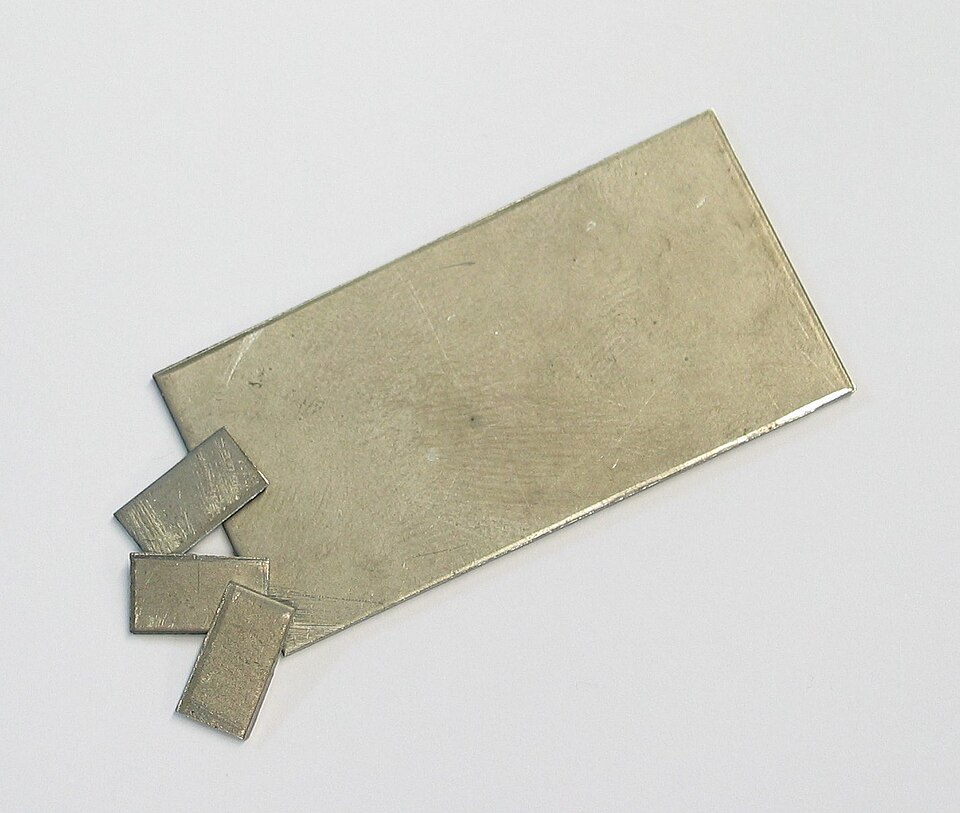

Niobium is a chemical element. It is sometimes named columbium. It has the chemical symbol Nb. It has the atomic number 41. It is a rare metal. Niobium is hard and grey. It is ductile. In chemistry it is placed in a group of metal elements named the transition metals. Niobium was discovered in a variety of a mineral called columbite (now called niobite). Niobite is an ore of niobium.
Niobium is considered a technology-critical element. It is used in alloys, such as to make special steels and strong welded joints. Less than 0.1% of Niobium significantly improves the strength of steel. It is in the superconducting alloys used in MRI scanners, which are one of the most important medical inventions of the modern age.
Name and history
In 1801, Charles Hatchett claimed to have discovered a new chemical element in a sample from the United States. He named the mineral “columbite” and his element “columbium”, after Columbia, another name for the United States. However, chemists were uncertain that columbium was a new element because of its similarity to tantalum. William Hyde Wollaston claimed that columbium and tantalum were the same element. Other chemists claimed that up to five new elements were in these minerals, one of which was named “niobium”.
It took until 1864 to make pure tantalum and niobium and show there were only two elements in these minerals. One of these two elements was named “tantalum”, but this showed that “niobium” and “columbium” were the same element. Americans preferred the name “columbium”, while “niobium” was more common in Europe. Almost a hundred years later, IUPAC decided on the name niobium as part of an effort to make the names of chemical elements more universal.
Production
Niobium and tantalum are in the same group, so their chemistry is very similar. Their ores make a solid solution series called coltan. Niobium and tantalum are both extracted from coltan by leaching. Pyrochlore is another important niobium ore, which can be reduced by aluminium or carbon to make ferroniobium..
Where this page comes from
The article above is adapted from “Niobium” on Simple English Wikipedia, by its contributors. We removed reference markers, navigation boxes and tables, expanded measurement templates into readable numbers, and kept the prose otherwise intact.
Both sources are published under CC BY-SA 4.0, so this page is published under the same licence. You may share and adapt it, including commercially, as long as you credit the original and keep the same licence.
Worksheets, answer keys and printable layouts elsewhere on K5Print are our own work and are not covered by this licence.