Particle model


Before we begin on particle models, let us recall a few points from the previous chapters.
- Matter is made of particles.
- Particles are always moving.
- Particles usually move from a place of higher concentration to a place of lower concentration. Here is one more point that we have not discussed before, but is equally important:
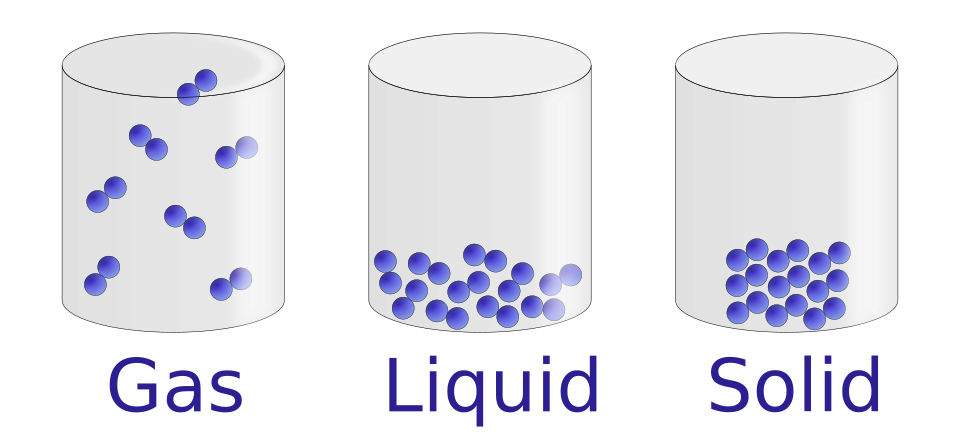
Now that these points are learnt, there are a lot of things we can explain with the particle model. But what exactly is a particle model? A particle model is basically a model which shows particles in action. You cannot find them in real life as they cannot be seen with microscopes. They can be 3-D models or 2-D ones. They can be used to explain a lot of things, such as the three states of matter, density, and thermal expansion and contraction.
The three basic states of matter
Do you still remember that we learnt about the three basic states of matter earlier? We can explain the three states of matter with the particle model. You will find out why matter is compressible, and why its shape is more stable as a solid.
Gas pressure
Gas is compressible; however, when compressed, the gas pressure will be different. This chapter will be all about gas and air pressure. Make sure you have read the previous chapter before proceeding to this one.
Density
Density is how much of matter there is in a fixed volume. Reading this chapter does not require much previous knowledge aside from those discussed in the ‘Matter’ and ‘Particle theory’ chapters.
Thermal expansion and contraction
As you know, hotter things grow and smaller things shrink. These are called thermal expansion and contraction. But why exactly do they happen? Can they be applied in daily life?
Quiz
Which of the following can be easily explained by the particle model, in your opinion?
- The water cycle
- Photosynthesis (the process in which plants make food)
- Comparison of density before and after dissolving
- Magnetic fields
- The movement of particles under different temperatures
- The respiratory system (the system by which you breathe)
Answer: 3 and 5.
Written for younger readers
Particle model, in simpler words
This version comes from Wikijunior, a set of books written for children aged 8 to 11. It is shorter and uses plainer language than the article above.
From Wikijunior: Particles
Before we begin on particle models, let us recall a few points from the previous chapters.
- Matter is made of particles.
- Particles are always moving.
- Particles usually move from a place of higher concentration to a place of lower concentration. Here is one more point that we have not discussed before, but is equally important:
Now that these points are learnt, there are a lot of things we can explain with the particle model. But what exactly is a particle model? A particle model is basically a model which shows particles in action. You cannot find them in real life as they cannot be seen with microscopes. They can be 3-D models or 2-D ones. They can be used to explain a lot of things, such as the three states of matter, density, and thermal expansion and contraction.
Do you still remember that we learnt about the three basic states of matter earlier? We can explain the three states of matter with the particle model. You will find out why matter is compressible, and why its shape is more stable as a solid.
Gas is compressible; however, when compressed, the gas pressure will be different. This chapter will be all about gas and air pressure. Make sure you have read the previous chapter before proceeding to this one.
Density is how much of matter there is in a fixed volume. Reading this chapter does not require much previous knowledge aside from those discussed in the ‘Matter’ and ‘Particle theory’ chapters.
As you know, hotter things grow and smaller things shrink. These are called thermal expansion and contraction. But why exactly do they happen? Can they be applied in daily life?
Which of the following can be easily explained by the particle model, in your opinion?
- The water cycle
- Photosynthesis (the process in which plants make food)
- Comparison of density before and after dissolving
- Magnetic fields
- The movement of particles under different temperatures
- The respiratory system (the system by which you breathe)
Answer: 3 and 5.
Where this page comes from
The article above is adapted from “Particle model” on Simple English Wikipedia, by its contributors. We removed reference markers, navigation boxes and tables, expanded measurement templates into readable numbers, and kept the prose otherwise intact. The simpler version is adapted from Wikijunior on Wikibooks.
Both sources are published under CC BY-SA 4.0, so this page is published under the same licence. You may share and adapt it, including commercially, as long as you credit the original and keep the same licence.
Worksheets, answer keys and printable layouts elsewhere on K5Print are our own work and are not covered by this licence.