Periodic Table
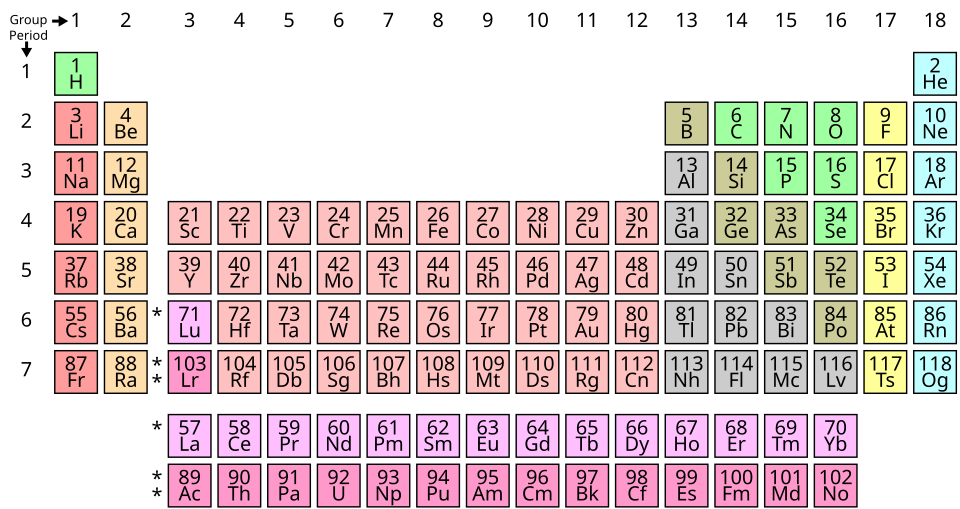

The periodic table is a table that puts all known chemical elements in a specific order. Elements that have similar characteristics are often put near each other. In the table, the elements are placed in the order of their atomic numbers starting with the lowest number of one, hydrogen. The atomic number of an element is the same as the number of protons in that particular nucleus of an atom. In the table the elements are arranged into periods and group. A row of elements across the table is called a period. Each period has a number; from 1 to 8. Period 1 has only 2 elements in it: hydrogen and helium. Period 2 and Period 3 both have 8 elements. Other periods are longer. Elements in a period have consecutive atomic numbers.
The periodic classification of elements offers a systematic approach to organizing and studying the universe’s vast array of elements. This method is crucial for comprehending the chemistry of elements and their compounds. By grouping elements with similar properties, scientists uncover patterns and trends in these fundamental building blocks of matter. Read more …
A column of elements down the table is called a group. There are 18 groups in the standard periodic table. Each group has a number: from 1 to 18. Elements in a group have electrons arranged in similar ways, according to the number of valency electrons, which gives them similar chemical properties (they behave in similar ways). For example, group 18 is known as the noble gases because they are all gases and they do not combine with other atoms. Read more …
There are two systems of group numbers; one using Arabic numerals (1, 2, 3) and the other using Roman numerals (I, II, III). The Roman numeral names were used in most of the 20th century. In 1990 the International Union of Pure and Applied Chemistry (IUPAC) decided to use the new system with Arabic numerals, to replace the two old group systems that used Roman numerals.
- The periodic classification of elements is a systematic way of organizing elements based on their chemical and physical properties.
- Understanding the periodic table and its patterns helps predict the behavior and reactivity of elements.
- Mendeleev’s periodic table and the modern periodic table are two important milestones in the classification of elements.
- Periodic trends, such as atomic size, valency, and electronegativity, can be observed within the periodic table. Read more …
The periodic table was invented by the Russian chemist Dmitry Ivanovich Mendeleyev (18341907). In his honor, element 101 was named after him, mendelevium.
Standard periodic table
Alkali metals
Alkaline earths
Lanthanides
Actinides
Transition metals
Poor metals
Metalloids/Semi metals/Half metals
Nonmetals
Halogens
Noble gases
those in blue are gases,
those in green are liquids,
and those in black are solids.
Those with solid borders have stable isotopes (Primordial Elements)
Those with dashed borders have only radioactive naturally occurring isotopes
Those with dotted borders do not occur naturally (Synthetic Elements)
Other arrangements of the Periodic Table
The version of the periodic table shown above is the one most used. Other widespread versions are shown below: File:Elementspiral.svg| Theodor Benfey arranged the elements in a spiral, around hydrogen. The atomic weight determines the position of the element. File:Mendeleev flower.jpg|Dmitry Ivanovich Mendeleyev used a flower arrangement; Actinides, Lanthanides are shown as loops beside the main group. File:Periodic system Stowe format.svg|Timothy Stove arranged the elements by quantum number. File:Das Bettermannsche Periodensystem.jpg|Betterman arranged the elements by their isoelectric properties, which can be converted to a polynomial form. File:Periodic system Zmaczynski&Bayley.svg|Triangular version, by Zmaczynski and Bayley File:Periodic system Pyramid format.svg|Arranged in a pyramid.
Other versions
- The standard table provides the basics. It is shown above
- A vertical table for improved readability in web browsers
- The big table provides the basics plus full element names
- The huge table provides the basics plus full element names and atomic masses
- Electron configurations
- Metals and Non Metals
- List of elements: includes name, symbol, atomic number, atomic mass, group, and period; sortable by any of those
- List of elements by symbol
- List of elements by boiling point
- List of elements by melting point
- List of elements by density
- Class 10 notes Periodic Classification
Written for younger readers
Periodic Table, in simpler words
This version comes from Wikijunior, a set of books written for children aged 8 to 11. It is shorter and uses plainer language than the article above.
From Wikijunior: The Elements
Although scientists know of many elements, the properties of many of them are similar. Thus, if they are grouped on the basis of their properties, it becomes easy to study and compare their properties. The periodic table of elements is a way of organising all the known elements. In the early days, elements were classified into only two groups: metals and non-metals. But, some elements showed the properties of both metals and non-metals. They are called metalloids.
History of the periodic table
People have known about basic chemical elements such as gold, silver, and copper from antiquity, as these can all be discovered in nature in native form and are relatively simple to mine with primitive tools. Aristotle, a philosopher, theorised that everything is made up of a mixture of one or more of four elements. They were earth, water, air, and fire. This was more like the four states of matter (in the same order): solid, liquid, gas, and plasma, though he also theorised that they change into new substances to form what we see.
Hennig Brand was the first person to discover a new element. Brand was a bankrupt German merchant who was trying to discover the Philosopher’s Stone — a mythical object that was supposed to turn inexpensive base metals into gold. He experimented with distilling human urine until in 1669 he finally obtained a glowing white substance which he named phosphorus. He kept his discovery secret, until 1680 when Robert Boyle rediscovered it and it became public.
By 1809, a total of 47 elements had been discovered. As the number of known elements grew, scientists began to recognize patterns in the way chemicals reacted and began to devise ways to classify the elements.
Antoine Lavoisier’s Traité Élémentaire de Chimie (Elementary Treatise of Chemistry, 1789, translated into English by Robert Kerr) is considered to be the first modern chemical textbook. It contained a list of elements, or substances that could not be broken down further, which included oxygen, nitrogen, hydrogen, phosphorus, mercury, zinc, and sulfur. It also forms the basis for the modern list of elements. His list, however, also included light and caloric, which he believed to be material substances. While many leading chemists of the time refused to believe Lavoisier’s new revelations, the Elementary Treatise was written well enough to convince the younger generation.
This model only classified elements into metals and non-metals and thus was not accepted.
Alexandre-Emile Béguyer de Chancourtois, a French geologist, was the first person to notice the periodicity, the periodic or repetitive nature, of the elements — similar elements seem to occur at regular intervals when they are ordered by their atomic weights. He devised an early form of periodic table, which he called the telluric helix. With the elements arranged in a spiral on a cylinder by order of increasing atomic weight, de Chancourtois saw that elements with similar properties lined up vertically. His chart included some ions and compounds in addition to elements. His paper was published in 1862, but used geological rather than chemical terms and did not include a diagram; as a result, it received little attention until the work of Dmitri Mendeleev.
John Newlands was an English chemist who in 1863 classified the 56 elements that had been discovered at the time into 11 groups which were based on similar physical properties. He noted that many pairs of similar elements existed which differed by some multiple of eight in atomic weight.
Dmitri Mendeleev, also spelt Dmitry Mendeleyev, middle name (patronymic) Ivanovich, a Siberian-born Russian chemist, was the first scientist to make a periodic table much like the one we use today. Mendeleev arranged the elements in a table ordered by atomic mass. It is sometimes said that he played “chemical solitaire” on long train rides using cards with various facts of known elements. On March 6, 1869, a formal presentation was made to the Russian Chemical Society, entitled The Dependence Between the Properties of the Atomic Weights of the Elements. His table was published in an obscure Russian journal but quickly republished in a German journal, Zeitschrift für Chemie, in 1869. It stated
- The elements, if arranged according to their atomic weights, exhibit an apparent periodicity of properties.
- Elements which are similar as regards to their chemical properties have atomic weights which are either of nearly the same value (e.g., Pt, Ir, Os) or which increase regularly (e.g., K, Rb, Cs).
- The arrangement of the elements, or of groups of elements in the order of their atomic weights, corresponds to their so-called valencies, as well as, to some extent, to their distinctive chemical properties; as is apparent among other series in that of Li, Be, Ba, C, N, O, and Sn (probably an error for Li, Be, B, C, N, O and F, since the symbols for the elements weren’t completely standardized yet at that time).
- The elements which are the most widely diffused have small atomic weights.
- The magnitude of the atomic weight determines the character of the element, just as the magnitude of the molecule determines the character of a compound body.
- We must expect the discovery of many yet unknown elements–for example, elements analogous to aluminium and silicon–whose atomic weight would be between 65 and 75.
- The atomic weight of an element may sometimes be amended by a knowledge of those of its contiguous elements. Thus the atomic weight of tellurium must lie between 123 and 126, and cannot be 128.
- Certain characteristic properties of elements can be foretold from their atomic weights.
Advantages
- Mendeleev predicted the discovery of other elements and left space for these new elements, namely eka-silicon (germanium), eka-aluminium (gallium), and eka-boron (scandium). Thus, there was no disturbance in the periodic table.
- He predicted (often accurately as it turned out) properties of some of these then missing elements as well as properties of some of their compounds.
- He pointed out that some of the then current atomic weights were incorrect.
- He provided for variance from atomic weight order
Drawbacks
- There was no place for the isotopes of the various elements.
- His table did not include any of the noble gases, which hadn’t been discovered. But these were added by Sir William Ramsay as Group 0, without any disturbance to the basic concept of the periodic table.
Unknown to Mendeleev, Lothar Meyer was also working on a periodic table. In his work published in 1864, Meyer presented only 28 elements, classified not by atomic weight but by valence alone. Also, Meyer never came to the idea of predicting new elements and correcting atomic weights. Only a few months after Mendeleev published his periodic table of all known elements (and predicted several new elements to complete the table, plus some corrected atomic weights), Meyer published a virtually identical table. Some people consider Meyer and Mendeleev the co-creators of the periodic table, although most agree that Mendeleev’s accurate prediction of the qualities of the undiscovered elements lands him the larger share of credit. In any case, at the time Mendeleev’s predictions greatly impressed his contemporaries and were eventually found to be correct. An English chemist, William Odling, also drew up a table that is remarkably similar to that of Mendeleev in 1864.
In 1914, Henry Moseley found a relationship between an element’s X-ray wavelength and its atomic number and therefore resequenced the table by electronic charge rather than atomic weight. Before this discovery, atomic numbers were just sequential numbers based on an element’s atomic weight. Moseley’s discovery showed that atomic numbers had an experimentally measurable basis.
Moseley’s research also showed that there were gaps in his table at atomic numbers 43 and 61 which are now known to be radioactive and not naturally occurring. Following in the footsteps of Dmitri Mendeleyev, Henry Moseley also predicted new elements.
During his Manhattan Project research in 1944, Glenn T. Seaborg experienced unexpected difficulty isolating Americium (95) and Curium (96). He began wondering if these elements more properly belonged to a different series which would explain why the expected chemical properties of the new elements were different. In 1945, he went against the advice of colleagues and proposed a significant change to Mendelev’s table: the actinide series.
Seaborg’s actinide concept of heavy element electronic structure, predicting that the actinides form a transition series analogous to the rare earth series of lanthanide elements, is now well accepted in the scientific community and included in all standard configurations of the periodic table. The actinide series are the second row of the f-block (5f series) and comprise the elements from Actinium to Lawrencium. Seaborg’s subsequent elaborations of the actinide concept theorized a series of superheavy elements in a transactinide series comprising elements 104 through 121 and a superactinide series inclusive of elements 122 through 153.
Where this page comes from
The article above is adapted from “Periodic Table” on Simple English Wikipedia, by its contributors. We removed reference markers, navigation boxes and tables, expanded measurement templates into readable numbers, and kept the prose otherwise intact. The simpler version is adapted from Wikijunior on Wikibooks.
Both sources are published under CC BY-SA 4.0, so this page is published under the same licence. You may share and adapt it, including commercially, as long as you credit the original and keep the same licence.
Worksheets, answer keys and printable layouts elsewhere on K5Print are our own work and are not covered by this licence.