PH
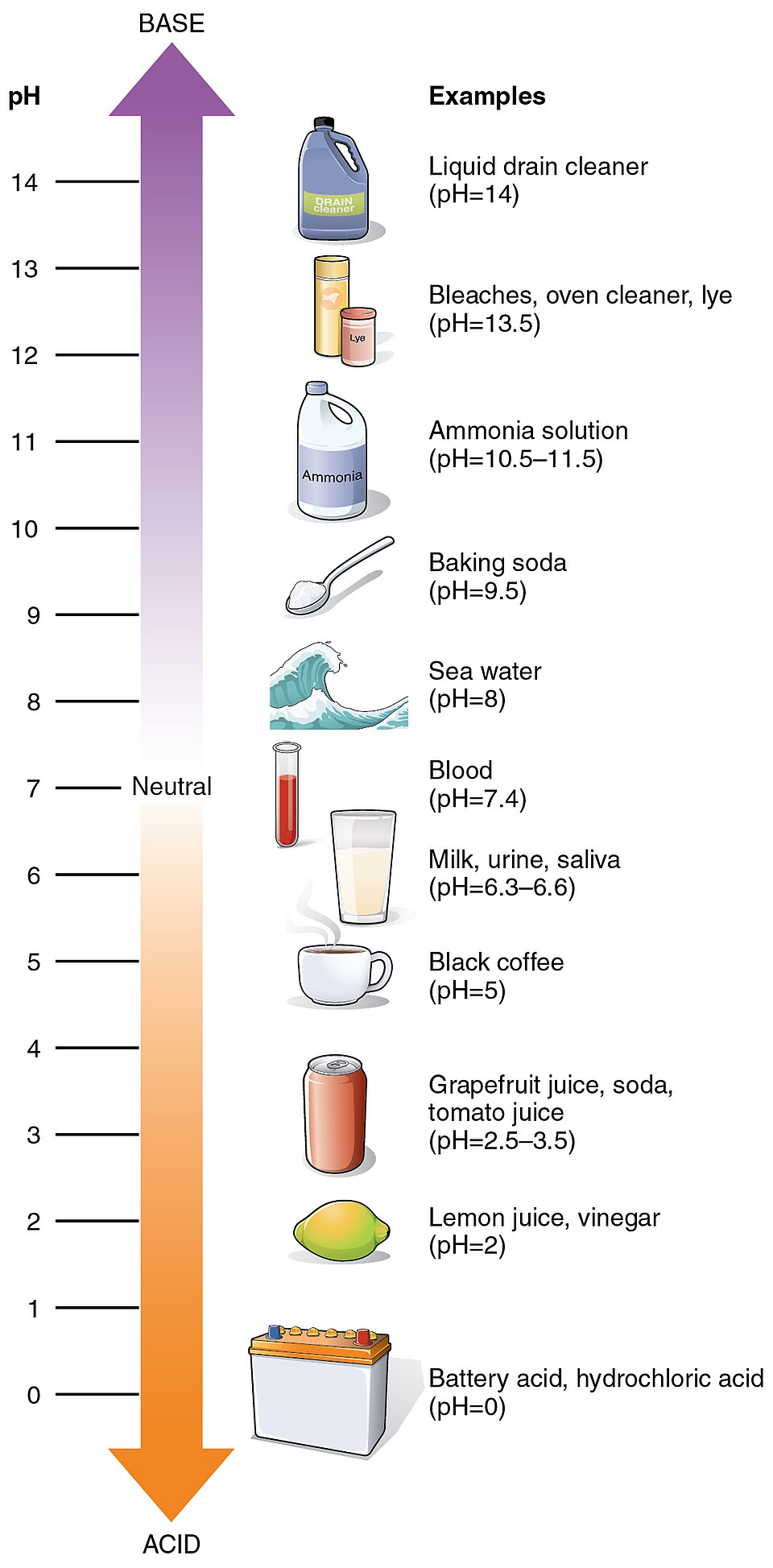

pH is a scale of acidity from 0 to 14. It tells how acidic or alkaline a substance is. More acidic solutions have lower pH. More alkaline solutions have higher pH. Substances that aren’t acidic or alkaline (that is, neutral solutions) usually have a pH of 7. Acids have a pH that is less than 7. Alkalis have a pH that is greater than 7.
pH is a measure of the concentration of protons (H + ) in a solution. S.P.L. Sørensen introduced this concept in the year 1909. The p stands for the German potenz, meaning power or concentration, and the H for the hydrogen ion (H + ).
The most common formula for calculating pH is:
[H + ] indicates the concentration of H + ions (also written [H 3 O + ], the equal concentration of hydronium ions), measured in moles per litre (also known as molarity).
However, the correct equation is actually:
where a_{\mathrm{H^+}} indicates the activity of H + ions. But, this equation in most cases provides the same value as the more common formula, so in introductory chemistry the previous equation is given as the definition of pH.
Most substances have a pH in the range of 0 to 14, although extremely acidic or alkaline substances may have pH < 0, or pH > 14.
Alkaline substances have, instead of hydrogen ions, a concentration of hydroxide ions (OH - ).
pH indicators
Certain dyes change colour depending on whether they are in an acid solution or an alkaline solution . pH indicator is a chemical compound added in small amounts to a solution so the pH (acidity or basicity) of the solution can be seen. The pH indicator is a chemical detector for hydronium ions (H 3 O + ) or hydrogen ions (H + ). Normally, the indicator causes the colour of the solution to change depending on the pH.
Typical indicators are phenolphthalein, methyl orange, methyl red, bromothymol blue, and thymol blue. They each change colour at different points on the pH scale, and can be used together as a universal indicator.
Another way is to use litmus paper, which is based on a natural pH indicators. The paper can tell you how strong the chemical is, whether it is a stronger acid or a stronger base.
Neutralization
Neutralization can be summed up by the equation:
(acid + base → water)
Where this page comes from
The article above is adapted from “PH” on Simple English Wikipedia, by its contributors. We removed reference markers, navigation boxes and tables, expanded measurement templates into readable numbers, and kept the prose otherwise intact.
Both sources are published under CC BY-SA 4.0, so this page is published under the same licence. You may share and adapt it, including commercially, as long as you credit the original and keep the same licence.
Worksheets, answer keys and printable layouts elsewhere on K5Print are our own work and are not covered by this licence.