Phosphorus
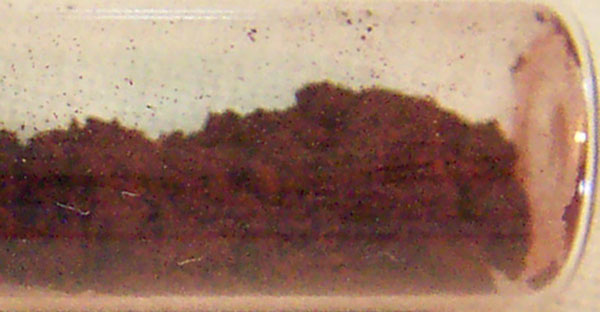

Phosphorus has the chemical symbol P, and its atomic number is 15. Its mass number is 30.97. It is not found in nature as an element, but as compounds, such as phosphates. There are many different forms. The most common form is a red or white waxy solid.
Physical properties
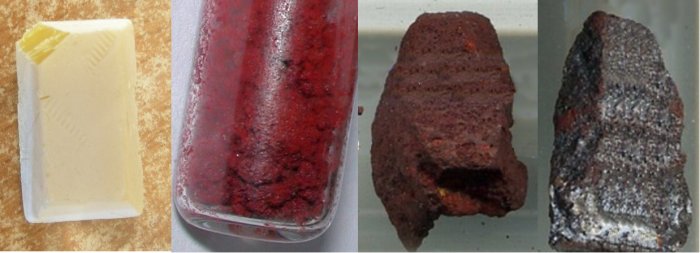
Phosphorus comes in several forms. White and red phosphorus are the most common forms. White phosphorus is a waxy white solid. When pure, it is colourless. It is insoluble in water, but soluble in carbon disulfide, an organic solvent. It turns light yellow when in air. It glows in the dark because it “burns” very slowly in air.
When exposed to sunlight, or when heated in its own vapour to 250 °C, it is converted to the red variety. This form does not ignite spontaneously and it is less toxic and less flammable than white phosphorus. The red modification is fairly stable and sublimes with a vapor pressure of 1 atmosphere at 417 °C.
Chemical properties
White phosphorus is more reactive than red phosphorus. White phosphorus catches fire spontaneously in air, burning to make smoke of phosphorus(V) oxide. If it burns in a little air, it produces poisonous phosphorus(III) oxide. When white phosphorus is heated in an alkali, it disproportionates to produce hypophosphites and phosphine. Red phosphorus can burn but needs to be ignited. Phosphorus reacts with the halogens to make phosphorus halides. It reacts with some metals to make phosphides.
Chemical compounds
Phosphorus compounds are chemical compounds containing phosphorus. They are listed below with some of their properties. Phosphorus comes in several oxidation states, the number of electrons moved during a redox reaction. -3 is flammable, powerful reducing agent, and toxic; +1 is a strong reducing agent and is rare; +3 is a weaker reducing agent that is poisonous; +5 is not a reducing agent and is very common.
Phosphides
- Phosphine, toxic gas that smells like fish and ignites by itself
- Phosphide, the ion
- Sodium phosphide
Other compounds
- Phosphonium, another ion
In +1 oxidation state
- Hypophosphorous acid, salts are called hypophosphites
- Sodium hypophosphite
Phosphites
- Phosphorous acid, poisonous, salts are called phosphites
- Sodium phosphite
Other compounds
- Phosphorus trichloride
- Phosphorus triiodide
- Phosphorus(III) oxide, phosphorus trioxide, poisonous, garlic-smelling
Phosphates
- Phosphoric acid, most common, salts are called phosphates
- Calcium phosphate
- Dicalcium phosphate
- Monocalcium phosphate
- Sodium phosphate
- Zinc phosphate
Other compounds
- Phosphorus(V) oxide, phosphorus pentoxide, absorbs water
- Phosphorus(V) chloride
File:Fosforsyra.jpg|Phosphoric acid File:Trisodium phosphate hydrate.jpg|Trisodium phosphate File:Phosphorus pentachloride and Phosphorus trichloride.JPG|Phosphorus pentachloride (left) and phosphorus trichloride (right)
Occurrence
It is an essential component of living systems and is found as phosphate in nervous tissue, bones and cell protoplasm. It is also found in the earth as phosphate rock. Phosphate rock is the main source of phosphorus and phosphorus compounds. Many body tissues have calcium phosphates in them.
Preparation
Phosphorus was first made by heating a mixture of phosphates and carbon in an iron pot. The phosphates were made by dissolving bones in strong acids and evaporating the solution.
Phosphorus is made now by heating calcium phosphate, carbon, and silicon dioxide in an electric arc furnace. The heat of the electric arc melts the mixture of materials, and phosphorus gas is given off. It is absorbed under water. This makes white phosphorus.
As an element
White phosphorus is used in incendiary weapons and smoke grenades. It is also used to make organic compounds that have phosphorus in them. Phosphorus is used to dope semiconductors. Phosphorus is used to remove oxygen from copper. It is also used in making alloys. Red phosphorus is used in matches and flares.
As chemical compounds
Phosphorus compounds are used for fertilizers, soft drinks, toothpaste, and detergents. Most of these are phosphates. Phosphides can be used to kill rodents.
Safety
White phosphorus is very dangerous. It is very toxic and ignites easily, burning with a very hot flame. Red phosphorus is much safer. Some phosphorus compounds are toxic, but the common phosphates are not toxic.
Written for younger readers
Phosphorus, in simpler words
This version comes from Wikijunior, a set of books written for children aged 8 to 11. It is shorter and uses plainer language than the article above.
From Wikijunior: The Elements
NOTOC
Phosphorus is white, purple, red, or black in color. When phosphorus is combined with certain other elements, it glows in the dark. Phosphorus can smell like garlic. It is not usually found free in nature.
Phosphorus was discovered by Hennig Brand in 1669 through experiments that involved boiling down and distilling the residue from urine.
The name “phosphorus” comes from the combination of the Greek words “phos” (light) and “phoros” (bearer).
Did You Know?
- Plants need a small amount of phosphorus to live.
- One type of phosphorus can be changed into another by increasing the temperature or the pressure.
Elemental phosphorus comes in four forms: white phosphorus, red phosphorus, purple phosphorus, and black phosphorus. White phosphorus is very reactive and will spontaneously combust (burst into flames) when exposed to warm air. Therefore it is usually stored under water. The other forms are relatively nonreactive. One compound of phosphorus, calcium phosphate (Ca3(PO4)2), is a major component of bones. Another, ATP, is used by cells to produce energy.
Phosphorus is used in fertilizers and detergents. Phosphoric acid (H 3 PO 4 ) is used to make soft drinks. Some phosphorus compounds are used to make light bulbs and television sets. Drinking water with phosphorus or taking phosphorus pills became fashionable and was thought to increase brain activity and make you smarter in the mid-1800s when phosphorus was discovered in the brain. In an ironic twist, phosphorus was used by the Allies in World War II to make their bombs glow bright during nighttime raids over Germany, the country of its initial discovery almost 300 years earlier. Phosphorus is also used to make nerve gas and inside glow sticks.
White phosphorus is very toxic and is very damaging to human tissues, especially bones and cartilage. White phosphorus will spontaneously combust (burn) if exposed to air warmer than 35 degrees Celsius. Red, purple, and black phosphorus are relatively safe to handle.
The phosphorus atom (pictured right) shows a view of it very, very, zoomed in. At this level we can’t even see light but if we magically could - this is more or less what we would see. In the centre is the nucleus (purple + red “subatomic particles”) and around it are 3 electron “shells”, the nucleus is made up of protons (red) and neutrons (purple). The protons have a little “+” sign on them because they carry positive charge, neutrons have no charge and electrons orbiting around the outside (blue) have a “-” sign because they have negative charge.
On the 3 shells, the inner, middle, and outer, you can see varying amounts of electrons on the rings. On the inner ring, you can see two electrons.
Where this page comes from
The article above is adapted from “Phosphorus” on Simple English Wikipedia, by its contributors. We removed reference markers, navigation boxes and tables, expanded measurement templates into readable numbers, and kept the prose otherwise intact. The simpler version is adapted from Wikijunior on Wikibooks.
Both sources are published under CC BY-SA 4.0, so this page is published under the same licence. You may share and adapt it, including commercially, as long as you credit the original and keep the same licence.
Worksheets, answer keys and printable layouts elsewhere on K5Print are our own work and are not covered by this licence.