Platinum
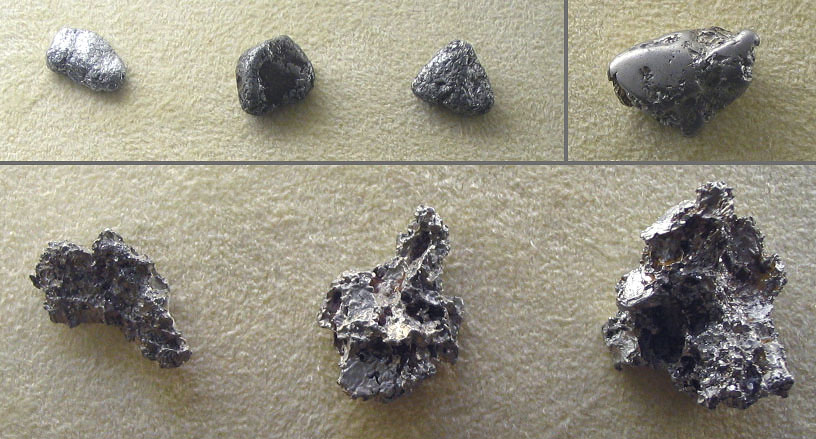

Platinum is a chemical element. It has symbol Pt and atomic number 78. Platinum is a soft, heavy, white metal. It is a precious metal and a transition metal. Its name comes from the Spanish word platina meaning “little silver”.
Platinum is part of the platinum group of elements. It is on group 10 in the periodic table of elements. Its atoms have an atomic weight of 195 atomic mass units. It has 6 isotopes that is found in nature. Platinum can be found in some nickel and copper ores. 90% of platinum is found in the Ural Mountains, Colombia, the Sudbury basin of Canada, and a large reserve in South Africa.
In the past, it was worth more than gold. Since the late 2010s, gold cost more. The element is hard to find in the Earth’s crust. It has an average abundance of about 5 μg/kg. Since it is so rare, only a few hundred tonnes of Platinum are made every year.
Platinum is very dense; almost twice as dense as lead. It is malleable and ductile. This means it can be made thin sheets and it can be pulled into wire. Platinum is very stable. Acids do not change platinum.
Platinum has many uses. The most common use of Platinum is in a vehicle’s catalytic converter. It is also used in laboratory equipment, electrical contacts and electrodes, platinum resistance thermometers, dentistry equipment, and jewelry. Platinum is also used in the glass industry. There, it is used to change molten glass. Elemental platinum is not found to be dangerous to human health. Compounds that have platinum, such as cisplatin, oxaliplatin and carboplatin, are used in chemotherapy against some types of cancer.
Written for younger readers
Platinum, in simpler words
This version comes from Wikijunior, a set of books written for children aged 8 to 11. It is shorter and uses plainer language than the article above.
From Wikijunior: The Elements
NOTOC
Platinum is a heavy metal that is grayish-white.
It has a melting point of one thousand seven hundred sixty-eight degrees Celsius. This is hotter that a Bunsen burner flame. Heating platinum to this temperature makes it glow a reddish-orange color. Heating it up even more, to three thousand eight hundred twenty-five degrees Celsius, will turn it into a glowing orange gas.
It was first discovered by South Americans and used by pre-Columbian Indians. It was taken to Europe in the 1750s.
Did You Know?
- Platinum, even though it is a metal, can be scratched by minerals such as fluorite
- Platinum is a valuable metal, costing just over £1000 per ounce Its name came from the Spanish word platina (meaning “little silver”).
Platinum is found in South America and Russia. It is obtained as a by-product of nickel and copper mining and processing.
Platinum is used in jewelry, laboratory equipment, electical contacts, and dentistry. It is also used in the catalytic converter inside cars.
Yes. According to the Centers for Disease Control and Prevention, short-term exposure to platinum salts “may cause irritation of the eyes, nose, and throat” and long-term exposure “may cause both respiratory and skin allergies.”
Where this page comes from
The article above is adapted from “Platinum” on Simple English Wikipedia, by its contributors. We removed reference markers, navigation boxes and tables, expanded measurement templates into readable numbers, and kept the prose otherwise intact. The simpler version is adapted from Wikijunior on Wikibooks.
Both sources are published under CC BY-SA 4.0, so this page is published under the same licence. You may share and adapt it, including commercially, as long as you credit the original and keep the same licence.
Worksheets, answer keys and printable layouts elsewhere on K5Print are our own work and are not covered by this licence.