Plutonium
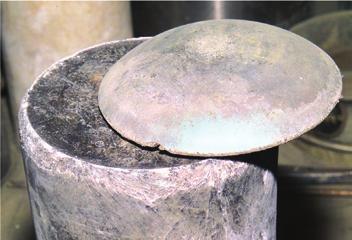

Plutonium is the chemical element with the atomic number 94 and chemical symbol Pu. It is a highly radioactive metal, and is the metal used in most nuclear weapons. The chemical element plutonium has some different isotopes. The most important isotope of plutonium is 239 Pu (or plutonium-239). It takes 24,110 years for half of a sample of plutonium-239 to decay, which is called its half-life. It can be made from natural uranium. It is fissile and a nuclear fuel.
The isotope that has the longest half-life is 244 Pu (or plutonium-244). Plutonium-244 has a half-life of about 80 million years. The half-life of 244 Pu is long enough that some of this isotope of plutonium is found in very small amounts in nature. Plutonium-238 is used in Radioisotope Thermoelectric Generators.
Like other transuranium elements, plutonium can react with water, oxygen, carbon, halogens, nitrogen, and silicon. It forms oxides and hydrides in moist air, causing the plutonium sample to expand by up to 70%. Plutonium from the expanding sample can flake off and catch fire at room temperature. Plutonium is also toxic, although it is less toxic than many people think. The reactivity and toxicity of plutonium make it difficult to handle.
It is a solid, at 25 degrees Celsius (77 °F) at standard atmosphere (a pressure). Fresh plutonium has a silvery bright colour but takes on a dull grey, yellow or olive green tarnish when exposed to air.
List of isotopes
- 238 Pu. The countries that produce the most (as of 2021), are the United States and Russia.
- 239 Pu
- 240 Pu
- 241 Pu
- 242 Pu
- 244 Pu
Written for younger readers
Plutonium, in simpler words
This version comes from Wikijunior, a set of books written for children aged 8 to 11. It is shorter and uses plainer language than the article above.
From Wikijunior: The Elements
NOTOC
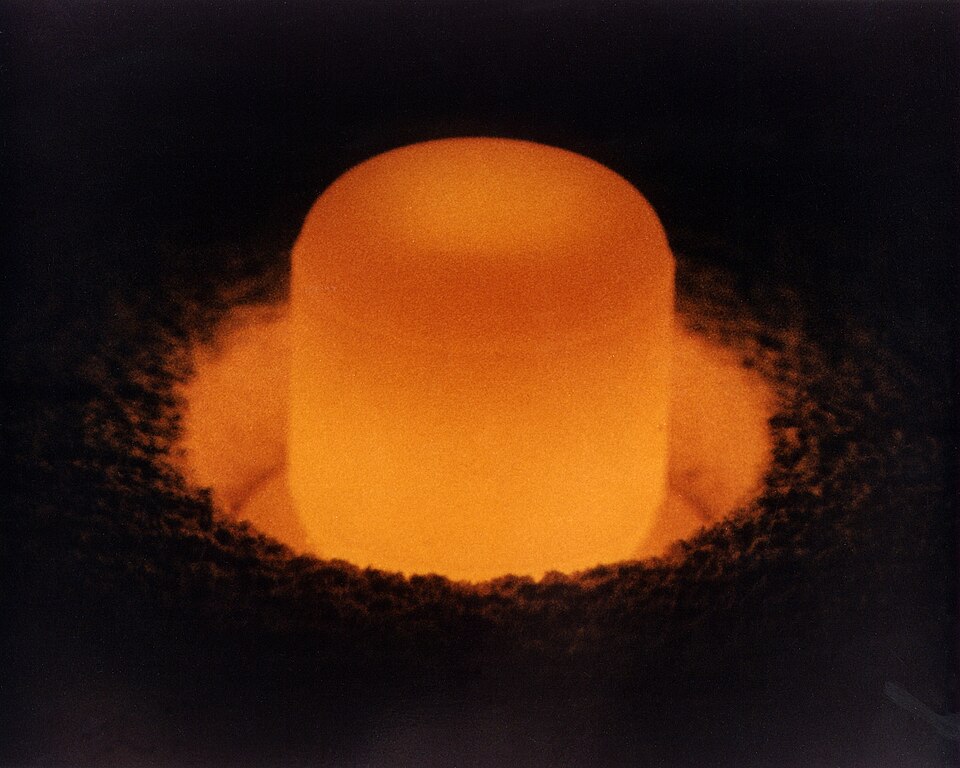
Plutonium is silver when pure and turns a yellowish color when it oxidizes. A large piece of Plutonium is warm to the touch, and even larger pieces produce enough heat to boil water.
Plutonium (pronounced /pluːˈtoʊniəm/) is a radioactive, metallic and toxic chemical element. It has the symbol Pu and the atomic number 94. It is a fissile element used in most modern nuclear weapons. The most significant isotope of plutonium is 239 Pu, with a half-life of 24,100 years. It can be made from natural uranium and is the most useful fissile isotope of plutonium. The most stable isotope is 244 Pu, with a half-life of about 80 million years, long enough to be found in extremely small quantities in nature, making 244 Pu the nucleon-richest atom that naturally occurs in the Earth’s crust, albeit in small traces.
Plutonium was first made by Glenn T. Seaborg, Joseph W. Kennedy, Edward M. McMillan and Arthur C. Wahl at the University of California, Berkley in 1940. It is, therefore, an artificial element (although it IS found in extremely small quantities in nature.) It was created for use in the atomic bomb.
Plutonium was named for the planet Pluto. There is an interesting story behind its abbreviation, though. It became Pu instead of Pl because the discoverers, knowing it to be a dangerous element, chose Pu. Have you ever heard the exclamation “P.U.!” used? Well, now you can make a connection to the world of atoms and molecules. Did You Know?
- One kilogram of plutonium produces 22 million kilowatt hours of heat energy.
- Plutonium has been used to power space probes and heart pacemakers.
- It was used aboard Apollo 14 to power seismic devices.
Plutonium is usually manufactured artificially in special reactors designed and built especially for this task. Trace amounts of plutonium have also been found naturally inside some uranium ores. It’s virtually nonexistent, however, in the soil.
The most well known use of plutonium is in the building of nuclear weapons and power plants, using its isotope 239. It is one of the key materials that cause the nuclear explosion. Less well known, however, it has been used in many instances to build long-lasting batteries for things like space probes/satellites and heart pacemakers. The heart-pacemaker use of plutonium uses the isotope 238, just one neutron away from the deadly isotope 239. If it (naturally or artificially) gained just one neutron, the heart pacemaker would probably kill you if you used it. The use of plutonium as a power source for pacemakers has been stopped in more recent years, due to this.
Raw plutonium is both radioactive and toxic. If it comes in contact with a person, it is likely to cause an increased chance of cancer in later years of life. If ingested or inhaled it can be toxic. When used to build weapons, plutonium is extremely dangerous. It is used in the two most powerful and deadliest weapons of all time, the atomic and hydrogen bombs.
Where this page comes from
The article above is adapted from “Plutonium” on Simple English Wikipedia, by its contributors. We removed reference markers, navigation boxes and tables, expanded measurement templates into readable numbers, and kept the prose otherwise intact. The simpler version is adapted from Wikijunior on Wikibooks.
Both sources are published under CC BY-SA 4.0, so this page is published under the same licence. You may share and adapt it, including commercially, as long as you credit the original and keep the same licence.
Worksheets, answer keys and printable layouts elsewhere on K5Print are our own work and are not covered by this licence.