Polonium
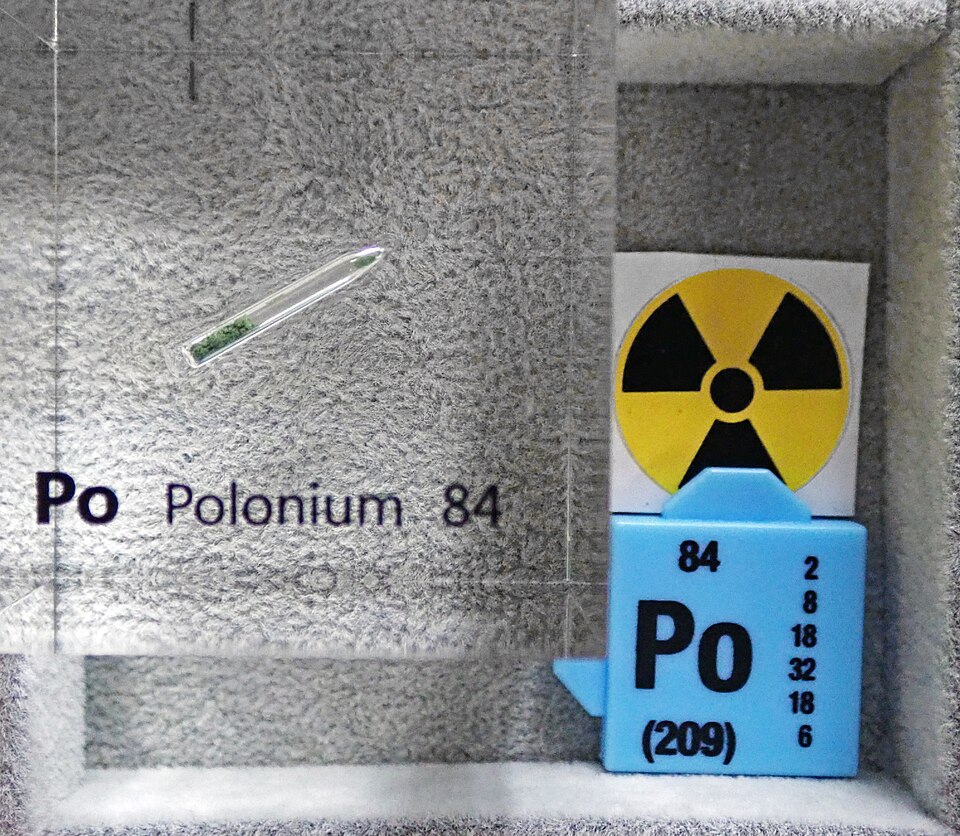

Polonium is a rare radioactive metalloid. It is chemical element 84 on the periodic table and its symbol is Po. It was discovered in 1898 by Marie and Pierre Curie.
Polonium is highly unstable, radioactive and toxic. This makes it difficult to handle. It can be dangerous, even in very small amounts. One gram of Po will self-heat to a temperature of about 500 degrees Celsius (500 °F). It also vaporizes easily.
Polonium has 42 isotopes, and all of them are radioactive. It is a very rare element in nature because of its short half-life. It is a breakdown product of uranium, so it is found in uranium ores.
Polonium is also very important because it is the main element of nuclear bombs.
Polonium emits alpha radiation, which cannot pass through the skin and is blocked by a piece of paper.
Properties
Polonium emits alpha radiation, and it has a half-life of 138 days (approximately 4 months). It decays into Lead, A milligram of polonium emits about as many alpha particles per second as 5 grams of Radium, which means it is 5,000 times more radioactive than radium. A few grams of Polonium emit a blue glow which is caused by ionization of the surrounding air. Polonium is 100 billion times more dangerous than hydrogen cyanide.
Polonium has an atomic number of 84, meaning it has 84 protons, which is why it’s so unstable, because it’s atom is large.
Written for younger readers
Polonium, in simpler words
This version comes from Wikijunior, a set of books written for children aged 8 to 11. It is shorter and uses plainer language than the article above.
From Wikijunior: The Elements
NOTOC
Polonium is a silvery metal at room temperature. It feels much like its neighbor, lead. You would not want to taste it as it is deadly poison.
Polonium was discovered by Marie and Pierre Curie in 1898. They isolated it from pitchblende, which also contains uranium.
The name “polonium” comes from Poland, where Marie Curie was born. It is also referred to as Radium F. Did You Know?
- Polonium is so radioactive that it spontaneously heats up and vaporises, even at room temperature.
Polonium is very rare and only occurs as an impurity in some uranium ores.
Polonium doesn’t have much use because it’s so radioactive. Because it produces so much heat from its radioactivity, it’s used in some generators which use that heat to produce electricity.
Polonium is toxic and radioactive. This radioactivity is very dangerous. Because polonium is so radioactive, it heats up quickly and can cause burns.
Where this page comes from
The article above is adapted from “Polonium” on Simple English Wikipedia, by its contributors. We removed reference markers, navigation boxes and tables, expanded measurement templates into readable numbers, and kept the prose otherwise intact. The simpler version is adapted from Wikijunior on Wikibooks.
Both sources are published under CC BY-SA 4.0, so this page is published under the same licence. You may share and adapt it, including commercially, as long as you credit the original and keep the same licence.
Worksheets, answer keys and printable layouts elsewhere on K5Print are our own work and are not covered by this licence.