Potassium
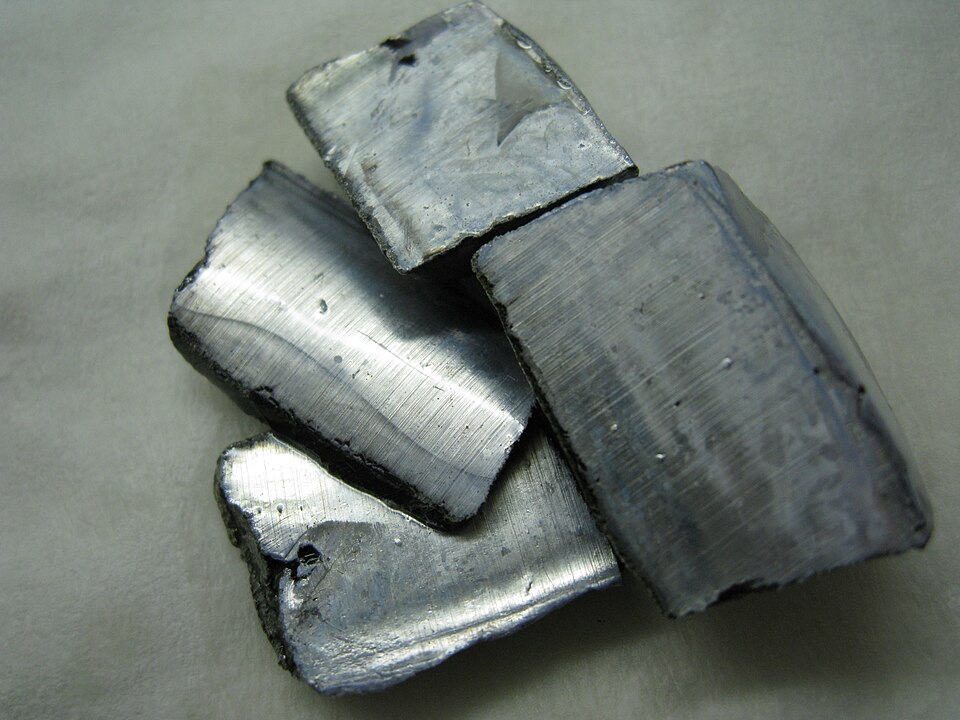

Potassium is a chemical element in the periodic table. It has the symbol K. This symbol is taken from the Latin word kalium. Potassium’s atomic number is 19. It has 19 protons and electrons. Potassium is not found as an element in nature, because it is so reactive.
Potassium has two stable isotopes, with 20 or 22 neutrons. Its atomic mass is 39.098. The unstable isotope with 21 neutrons is one of the most common radioactive materials.
Physical properties
Potassium is a soft gray metal. It can be cut easily with a knife. Its melting point is 63 degrees Celsius (145.4 degrees Fahrenheit). It melts at a very low temperature. It is an alkali metal. It is the second lightest metal, after lithium.
Chemical properties
Potassium reacts in many chemical reactions similar to sodium and other alkali metals. It tarnishes in air to produce a whitish oxidized layer on the surface. This is why it is stored in oil. It also reacts very fast with water, which is another reason for its storage in oil. The hydrogen produced during its reaction with water can burst into flames when a large amount of potassium is added to water. Potassium hydroxide is also produced. Potassium also burns in air easily, to make the peroxide or the superoxide.
Chemical compounds
Potassium compounds are only in one oxidation state: +1. Potassium ions are colorless and similar to sodium ions. Potassium chloride can be used as a substitute for table salt. Potassium hydroxide is used in the electrolyte of alkaline cells. Most potassium compounds are nontoxic. If they are toxic, it is because of the anion. Potassium chromate is colored because of the chromate, not the potassium. Potassium chromate is toxic because of the chromate, not the potassium.
- Chrome alum
- Potash alum
- Potassium arsenate, oxidizing agent, toxic
- Potassium arsenite, colorless solid, toxic
- Potassium bromate, colorless, oxidizing agent, used in flour
- Potassium bromide, colorless, used as sedative
- Potassium carbonate, colorless, reacts with acids
- Potassium chlorate, used in matches and explosives
- Potassium chloride, salt substitute
- Potassium chromate, yellow solid, oxidizing agent, toxic
- Potassium dichromate, red solid, oxidizing agent, toxic
- Potassium fluoride, used to make fluorine, corrosive
- Potassium hydroxide, also known as potash, caustic, strong base, white solid
- Potassium hypomanganate, bright blue hypomanganate, rare
- Potassium iodate, used to supply iodine
- Potassium iodide, used to supply iodine
- Potassium manganate, used to make potassium permanganate
- Potassium nitrate, used in gunpowder
- Potassium perchlorate, used in some rockets
- Potassium periodate
- Potassium permanganate, purple, disinfectant, oxidizing agent
- Potassium sulfide, reacts with water
- Potassium sulfite, used in food preservation
- Potassium sulfate, colorless, used in fertilizers
File:Potassium hydroxide.jpg|Potassium hydroxide File:KClO3.jpg|Potassium chlorate File:Potassium chloride.jpg|Potassium chloride File:Potassium-chromate-sample.jpg|Potassium chromate
Name
The word potassium comes from the word “potash”. Potash is a mixture of potassium carbonate and potassium hydroxide that has been used for a very long time. In past centuries potash was made from ashes in pots. It is used to make fertilizer, soap, and glass.
Occurrence
Potassium does not occur in nature because it is too reactive. It is found in minerals, though. It is extracted from them by electrolysis of potassium hydroxide or potassium chloride. The potassium hydroxide or potassium chloride has to be melted at a very high temperature.
Uses
Potassium metal is used to absorb water from solvents. It is also used in some scientific instruments.
Potassium compounds are used in soap, fertilizer, explosives, and matches.
Nutrition
Potassium ions are very important to organisms. That is why fertilizers have potassium compounds in them. The ions send messages from cells to other cells. It helps biological membranes depolarize. This means go from a negative to a positive electrical charge. This is needed for muscles to contract (get shorter and move things.) It is needed for the heart to beat (push blood through blood vessels.) If the potassium level in the blood is too high or too low it can cause death because the heart stops. A few good sources of potassium are bananas, apricots and raisins.
Safety
Potassium metal is very dangerous and can form an explosive coating if it is kept in air. It also reacts violently with water, spewing corrosive liquid. Potassium compounds are not normally dangerous, unless they contain a toxic anion like chromate or chlorate.
Written for younger readers
Potassium, in simpler words
This version comes from Wikijunior, a set of books written for children aged 8 to 11. It is shorter and uses plainer language than the article above.
From Wikijunior: The Elements
NOTOC
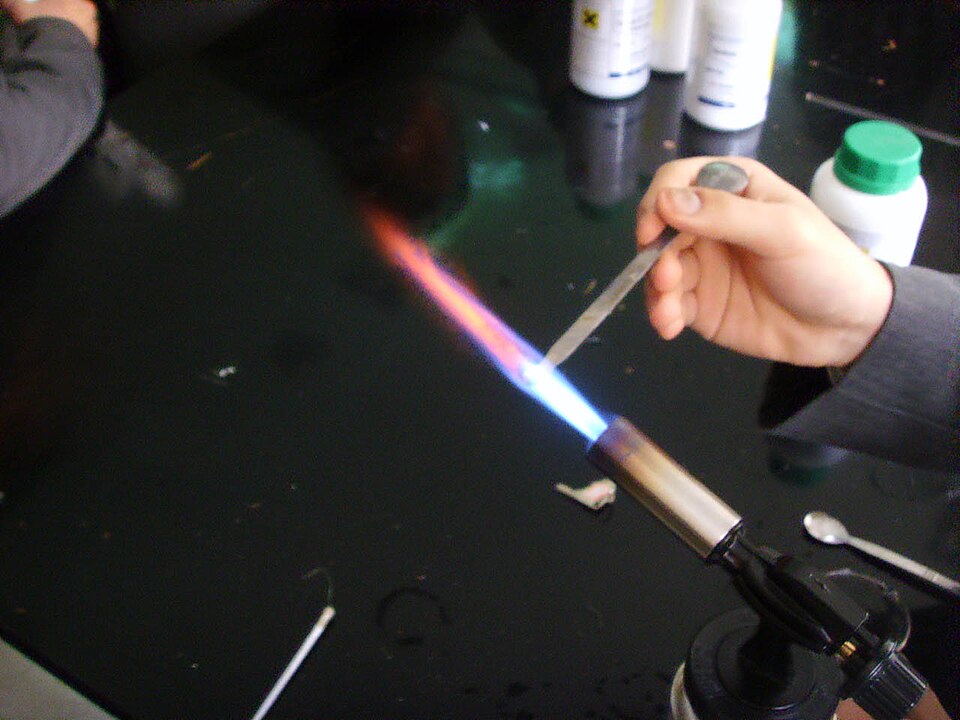
Potassium is metallic and silvery white. It is soft, waxy and can easily be cut with a knife. Potassium has a lilac colored flame and burns when in contact with water. It reacts with oxygen to form potassium superoxide (KO2) and with water to form potassium hydroxide (KOH), hydrogen gas and heat. Enough heat is produced to ignite the hydrogen gas.
It was discovered in 1807 when Sir Humphrey Davy extracted it from potassium hydroxide (or caustic potash, KOH,) a compound used in cooking.
The name “potassium” comes from the Dutch word Potasch. Potassium was discovered in 1807 in England by Sir Humphry Davy.
Potassium’s chemical symbol, K, comes from the Arabic word القلية (al-qalya), meaning potash, formed into the Latin word “kalium”, most likely because it is an alkali metal.
Did You Know?
Potassium is important for your nerves and muscles.
Potassium makes up nearly 3% of the Earth’s crust and is the seventh most abundant element on the planet. Potassium is rarely found free in nature as it is a very reactive element. Instead, potassium is usually found in minerals such as sylvite, carnallite, langbeinite, and polyhalite. These minerals are usually found in ancient lake and sea beds. Another important source of potassium, caustic potash, is mined in Germany as well as New Mexico, California and Utah in the United States.
Plants need potassium to grow. Potassium can be found it most soils, usually in the form of potassium chloride (KCl) or potassium nitrate (KNO 3 ). In addition, potassium chloride is a salt substitute and aids in the production of other chemicals. Potassium nitrate, also known as saltpeter or niter, is also used to make the heads of matches and pyrotechnics (it is the major component of gunpowder.) Potassium hydroxide (KOH) can be found in soaps, detergents and drain cleaners. Potassium carbonate (KHCO 3 ), or pearl ash, is a byproduct of ammonia that can be found in certain types of soap and glass. Potassium is also found in bananas.
Pure potassium, as a metal, will light on fire if it touches water. However, potassium is a required mineral in the body as an ion — an electric atom. One of its uses inside the body is in the nerves. Nerves, and neurons in the brain, carry electricity; the potassium ion, along with the sodium ion, are important to this.
Potassium hydroxide and its solutions should never be touched in any way, as they are EXTREMELY POISONOUS AND CORROSIVE!!!!!!!!!!!!!!!!!!!.
Where this page comes from
The article above is adapted from “Potassium” on Simple English Wikipedia, by its contributors. We removed reference markers, navigation boxes and tables, expanded measurement templates into readable numbers, and kept the prose otherwise intact. The simpler version is adapted from Wikijunior on Wikibooks.
Both sources are published under CC BY-SA 4.0, so this page is published under the same licence. You may share and adapt it, including commercially, as long as you credit the original and keep the same licence.
Worksheets, answer keys and printable layouts elsewhere on K5Print are our own work and are not covered by this licence.