Radon
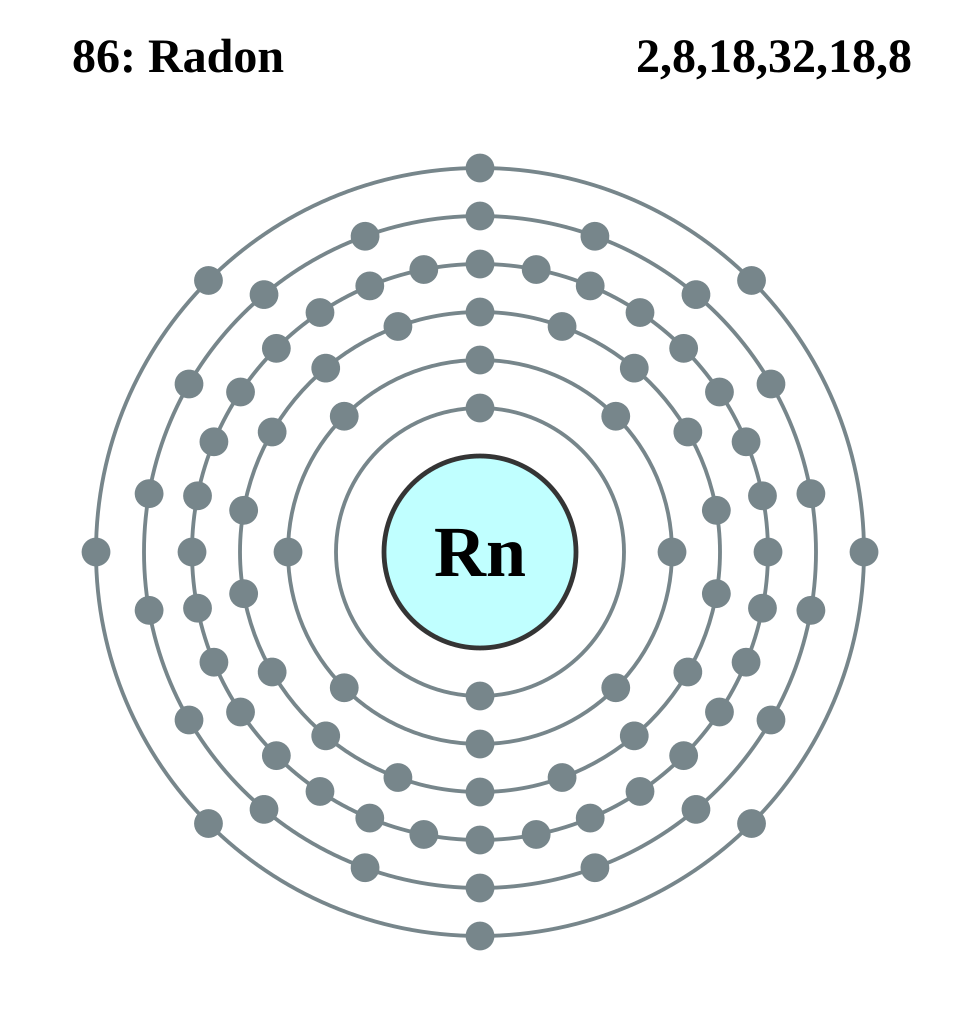

Radon is a chemical element in the periodic table. It is element 86 on the periodic table and its symbol is Rn. It is an odorless, tasteless noble gas. It is quite radioactive and can decay very quickly. 27 isotopes of Radon are known today. The most stable of them has a half life of about 3.8 days.
Chemistry
Radon is a gas and is part of the group known as the noble gases. It does not react with other elements, so it is found pure. Radon is radioactive, meaning that it can give off harmful rays. Some people have high levels of radon in their houses, and this can be very dangerous. A lot of radon can get stuck in the basement of old houses, and so people end up breathing it in. It gets stuck in the lungs and has been known to cause cancer. There are groups that try to make sure there is no dangerous radon in houses.
It can occur naturally on the Earth but is a very small amount. As elements like Thorium and Uranium decay, some of that gets turned into Radon.
Radon can cause lung cancer and is the second most popular cause of lung cancer straight after smoking.
History
Radon was the fifth radioactive element to be discovered, in 1899 by Ernest Rutherford and Robert B. Owens at McGill University in Montreal, after uranium, thorium, radium, and polonium. In 1899, Pierre and Marie Curie saw that the gas given off by radium remained radioactive for a month. Later that year, Rutherford and Owens noticed different types of them when trying to measure radiation from thorium oxide.
Uses
It is sometimes used in radiation therapy. However, it is very dangerous to use.
Written for younger readers
Radon, in simpler words
This version comes from Wikijunior, a set of books written for children aged 8 to 11. It is shorter and uses plainer language than the article above.
From Wikijunior: The Elements
NOTOC
Radon is an invisible, odorless gas. You can’t see, smell, or taste it.
Radon was discovered in 1900 by Friedrich Ernst Dorn. Dorn originally called the gas “radium emanation”. The gas was later called “niton”, and, in 1923, it became “radon”. It was named after the element radium.
Radon was named for radium, another element, which decays (breaks down) into it. Did You Know?
- Radon is the heaviest noble gas.
- It was originally called radium emanation.
- Radon is the second leading cause of lung cancer (after tobacco smoking.)
Radon makes up a small part of the air. It naturally comes up from the ground. It is released from the decay of uranium in rocks and soil. Radon is created when radium in the earth’s crust decays.
It is used to treat some forms of cancer, and is also used in earthquake prediction.
Radon is highly radioactive. Based on studies carried out by the National Academy of Sciences in the United States, radon is the second most common cause of lung cancer, after tobacco smoking. Homes need to be regularly tested for it.
Where this page comes from
The article above is adapted from “Radon” on Simple English Wikipedia, by its contributors. We removed reference markers, navigation boxes and tables, expanded measurement templates into readable numbers, and kept the prose otherwise intact. The simpler version is adapted from Wikijunior on Wikibooks.
Both sources are published under CC BY-SA 4.0, so this page is published under the same licence. You may share and adapt it, including commercially, as long as you credit the original and keep the same licence.
Worksheets, answer keys and printable layouts elsewhere on K5Print are our own work and are not covered by this licence.