Rubidium
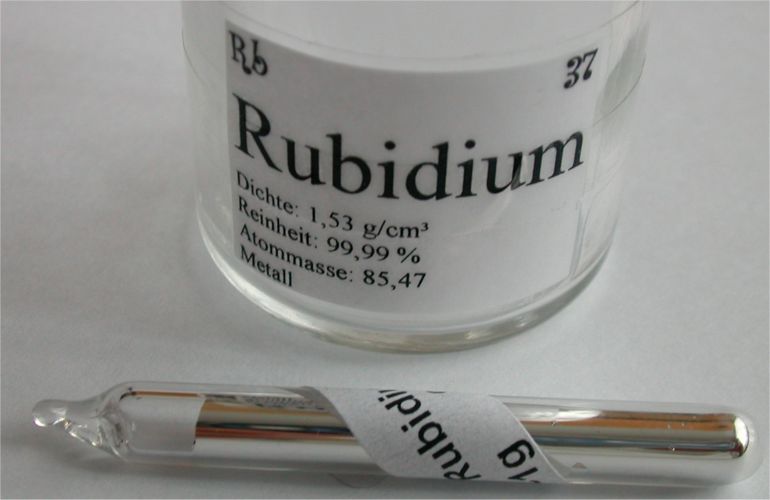

Rubidium is chemical element 37 on the periodic table. Its symbol is Rb. Its atomic mass is 85.47. It has 37 protons and 37 electrons. It is a soft silver colored metal. It was first discovered in 1861 by Robert Bunsen and Gustav Kirchoff in Heidelberg, Germany.
Physical properties
Rubidium melts at a very low temperature, for example it could melt in a person’s hand. Rubidium is an alkali metal. It can make an amalgam with mercury.
Chemical properties
Rubidium is very reactive. It will ignite in air because it reacts with many other elements in the air like oxygen and nitrogen. Rubidium reacts very violently with water to make hydrogen and rubidium hydroxide, a strong corrosive base. The reaction is normally very hot so the hydrogen ignites.
Chemical compounds
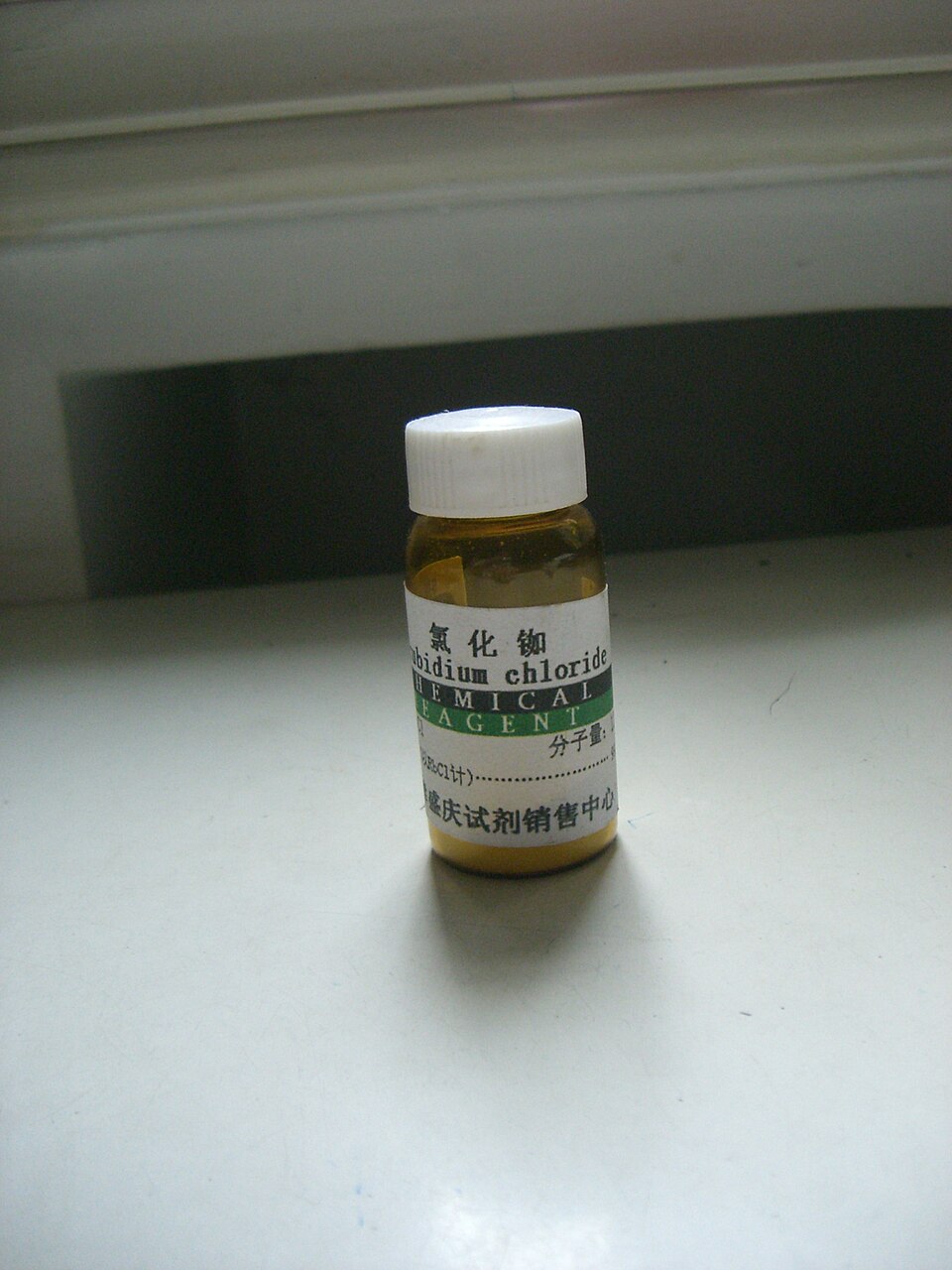
Rubidium forms chemical compounds in only one oxidation state: +1. Some rubidium compounds have a mixed oxidation state, though. Rubidium chloride is the most common rubidium compound. Rubidium hydroxide and rubidium carbonate are also used commonly. Rubidium compounds makes a red-violet color in a flame. Most rubidium compounds are colorless. Rubidium compounds are not as common as other alkali metal compounds, such get sodium compounds. Otherwise, they are similar.
- Rubidium chloride, similar to sodium chloride
- Rubidium hydride, strong reducing agent
- Rubidium hydroxide, powerful base
- Rubidium nitrate, strong oxidizing agent
- Rubidiumoxide, yellow, strong base when dissolved in water
Occurrence and preparation
Rubidium is about as common as zinc. It is the 23rd most common element in the Earth’s crust. Most minerals only have a small amount of rubidium in them. It normally comes in small quantities in other minerals. It is made by reduction of rubidium ores with calcium. It is expensive because calcium is difficult to make and the rubidium needs to be kept in argon and away from water or air.
Uses
There are not many common uses for rubidium. Rubidium compounds are sometimes used in purple fireworks. It and its compounds are used mainly in science research though. It is also used to make superoxide ions. It is used in some special types of glass.
Safety
Rubidium compounds are not very dangerous in the human body; however, if a person gets too much from eating, they could get sick because it acts like other alkali metal ions such as sodium ions in sodium chloride. Rats can live with up to half of their potassium replaced with rubidium, though it is not likely for that to happen.
Rubidium metal is very dangerous. It reacts with air and water and makes the corrosive substance rubidium hydroxide.
Written for younger readers
Rubidium, in simpler words
This version comes from Wikijunior, a set of books written for children aged 8 to 11. It is shorter and uses plainer language than the article above.
From Wikijunior: The Elements
NOTOC
Rubidium is silvery white. It is a soft metal — ductile, meaning it can be drawn out into thin wire without breaking. It has no smell.
It was discovered in 1861 by two German chemists, Robert Bunsen and Gustav Kirchhoff, using flame spectroscopy. Flame spectroscopy was a new technique at the time; scientists heat material with a flame and observe the spectrum of light the material emits.
Bunsen and Kirchhoff named this element after the color of the light they observed from it with their spectroscope. The Latin word rubidus means red.
Did You Know?
- Rubidium ignites spontaneously in the air.
- It helps make fireworks purple.
- The name Rubidium comes from the latin term for “deep red,” Rubidus
It occurs naturally in the minerals leucite, pollucite, carnallite, and zinnwaldite, which contain as much as 1% rubidium oxide. Lepidolite contains between 0.3% and 3.5% rubidium, and is the commercial source of the element.
Rubidium is used in some fireworks, for its color. It is also used for various high-tech devices. It is used in vacuum tubes as a getter, a material that combines with and removes trace gases from inside the tubes, to keep the inside of the tube a vacuum. It is used in lasers and high-precision clocks. It is also used in the manufacture of photocells and in special kinds of glass. Since it is easily ionized, it might be used as a propellant in ion engines on spacecraft.
Rubidium burns when exposed to water, like potassium.
Where this page comes from
The article above is adapted from “Rubidium” on Simple English Wikipedia, by its contributors. We removed reference markers, navigation boxes and tables, expanded measurement templates into readable numbers, and kept the prose otherwise intact. The simpler version is adapted from Wikijunior on Wikibooks.
Both sources are published under CC BY-SA 4.0, so this page is published under the same licence. You may share and adapt it, including commercially, as long as you credit the original and keep the same licence.
Worksheets, answer keys and printable layouts elsewhere on K5Print are our own work and are not covered by this licence.