Sodium
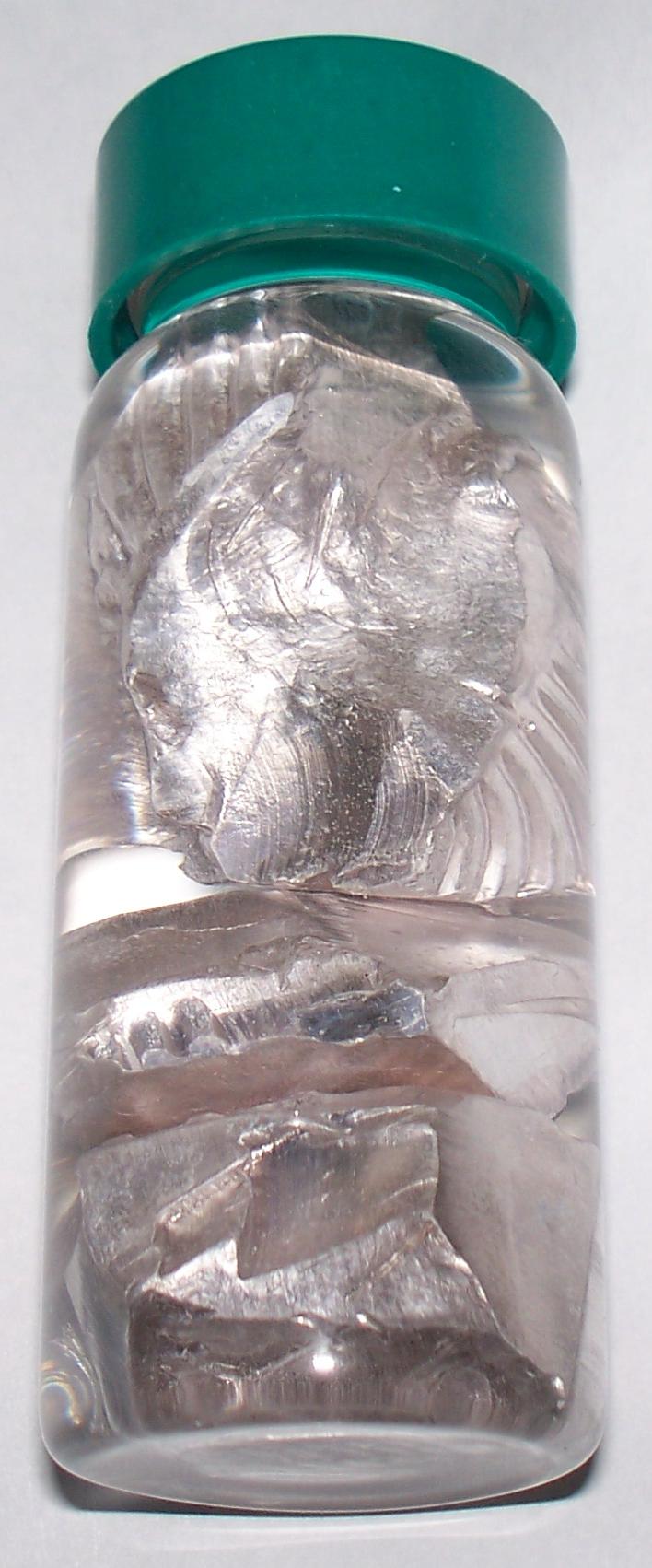

Sodium is a chemical element with an atomic number of 11. Its symbol is Na (from its Latin name natrium). It is an alkali metal. Although sodium has many isotopes, most decay in a short time. Because of this, all sodium in nature (mainly found in seawater) is of the isotope 11 Na 23 . The atomic mass of sodium is 22.9898.
Properties
Sodium is a light-weight, silver-colored metal. Sodium is soft. It can easily be cut with a knife. When someone cuts it, the exposed part will become white over time. It reacts with air to form, at first sodium oxide, then slowly sodium hydroxide and sodium carbonate. Sodium is a little less dense than water. It floats and reacts instantly with water, producing hydrogen and sodium hydroxide. This reaction makes a lot of heat, usually causing the hydrogen to light on fire. When this happens, sodium melts because of its low melting point. Sodium is highly reactive because it has one valence electron, which is easily removed.
Compared with other alkali metals, sodium is less reactive than potassium and more reactive than lithium.
Chemical compounds
These are chemical compounds that contain sodium ions. Sodium only exists in one oxidation state: +1.
- Sodium aluminum fluoride, used to make aluminum
- Sodium amide, very strong base
- Sodium arsenite, colorless solid, very toxic
- Sodium arsenate, oxidizing agent, very toxic
- Sodium azide, used in airbags
- Sodium bicarbonate, baking soda, used in cooking
- Sodium bismuthate, oxidizing agent, used to test for manganese
- Sodium bisulfate, acidic, used to lower pH
- Sodium bromate, oxidizing agent, used to dye hair
- Sodium bromide, rare, used in some medicine
- Sodium carbonate, used to make glass
- Sodium chlorate, used in some explosives
- Sodium chlorite, used in disinfectants
- Sodium chloride, table salt
- Sodium chromate, yellow, oxidizing agent, toxic
- Sodium dichromate, orange, oxidizing agent, toxic
- Sodium fluoride, used in toothpaste, bitter, toxic in large doses
- Sodium hydroxide, lye, used in soap, strong base
- Sodium hypochlorite, bleach, disinfectant
- Sodium hypophosphite, reducing agent, poisonous
- Sodium iodate, oxidizing agent, prevents iodine deficiency
- Sodium iodide, a weak reducing agent, prevents iodine deficiency
- Sodium manganate, rare green solid
- Sodium nitrate, used in blasting powder
- Sodium nitrite, used in food preservation
- Sodium periodate, oxidizing agent
- Sodium permanganate, less common than potassium permanganate, oxidizing agent
- Sodium phosphate, various uses
- Sodium phosphide, catalyst, used to speed up chemical reactions
- Sodium phosphite, toxic, reducing agent
- Sodium selenate, strong oxidizing agent, other selenium compounds
- Sodium selenide, strong reducing agent, reactive
- Sodium selenite, weak oxidizing agent, vitamin supplement
- Sodium sulfate, bitter, laxative
- Sodium sulfite, a weak reducing agent, used to preserve dried food
- Sodium tellurate, strong oxidizing agent
- Sodium telluride, a strong reducing agent, reacts with air easily
- Sodium tellurite, main tellurite compound
Discovery and name origins
Sodium was discovered by Sir Humphrey Davy, an English scientist, in 1807. He created it by electrolyzing sodium hydroxide. Davy named the element after soda, a name for sodium hydroxide or sodium carbonate.
Uses
Scientists can use it in the creation of organic compounds. It is used in orange streetlights and lamps that emit ultraviolet light.
Sodium compounds are used in soaps, toothpaste, baking, and antacids.
The human body needs sodium ions, taken in the form of sodium chloride, to live. Too much of it can cause health problems. Many organisms in the ocean depend on the concentration of sodium ions in water to survive.
Occurrence and production
Sodium does not occur as an element in nature, because it is not stable enough. It exists only in chemical compounds. Sodium ions are found in the ocean and in the Earth’s crust.
Sodium is normally made by electrolysis of sodium chloride, which is mined from the Earth’s crust.
Written for younger readers
Sodium, in simpler words
This version comes from Wikijunior, a set of books written for children aged 8 to 11. It is shorter and uses plainer language than the article above.
From Wikijunior: The Elements
NOTOC
Pure sodium is a soft and silvery metal. Sodium is prevented from contact with the air and water and kept by immersion in oil, because it tarnishes very quickly when exposed to air. It is so soft that you could cut it with a butter knife.
Sodium was isolated by Sir Humphrey Davy in 1807 from sodium hydroxide.
Sodium gets its name from the English soda. In Latin it was called natrium. Did You Know?
- Sodium is the sixth most abundant element overall.
- Sodium is the most abundant alkali metal, in the first column of the periodic table.
- Sodium ions taste salty in flavor.
The most common compound of sodium is sodium chloride, better known as salt, which can be found in seawater and in the mineral halite. Sodium is relatively common in stars. Because sodium is highly reactive, it is never found in its pure state in nature.
We use sodium every day. Sodium chloride is used to help flavor food in the form of table salt. Sodium is also found in sodium bicarbonate, also called baking soda. Sodium is also used in most soaps and detergents (although some, such as those in shaving cream, use potassium instead.)
Sodium is also required by the body for proper blood, brain cell action, heart activity, and more. It is so important that animals and people are adapted to tasting sodium. Sodium is salty.
Sodium is highly reactive and may ignite on contact with water. It can even cause an explosion. The strong alkali sodium hydroxide — also called lye — is very corrosive and should never be touched, as it can cause severe chemical burns; neither should solutions of it.
Where this page comes from
The article above is adapted from “Sodium” on Simple English Wikipedia, by its contributors. We removed reference markers, navigation boxes and tables, expanded measurement templates into readable numbers, and kept the prose otherwise intact. The simpler version is adapted from Wikijunior on Wikibooks.
Both sources are published under CC BY-SA 4.0, so this page is published under the same licence. You may share and adapt it, including commercially, as long as you credit the original and keep the same licence.
Worksheets, answer keys and printable layouts elsewhere on K5Print are our own work and are not covered by this licence.